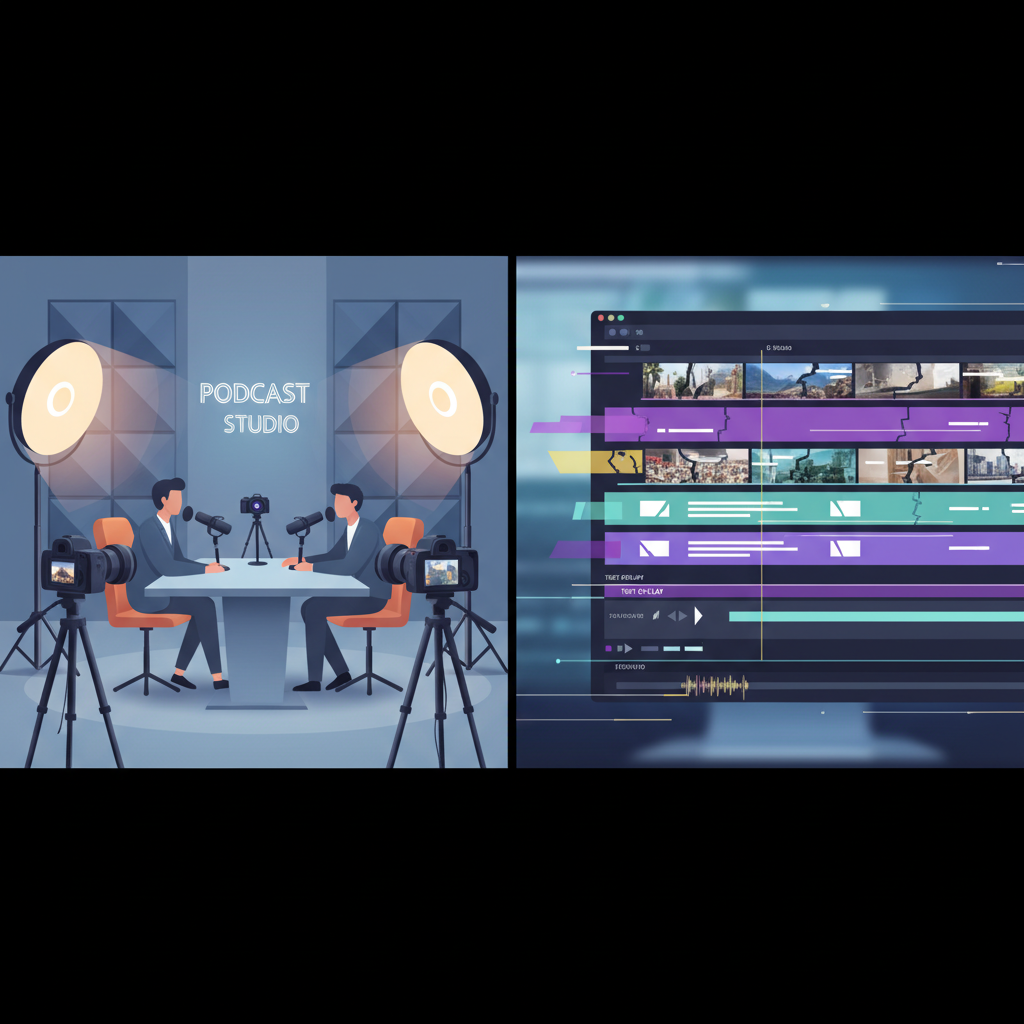
Steven Bartlett's Diary of a CEO operates at a scale most podcasters never reach. The show is updated twice weekly, and Flight Story (Bartlett's media company) integrates content with investment opportunities. But the retention mechanics that keep viewers watching are less about Bartlett's interview style and more about a disciplined video structure that blends fast-paced editing with strategic B-roll deployment.
Businesses trying to build long-form content can learn from how Bartlett's operation engineers retention at the edit level, not just the recording level.
The Opening Hook: Question, Answer, Visual Payoff in Under 10 Seconds
In a recent AI-focused episode, the video opens with text on screen: "What is the most consequential thing we should be talking about right now?" A voice asks the question. Another voice immediately answers: "I think it's AI." The visual cuts from speaker to speaker in under 3 seconds. No preamble, no intro music, no channel branding. The hook is a direct question with an instant payoff.
Another episode opens with a medium shot of the guest mid-thought: "Do you find that quite so interesting because I've heard that quite a lot that AI won't take your job, someone that understands AI will take your job." The statement is a question, a provocation, and a thesis all at once. The viewer is dropped into a conversation already in progress, creating immediate curiosity about context.
This pattern repeats across episodes: no cold opens, no host introduction, no "thanks for tuning in." The first 5 seconds deliver a high-stakes question or controversial claim, often pulled from later in the interview. The viewer is given a reason to stay before they've consciously decided to leave.
Fast Cuts Meet Slow Conversations: The Hybrid Pacing Model
Diary of a CEO episodes run 60 to 90 minutes, but the editing rhythm varies dramatically depending on content density. In the Tony Robbins AI discussion, the cut rhythm averages well under 1 second per shot during information-heavy segments. Quick cuts between the speaker, text overlays, B-roll footage of server rooms, news reports, self-driving cars, and motion graphics keep the visual field constantly shifting even as the audio remains a single unbroken thought.
In a different episode, the pacing slows to 3 to 5 second holds when the conversation turns philosophical. The slower rhythm allows viewers to absorb complexity without feeling rushed, but the trade-off is intentional: when the topic is abstract, the visuals stay simple (two-camera interview setup, minimal B-roll). When the topic is concrete (statistics, historical examples, product demos), the cuts accelerate and the B-roll density increases.
This hybrid model solves a common long-form problem: how to maintain retention during slower segments without sacrificing depth. The answer is selective acceleration. Not every minute needs to cut fast, but every minute needs to justify its pacing with either visual variety or conceptual density.
Text Overlays as a Retention System, Not a Decoration
Text overlays appear in nearly every Diary of a CEO episode, but they function as more than subtitles. In the AI episode, key phrases are pulled from the speaker's dialogue and displayed as on-screen text: "It's AI," "The rapid change in technology," "They let go of 5,000 customer service agents." The text reinforces the audio but also creates visual punctuation, breaking the interview into digestible claims.
Another episode uses "DOAC Community Notes" overlays to define terms mid-conversation (e.g., "nihilist"). The overlay appears when a guest uses jargon or references a concept that might lose casual viewers. The effect is educational without being condescending: the conversation continues uninterrupted, but viewers who need context get it in real time.
This system works because it assumes partial attention. A viewer scrolling on their phone or listening in the background can still extract value from the text overlays, which surface the most quotable or clarifying moments. The overlays also create natural clip points: each text-highlighted phrase is a potential short-form asset for TikTok, Instagram, or YouTube Shorts.
B-Roll as Argument, Not Atmosphere
Most interview podcasts use B-roll to cover jump cuts or add visual interest. Diary of a CEO uses B-roll to build arguments. In the Tony Robbins episode, when the conversation turns to job displacement, the edit cuts to footage of empty offices, news reports about layoffs, and historical illustrations of Luddites smashing machines. The B-roll isn't decorative, it's evidential. The viewer sees the claim and the supporting imagery simultaneously, reinforcing the point without requiring the speaker to pause and explain.
In another segment, historical B-roll (cigarette ads, presidential events) appears when the guest references past technological or social shifts. The footage is often black and white or desaturated, visually distinguishing it from present-day examples. The color grading creates a temporal map: warm tones for the present, cool or monochrome tones for the past, occasionally red overlays for urgency or danger.
This approach requires a large B-roll library and an editor who understands the argument being made, not just the words being spoken. The B-roll has to arrive at the exact moment the claim is made, or the connection weakens. The precision suggests either a highly detailed edit script or an editor with deep familiarity with the content.
AI-Assisted Retention Analysis: Predicting Drop-Off Before It Happens
In a transcript from a recent episode, Bartlett describes using Google's Gemini AI to analyze retention data: "We upload the video to YouTube, we get the retention data back, and Gemini, in the last 2 times that I've done it, has a 100% record of knowing that at minute 7, where insert person talked for too long, might have been a bit more silly, might have tried to sell a hoodie, for example, in that part, it would say, you're going to lose people here."
This reveals a post-production feedback loop: the team uploads episodes, reviews where viewers drop off, and uses AI to identify patterns (e.g., tangents, sales pitches, pacing lulls). The AI doesn't edit the video, but it flags the structural weaknesses that human editors can address in future episodes. Over time, this creates a retention optimization system: the team learns which segment types (stories, statistics, philosophical tangents) hold attention and which ones need tighter cuts or stronger B-roll support.
This is not a creative decision. It's an operational one. The content strategy is informed by measurable viewer behavior, not intuition.
What EditorDuel Readers Can Take From This
Diary of a CEO's retention system is replicable at smaller scales. Businesses producing long-form content (webinars, product demos, founder interviews) can apply several of these mechanics without needing Bartlett's budget:
- Open with the payoff, not the setup. Pull a high-stakes question or claim from later in the content and use it as the first 5 seconds. The viewer should know what they're getting before they've invested time.
- Vary pacing based on content density. Fast cuts work for information-heavy segments (statistics, lists, case studies). Slower pacing works for abstract or emotional segments. Don't lock into one rhythm for the entire video.
- Use text overlays to surface key claims. Every quotable phrase, statistic, or definition should appear as on-screen text. This creates clip-ready moments and helps viewers who are watching with partial attention.
- Deploy B-roll as evidence, not decoration. If a speaker makes a claim, show the supporting imagery at the exact moment the claim is made. This requires scripting or tight collaboration between the editor and the person who understands the argument.
- Review retention data and identify patterns. YouTube Analytics shows exactly where viewers drop off. If multiple videos lose viewers at similar segment types (e.g., product demos, founder backstories), those segments need structural changes, not just tighter cuts.
The Diary of a CEO operation proves that retention is engineered, not accidental. The interviews may be conversational, but the edits are surgical.
Want to build content like this for your business? Post a competition on EditorDuel and get matched with editors who can deliver.