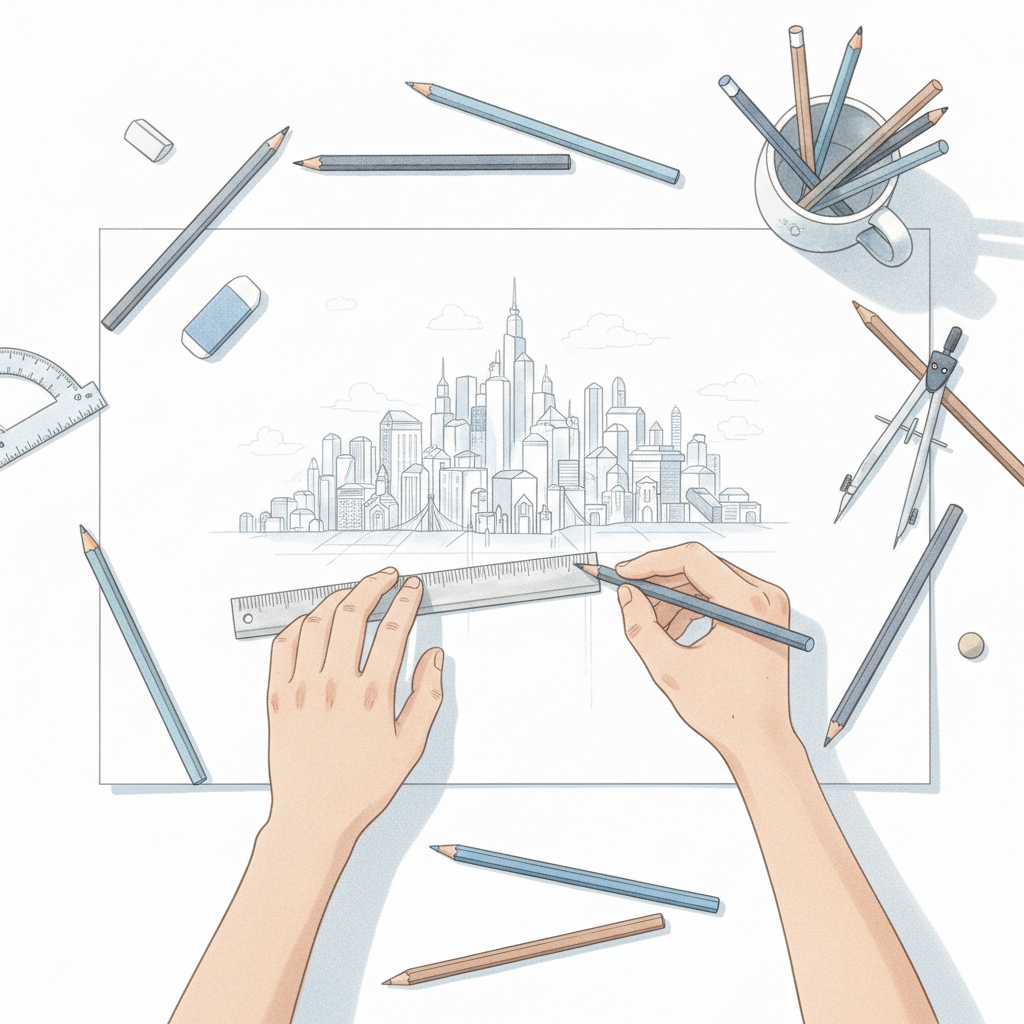
Kylie Cox, known online as Sketch, built a Twitch following with the catchphrase "What's up, brother?" That phrase went viral on TikTok in 2024, but a quieter content operation runs parallel: a YouTube drawing channel where Cox uploads silent, time-lapse tutorials that generate millions of views without a single word spoken.
The format is deceptively simple. A fixed overhead camera captures a hand drawing on white paper. No cuts to different angles. No talking head segments. No text overlays explaining technique. Just continuous footage of a pencil moving across a page, compressed into 3 to 6 minute videos, set to calm instrumental music. This city skyline tutorial exemplifies the structure: the video opens with art supplies arranged on a woven mat, a hand places a ruler, and the drawing begins immediately. No preamble.
The One-Shot, Time-Lapse Structure
The retention mechanic is architectural. Each video follows a linear build: establish the horizon line, add vertical structures, layer in detail, reveal the finished piece. In the nature scenery tutorial, the video is essentially one continuous shot from a fixed camera angle, showing the entire drawing process sped up. The cut rhythm is nonexistent because there are no cuts. The camera never moves. The only editing technique is time compression, making the drawing process unfold in under 5 minutes.
This creates a meditative viewing loop. The viewer arrives to see "what will this become," and the format delivers constant visual progress without interruption. There are no energy peaks in the traditional sense, no narrative beats or comedic payoffs. The "peak" is the incremental reveal: a building takes shape, windows appear in rows, shading adds depth. The payoff is always the same and always satisfying: the completed drawing in the final 5 seconds.
Why Silent Works for Retention
The absence of voiceover is not a limitation but a feature. In the dot technique video, Cox does speak, explaining a sketching method over 5 minutes. The structure shifts to hook, setup, demonstration, payoff, with motion graphics highlighting reference points and text overlays prompting engagement. But the silent videos outperform on passive watch time. No language barrier. No need to parse instruction. The visual progression is self-explanatory, and the consistent instrumental background music maintains a calm energy that makes the video easy to leave running.
According to conversion research, viewers retain 95% of a message from video compared to 10% from text, and that retention begins with an emotional hook. The silent tutorial format hooks with immediate action (the first pencil stroke happens within 3 seconds) and sustains with visual momentum. There is no moment to click away because there is no gap in the action. The time-lapse compression ensures that something new appears on screen every few seconds: a new line, a new structure, a new layer of shading.
The Jump Cut Economy
When cuts do appear, they serve a utilitarian purpose. The cityscape video uses jump cuts to condense repetitive actions like drawing long horizontal lines or repositioning the ruler. The cuts happen every 3 to 5 seconds, not for pacing variety but to skip dead time. The result is a time-lapse feel without a continuous speed ramp. Each jump cut advances the drawing by one visible step, maintaining the illusion of unbroken progress.
This is the opposite of the frenetic cut rhythm common in retention-optimized content. No cuts every 0.8 seconds. No match cuts or J-cuts to smooth transitions. The editing is invisible because the format does not require it. The viewer's attention is held by the drawing itself, not by editorial manipulation.
Monetization Without Personality
The silent format strips out the personality-driven monetization typical of creator economies. No merch plugs. No Patreon callouts in the body of the video. The dot technique video does include a Patreon mention in the outro, but the silent videos end with only the finished drawing and a fade to black. The business model relies entirely on YouTube ad revenue from long watch times and repeat views.
This aligns with platform incentives. TikTok Creator Rewards focuses on qualifying original videos longer than a minute, and YouTube restricts monetization of mass-produced, repetitive content, according to recent creator economy analysis. The silent tutorial format qualifies as original (each drawing is unique) and long enough (3 to 6 minutes) to maximize ad placements without triggering repetitive content flags.
What EditorDuel Readers Can Take From This
The Sketch silent tutorial model demonstrates that retention does not require rapid cuts, voiceover, or on-screen talent. For businesses producing educational or process-driven content, the lessons are concrete:
- Immediate visual action beats verbal setup. The first stroke happens within seconds. No intro card, no logo sting, no "hey guys." The content is the hook.
- Time compression can replace complex editing. A single fixed camera and speed ramping can deliver the same satisfaction as a multi-angle, heavily edited piece, if the underlying process is visually interesting.
- Silence removes friction. No transcription, no localization, no audio mix. The format is globally accessible by default.
- Linear structure works when the payoff is guaranteed. Viewers will watch a 5 minute video with zero narrative surprises if they know the endpoint (a finished drawing) is worth seeing.
- Repetition is viable if each execution is unique. The format is identical across dozens of videos, but each drawing is different enough to sustain a library.
For teams producing how-to content, product demos, or time-lapse documentation, the Sketch model proves you can build a high-retention library without a single word spoken. The format scales because it requires minimal editorial labor: one camera, one speed ramp, one music track. The creator's job is to produce the underlying work (the drawing). The format does the rest.
Want to build content like this for your business? Post a competition on EditorDuel and get matched with editors who can deliver.