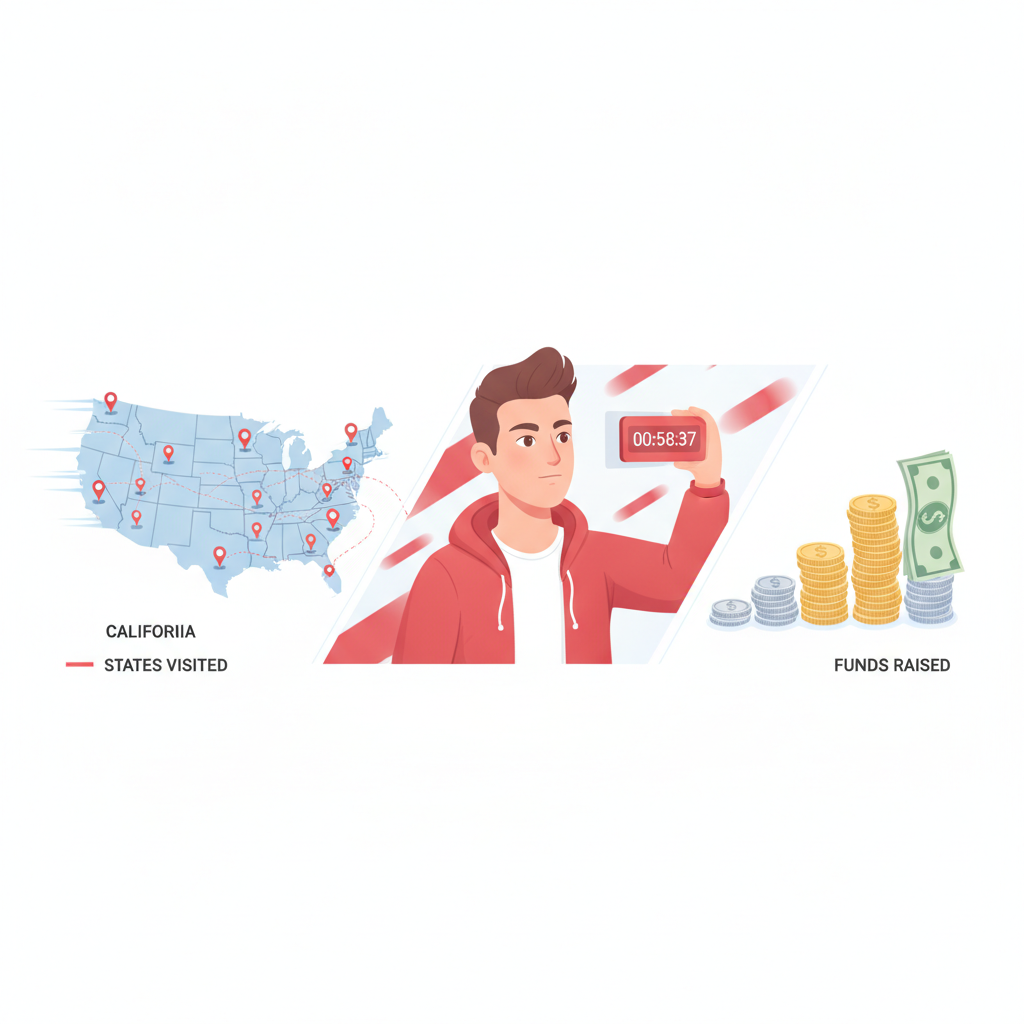
Ryan Trahan has built one of YouTube's most recognizable challenge formats by turning simple constraints into multi-day narrative arcs. His Penny Series and 50 States in 50 Days campaigns demonstrate how structured rules, personal stakes, and daily episodic pacing create sustained audience investment. The result is a content system that supports high-value sponsorships, merchandise lines, and a low-sugar candy brand that sits on shelves nationwide.
This case study examines the structural mechanics of Trahan's challenge format and how the framework translates viewer attention into business outcomes.
The Three-Rule Framework That Creates Repeatable Stakes
Trahan's challenge videos operate on explicit constraints that viewers can track episode to episode. The Penny Series, for example, establishes clear rules that provide structure and a repeatable format. The 50 States challenge adds geographic and temporal limits: visit all 50 states in 50 consecutive days.
These frameworks create three structural advantages. First, the rules are simple enough to explain quickly, reducing friction for new viewers entering mid-series. Second, daily episodes create appointment viewing, where audiences return to see incremental progress rather than binge-watching a single long video. Third, the constraints generate natural content variety without requiring new creative concepts for each upload. A penny challenge in Texas looks different from one in Maine because the location itself provides novelty within a stable format.
The structure also allows for audience participation. Viewers debate optimal strategies in comments, suggest locations or trades, and track progress against the clock. This transforms passive watching into active engagement, which platforms reward with higher distribution.
Personal Stakes and Relationship Dynamics as Retention Hooks
Trahan frequently features his wife Haley Pham in challenge videos, adding interpersonal dynamics to logistical problem-solving. TikTok content analysis shows that couple banter, cooperative challenge attempts, and inside jokes between Ryan and Haley create emotional texture around what could otherwise be purely transactional content.
The personal stakes model works because it gives viewers someone to root for beyond the creator himself. When Trahan attempts a challenge with a best friend or partner, the risk of failure carries social consequences, not just individual ones. This raises perceived stakes without requiring extreme stunts or large budgets.
The relationship framing also enables callback humor and recurring bits that reward long-term viewers. References to previous challenges, travel moments, and shared jokes create continuity across uploads, encouraging audiences to watch entire series rather than isolated videos.
Daily Episodic Pacing and the Multi-Day Narrative Arc
Unlike single-upload challenges, Trahan's multi-day formats serialize the narrative. Each episode ends on a cliffhanger or unresolved question: Will he complete the trade in time? Can he reach the next state before midnight?
This pacing mirrors television serialization but leverages YouTube's recommendation algorithm. Daily uploads during an active challenge flood subscriber feeds and suggested video slots, creating sustained visibility. The format also allows for mid-series sponsorship integrations, where a brand can appear across multiple episodes rather than a single mention.
The episodic structure reduces production pressure per video. Daily uploads require less polish than longer standalone pieces, allowing Trahan to maintain velocity without sacrificing consistency. The trade-off is volume: a 50-day challenge produces 50 uploads, which compounds algorithmic favor and keeps the channel active in viewer feeds.
Monetization Beyond AdSense: Sponsorships and Product Lines
Trahan's challenge format creates multiple revenue streams. Strong audience engagement makes sponsorships valuable, as brands can integrate into the challenge premise itself rather than appearing as pre-roll ads. A food delivery service, travel app, or consumer product can become part of the challenge mechanics, turning the sponsorship into content rather than interruption.
Beyond direct sponsorships, Trahan has leveraged his audience into product ventures. His low-sugar candy brand Joyride sits on shelves nationwide, following the creator-to-CPG path pioneered by MrBeast's Feastables and Mark Rober's CrunchLabs. The challenge content serves as both entertainment and proof of concept: if Trahan can build a loyal audience through structured storytelling, that audience will follow him into adjacent product categories.
The brand-building effect is cumulative. Each successful challenge series reinforces Trahan's identity as someone who completes difficult, rule-bound tasks, which translates into trust when he launches a product. Viewers who watched him complete ambitious challenges through persistence are more likely to support his product ventures.
Distribution Discipline and Platform Fit
Recent analysis of YouTube growth strategies highlights Trahan alongside MrBeast and NPR as examples of creators who prioritize platform-fit content and distribution discipline. Trahan's challenge format is optimized for YouTube's recommendation engine: high watch time per video, strong session starts from serialized viewing, and comment activity that signals engagement.
The format also adapts to short-form platforms. TikTok and Instagram Reels feature highlight clips from challenge episodes, driving traffic back to YouTube for full episodes. This cross-platform funnel turns viral moments into sustained viewership rather than one-off impressions.
Trahan's distribution approach avoids chasing trends in favor of repeatable formats. Rather than pivoting to whatever is currently viral, he refines the challenge structure across multiple iterations, building audience expectations around a recognizable style.
What EditorDuel Readers Can Take From This
Businesses and production teams can apply Trahan's structural principles without replicating his specific challenges:
Constraint-based formats reduce creative overhead. Establishing clear rules for a content series allows teams to generate multiple episodes from a single concept. A B2B brand could create a "solve a client problem in 5 days" series, where each episode follows a structured problem-solving framework.
Serialization increases cumulative watch time. Breaking a long narrative into daily or weekly episodes keeps audiences returning. This works for product launches, case study series, or behind-the-scenes content where progress unfolds over time.
Personal stakes raise engagement without raising budgets. Featuring team members, customers, or partners in content adds interpersonal dynamics that viewers invest in emotionally. A founder attempting a challenge with their co-founder creates relational tension that pure solo content lacks.
Multi-platform distribution extends content lifespan. Cutting highlight reels for short-form platforms drives traffic to long-form episodes, turning a single shoot into weeks of content across channels.
Audience trust converts to product interest. Consistent, high-quality content builds credibility that supports product launches, sponsorships, or service offerings. The content operation becomes the top of the funnel for revenue beyond ad dollars.
Want to build content like this for your business? Post a competition on EditorDuel and get matched with editors who can deliver structured, serialized content that keeps audiences coming back.