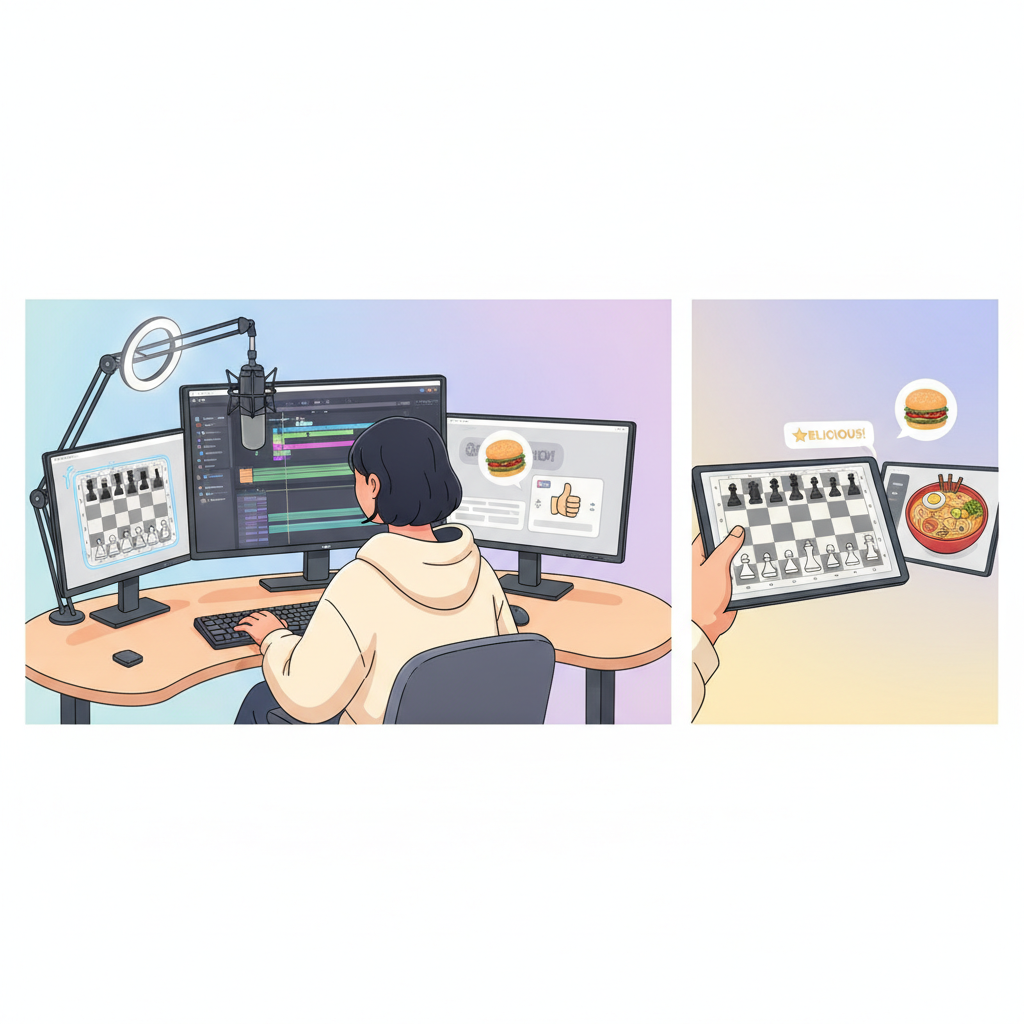
Pokimane (Imane Anys) has spent nearly a decade refining a content formula that translates seamlessly from long-form streams to viral shorts. With an estimated net worth between $1 and $2 million, built primarily through Twitch subscriptions, YouTube ad revenue, and sponsorships, her operation is a masterclass in retention mechanics. The work is not about personality alone. It is about structure, pacing, and visual grammar that keeps viewers locked in regardless of platform or format.
The Fast-Cut Rhythm That Prevents Drop-Off
Pokimane's edited content operates on a cut rhythm that averages 1 to 2 seconds per shot. In this LA food rating video, the opening five seconds deliver a direct hook ("rating viral LA food spots"), a friendly face, and four food emojis. From there, jump cuts fire continuously. Each food item gets a text overlay introduction, close-ups of the dish, reaction shots during tasting, and an animated numerical rating reveal. The cuts never pause long enough for attention to wander.
This is not random speed. The rhythm shifts deliberately. In a chess collaboration with Hikaru Nakamura, the initial chess explanation holds at a medium pace (1 to 3 seconds per shot) to let viewers process the board state. Then, during the "brain expanding" meme sequence at 0:29, cuts accelerate to under one second each, synchronized with a recognizable sound effect. The pacing returns to medium for the checkmate payoff. The variance itself becomes a retention tool, alternating between comprehension and stimulation.
Meme Overlays as Narrative Punctuation
Pokimane's editors treat memes as structural devices, not decoration. In the chess video, mathematical equations overlay her face at 0:14 as she contemplates a move. At 0:29, the "brain expanding" meme appears with a glowing brain graphic and more equations. The meme does not interrupt the narrative. It visualizes her internal process, turning a silent moment into a comedic beat that justifies its screen time.
In a reaction clip about scary movies, the setup is conversational dialogue about fear of true-story horror films. At 0:20, a jarring two-second clip of the "Freaky Nikki" face appears with a loud sound effect and darker color grading. The insert is abrupt, visually distinct, and aurally startling. It delivers the promised payoff from the title ("Pokimane does the 'Freaky Nikki' face and freaks Agent out") while creating an energy spike that resets viewer attention. The man's "scared" reaction immediately follows, highlighted with text and a high-pitched sound effect. The meme is not filler. It is the hinge between setup and payoff.
Text Overlays That Guide the Eye
Every Pokimane video analyzed uses text overlays to direct focus and reinforce spoken content. In the scary movie clip, key words ("LIKE," "WATCHING," "MOVIES," "BASED") appear synchronized with speech, often with a subtle bounce animation. This is not subtitling for accessibility. It is a retention tactic that gives the eye a secondary anchor when the visuals are static.
In the food rating video, text overlays serve three functions: they introduce each item with a numbered label ("1. sushi tacos," "2. matsu matcha"), they display animated numerical ratings ("8.3," "8"), and they create mini-peaks at each rating reveal. The viewer knows the format, anticipates the payoff, and stays engaged through the listicle structure. The text is not decorative. It is architectural.
The Hook-Setup-Payoff Loop at Every Scale
Pokimane's content follows a consistent three-part structure whether the runtime is 45 seconds or 12 minutes. The chess video opens with a strategic challenge (hook), builds anticipation through the "thinking" meme sequence (setup), and delivers a checkmate with reaction shots (payoff). The food video states its purpose in the first five seconds (hook), presents six items with tastings (setup), and reveals ratings for each (payoff). The scary movie clip promises a specific event in the title (hook), shows conversational lead-up (setup), and delivers the "Freaky Nikki" face with a startled reaction (payoff).
This loop scales. A 10-minute video will contain multiple sub-loops, each with its own micro-hook and payoff. A 30-second short compresses the loop into one tight sequence. The principle remains constant: tell the viewer what they will see, build tension or curiosity, then deliver. The formula is transparent, but transparency does not reduce effectiveness when execution is consistent.
Sound Design That Amplifies Emotional Beats
Pokimane's editors layer sound deliberately. The food video emphasizes eating sounds (crunching, slurping) to enhance sensory engagement. The chess video uses a distinct sound effect during the "brain expanding" meme. The scary movie clip pairs the "Freaky Nikki" face with a loud, jarring noise, then highlights the man's "scared" reaction with a high-pitched squeal. Each sound choice serves a narrative function: it either heightens a comedic moment, signals an energy shift, or reinforces an emotional reaction.
Background music in the food video is upbeat and continuous, maintaining energy without competing with dialogue. The chess video uses music sparingly, letting the meme sound effects punctuate key moments. The sound design is not subtle, but it is not random. Every audio element corresponds to a visual or emotional beat.
What EditorDuel Readers Can Take From This
Pokimane's retention mechanics are replicable systems, not personality-dependent magic. Businesses producing content for social platforms can apply these principles immediately:
Vary cut rhythm intentionally. Fast cuts maintain energy, but medium-paced sequences allow comprehension. Alternate between the two to prevent fatigue while keeping attention high.
Use memes and visual effects as structural tools. A well-timed meme can visualize internal thought, create a comedic beat, or reset viewer attention. Treat it as narrative punctuation, not decoration.
Layer text overlays to reinforce key information. Numbered lists, animated ratings, and synchronized keywords give the eye a secondary focus and make information digestible at a glance.
Build every video around hook-setup-payoff. State the premise in the first five seconds, build anticipation, then deliver. Scale this loop to fit any runtime.
Sound design is not optional. Emphasize key audio moments (reactions, eating sounds, meme effects) to amplify emotional beats and guide viewer response.
These are not abstract creative choices. They are operational decisions that directly impact watch time, completion rate, and shareability.
Want to build content like this for your business? Post a competition on EditorDuel and get matched with editors who can deliver.