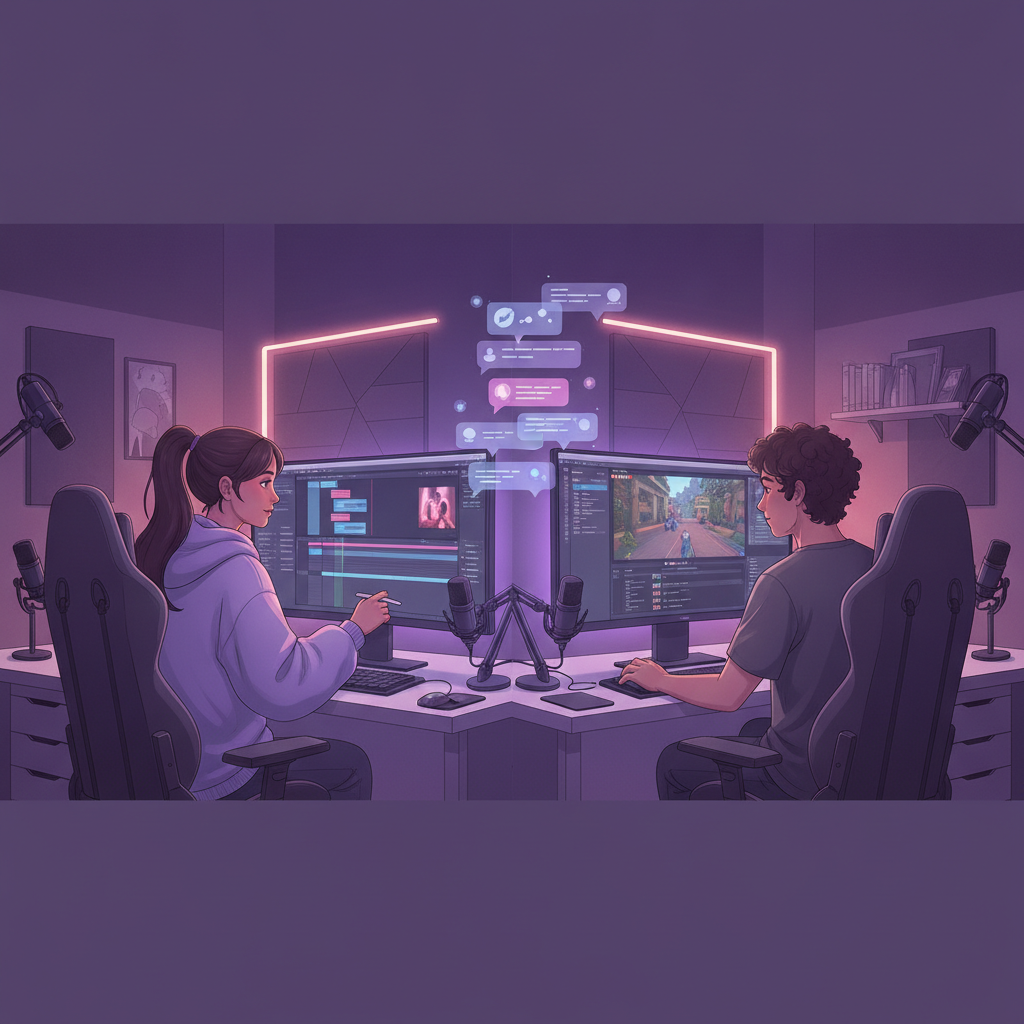
Pokimane's YouTube output reveals a deliberate editing philosophy centered on conversational transparency and real-time reaction capture. Unlike heavily produced narrative content, her collaborative videos prioritize showing both participants simultaneously, layering chat commentary, and cutting to maximize emotional peaks. For creators and producers studying retention mechanics, her approach offers a replicable model for turning unscripted interactions into structured, binge-worthy content.
The Split-Screen as Structural Foundation
In her recent collab with Agent00, Pokimane establishes the hook within the first 5 seconds using a split-screen format. Agent00 says "Uh-oh," followed by "F**king Pokimane's," and Pokimane immediately responds with "Not the uh-oh." The split-screen keeps both creators' faces and reactions visible, allowing viewers to read micro-expressions and body language simultaneously.
This is not accidental. The split-screen serves three functions:
- Removes reaction ambiguity. Viewers see the respondent's face in real time, not in a cut-away. This eliminates the editing lag that can flatten conversational energy.
- Distributes visual weight. Neither creator dominates the frame, signaling equal stakes and collaborative tone.
- Enables rapid energy tracking. The viewer's eye can move between both participants without a cut, creating a sense of liveness even in post-production.
After the opening 15 seconds, Pokimane transitions to a picture-in-picture model: one creator full-screen, the other in a corner window. The shift happens at natural conversational breaks, typically when one creator is speaking at length. The average shot duration ranges from 3 to 5 seconds during the split-screen phase, extending to longer takes (5 to 10 seconds) when one participant is delivering a monologue or reacting silently.
Cut Rhythm and Energy Peaks
Pokimane's editing does not chase a constant fast pace. Instead, it maps cuts to emotional inflection points. In the Agent00 video, energy spikes occur at moments of disagreement or humor. When Pokimane says "I'm giving you one chance" at 5:54, the cut lands on her face, isolating the statement. When Agent00 responds with "What the f**k, Poki!" at 7:53, the cut isolates his reaction. These are not random; they're editorial decisions to emphasize the comedic or confrontational beat.
Contrast this with her storytelling video about the LA event, where the cut rhythm is medium to fast (1 to 3 seconds per shot). Here, jump cuts compress her narration and maintain momentum. When she describes the "plot twist" at 03:59, rapid cuts between her face and text overlays build tension. At 04:30, when the TikTok video buffers at a crucial plot point, Pokimane's exaggerated frustration is captured in a single, longer take (3 to 4 seconds), letting the comedic moment breathe.
The principle: use fast cuts to accelerate, longer takes to emphasize. Pokimane does not cut randomly; she cuts to punctuate.
Overlay Strategy: Chat, Text, and Audience Integration
Both videos layer chat messages and text overlays onto the primary video feed. In the Agent00 collab, viewer chat appears on both creators' screens, making the audience feel like active participants rather than passive observers. This is subtle but effective: the overlay reinforces that the interaction is happening in a shared community space.
In the LA story video, text overlays appear at key moments ("PokimaneToo," "SUBSCRIBE") to reinforce information and encourage action. These are not distracting; they appear during pauses or moments of visual stasis, filling dead space rather than competing with her delivery.
The broader pattern: overlays add context and community feeling without obscuring the primary action. They work because they're placed strategically, not plastered across every frame.
Audio Design: Preservation Over Enhancement
Both videos preserve natural audio as the primary sound layer. There is no aggressive background music, no pumping bass drops, no sound effect spam. Instead, the conversation itself is the soundtrack. In the Agent00 video, J and L cuts (overlapping audio between shots) create a smoother conversational flow, mimicking how real dialogue works. In the LA story video, a subtle background track supports the narrative without competing.
Sound effects appear sparingly. A "ding" sound emphasizes a point in the LA video, but it's used once or twice, not on every beat. This restraint is crucial: excessive sound design would cheapen the conversational intimacy that makes these videos work.
Reaction Capture and Expressive Editing
Pokimane's editing emphasizes facial expression and body language. Subtle zoom-ins on her face during reactions draw attention to micro-expressions: a raised eyebrow, a smirk, a moment of genuine surprise. These are not jarring; they're incremental (typically 1.1x to 1.3x zoom), designed to emphasize rather than distort.
In the LA story video, her direct address to camera ("Are we ready? Let's get into it") immediately establishes intimacy. She's not performing for a crowd; she's talking to you. This conversational framing, paired with reaction-focused editing, creates a sense of personal connection that drives retention.
Why This Editing Model Works for Retention
Pokimane's approach solves a specific problem: how to keep viewers engaged in unscripted, multi-creator conversations where pacing is unpredictable. Her solution is structural rather than stylistic. She uses format (split-screen, picture-in-picture), cut placement (at emotional peaks), and overlay strategy (chat, text) to impose narrative shape on raw interaction.
The result is content that feels spontaneous but is actually carefully edited. Viewers don't feel the editorial hand because the cuts align with natural conversational rhythm. A pause in dialogue becomes a moment for a reaction shot or overlay. A punchline gets isolated and held slightly longer. Energy dips are bridged with text or chat commentary.
What EditorDuel Readers Can Take From This
If you're producing content around interviews, collaborations, or multi-participant conversations, Pokimane's playbook offers three concrete lessons:
1. Use split-screen and picture-in-picture deliberately. Don't cut between participants randomly. Start with split-screen to establish both parties, then shift to picture-in-picture during longer monologues. This rhythm feels natural because it mirrors how attention actually works in conversation.
2. Map cuts to emotional peaks, not clock time. Resist the urge to cut every 2 seconds. Instead, identify moments of disagreement, humor, surprise, or emphasis. Cut to those moments. Let quieter sections breathe. This makes your editing feel purposeful rather than frantic.
3. Layer overlays strategically. Chat, text, and graphics should add context or community feeling, not clutter. Place them during visual pauses. Keep them minimal. One well-placed overlay beats five distracting ones.
4. Preserve natural audio. Avoid over-producing with music and sound effects. Let conversation be the primary soundtrack. Use subtle audio bridges (J and L cuts) to smooth transitions. This maintains the intimacy that makes unscripted content compelling.
5. Emphasize reaction and expression. Subtle zoom-ins and reaction shots matter more than elaborate transitions. Your viewers are watching for human response, not editing flourish. Give them clear sight lines to facial expressions and body language.
These principles scale beyond gaming content. Any business producing interview-based content, customer testimonials, or team collaboration videos can apply this framework.
Want to build content like this for your business? Post a competition on EditorDuel and get matched with editors who can deliver conversation-focused, retention-driven edits that make unscripted interactions feel polished and intentional.