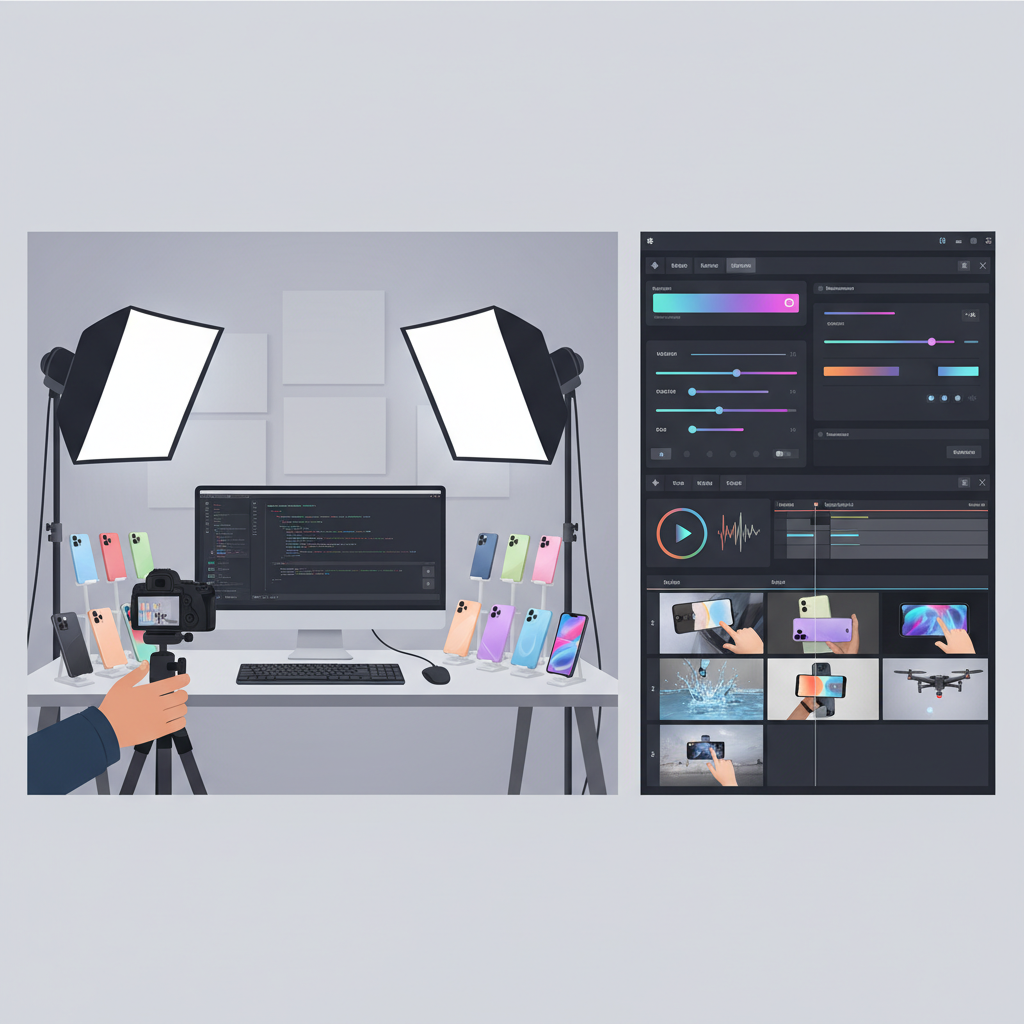
Marques Brownlee (MKBHD) has built one of YouTube's most successful tech channels without clickbait thumbnails or sensational titles. With 19 million subscribers, his reviews consistently pull millions of views on products ranging from smartphones to electric vehicles. The retention engine is not personality or controversy. It is a tightly controlled editing system that makes technical information visually digestible.
Businesses trying to explain complex products or services can learn from the specific techniques MKBHD's team uses to hold attention through 10 to 15 minute reviews. This is not about expensive gear or celebrity access. It is about cut rhythm, motion graphics, and structural pacing that keeps viewers from clicking away.
Cut Rhythm That Matches Information Density
MKBHD videos operate on a two speed system. In his breakdown of iPhone durability claims, the opening hits fast: shots change every 1 to 2 seconds during the hook ("This phone is four times more shatter resistant than its predecessor"). Once the explanation begins, the rhythm slows. Shots of Marques talking or animated graphics hold for 2 to 4 seconds. When he shows the Gorilla Glass timeline or independent drop test footage, the pace accelerates again, cutting every 1 to 2 seconds.
This is not random variation. Fast cuts accompany claims or visual evidence (product shots, B-roll, montages). Slower cuts accompany explanation or direct address. The pattern trains viewers: when the pace quickens, new information is arriving. When it slows, the current point is being developed. The rhythm itself becomes a retention tool, because viewers subconsciously know when to lean in.
Compare this to corporate explainer videos that hold a single talking head shot for 30 seconds while explaining a feature. MKBHD never lets a single visual element outstay its informational purpose. If a shot is not adding new information, it gets cut.
Motion Graphics That Externalize Abstract Concepts
The signature move in MKBHD videos is the animated slider or timeline. In the same durability video, Marques explains the inverse relationship between shatter resistance and scratch resistance using two animated sliders. As one slider moves right (more shatter resistance), the other moves left (less scratch resistance). The concept, which could take 90 seconds of verbal explanation, becomes visually obvious in 15 seconds.
These graphics are not decorative. They are functional. Text overlays label key terms ("Shatter Resistance," "Scratch Resistance"). Timelines show Gorilla Glass versions from 2007 to present, with alternating improvements highlighted. A graph visualizes the tradeoff between hardness and toughness. Every abstract claim gets a visual anchor.
The sound design reinforces this. Slider movements have distinct audio cues. Glass shattering in B-roll is paired with a sharp sound effect. Scratches get a scraping sound. The audio layer does not just accompany the visual. It emphasizes the informational beat.
For businesses, this is the difference between a viewer understanding your product and a viewer bouncing. If you are explaining a technical feature, a static slide deck will not hold attention. An animated diagram that builds as you explain will.
B-Roll That Proves Claims in Real Time
MKBHD videos use B-roll not as filler but as evidence. When discussing phone durability, the video cuts to split screen drop test footage: phones hitting pavement from multiple angles, slow motion shatters, close-ups of cracked screens. When explaining scratch resistance, the B-roll shows a hardness pick scraping across glass, zoomed in so the viewer can see the material response.
This is different from generic product shots. The B-roll is specific to the claim being made in the voiceover. Marques says "other factors besides glass contribute to durability," and the video immediately cuts to footage of phone frames, internal structures, and drop angles. The visual does not just illustrate. It substantiates.
The technique works because it eliminates the gap between claim and proof. In a traditional review, the reviewer might say "I tested this" and expect the viewer to trust them. MKBHD shows the test happening. The viewer does not have to take his word. They see the evidence playing out in real time.
Structure That Frontloads the Payoff
MKBHD videos do not build to a conclusion. They state the conclusion in the first 15 seconds, then spend the rest of the video explaining why it is true. The durability video opens with "This phone is four times more shatter resistant than its predecessor," immediately followed by "but that does not mean what you think it means." The hook is the thesis. The body is the proof.
This inverts the traditional essay structure (introduction, evidence, conclusion). MKBHD videos follow hook, setup, explanation, evidence, payoff. The "payoff" is not a reveal. It is a summary that reinforces what was already stated. The durability video concludes with "glass is still glass," which is the same point made in the first 30 seconds. The middle of the video earned that repetition by proving it with data and visuals.
For retention, this structure works because the viewer knows the destination from the start. They are not waiting for a reveal. They are watching to understand how the conclusion is justified. The tension is not "what will he say" but "how will he prove it." That keeps viewers through the full runtime, because skipping ahead means missing the evidence.
Color Grading and Visual Consistency
Every MKBHD video has the same visual signature: clean, bright, high contrast, with vibrant product colors against neutral backgrounds. The color grading is consistent across shots of Marques, B-roll, and motion graphics. This is not an accident. It is a brand identity that makes the content instantly recognizable.
The consistency also reduces cognitive load. Viewers do not have to adjust to new lighting or color temperatures between cuts. The visual environment is stable, so all attention can go to the information being delivered. This is the same principle behind Apple's product photography: eliminate visual noise so the subject can be the only focus.
Businesses producing educational or explainer content often overlook this. Inconsistent lighting, mismatched color grades, or cluttered backgrounds force the viewer to process visual information that is irrelevant to the message. MKBHD videos strip that away. Every visual element serves the explanation.
What EditorDuel Readers Can Take from This
MKBHD's editing system is not about expensive software or high end cameras. It is about information architecture. Every cut, graphic, and B-roll clip is placed to serve a specific informational purpose. The rhythm matches the density of the content. The visuals externalize abstract concepts. The structure frontloads the conclusion so viewers know why they should keep watching.
If you are producing content that explains technical products, services, or processes, the lessons are direct. Cut faster during claims and evidence. Slow down during explanations. Use motion graphics to make abstract ideas concrete. Show proof, do not just state it. Frontload your conclusion so viewers understand the stakes.
The result is not just better retention. It is content that actually communicates. Viewers leave understanding the product, not just having watched a video about it. That is the operational difference between content that generates views and content that generates results.
Want to build content like this for your business? Post a competition on EditorDuel and get matched with editors who can deliver.