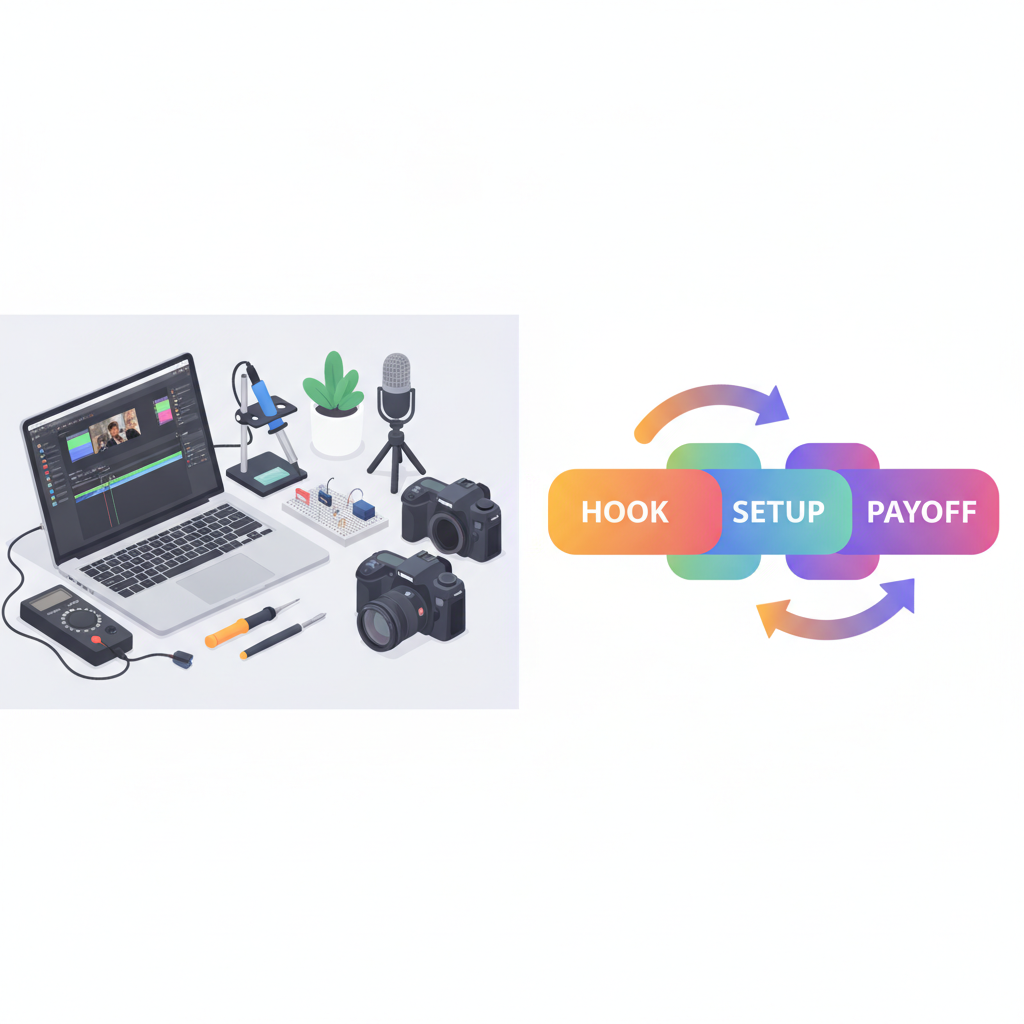
Mark Rober's YouTube channel ranks 37th globally with over 65 million subscribers. His videos routinely generate tens of millions of views. The creator, a former NASA engineer who worked on the Curiosity rover, has built a content operation that bridges educational science content with viral entertainment mechanics. His 2018 glitter bomb video received 25 million views in one day. What makes his format work is a structural discipline: every video, and every segment within it, follows the same hook, setup, payoff rhythm.
The Cold Open Formula
In his TED talk, Rober opens with a live experiment. He holds a bottle emitting white smoke and says, "I want to start off tonight with a two-step experiment." The cut rhythm during this setup is medium. As the experiment approaches its climax, the editing tightens. The bottle explodes. Sound design emphasizes the blast. The audience gasps. Then the pace returns to medium for the explanation.
This is the template. The opening seconds of a Rober video deliver a visual spectacle (smoke, explosion, elaborate contraption) paired with an immediate, intriguing setup. No long runway. The promise in the thumbnail lands in the first 10 seconds. Audience retention either holds strong, or starts sliding in an instant, and Rober's structure is designed to lock viewers before the algorithm registers drop-off.
Nested Payoffs: The Montage Structure
After the cold open, Rober uses the live demo as a metaphor for his teaching philosophy. He cuts to a montage of his YouTube videos. Each clip in the montage is its own mini hook, setup, payoff. A cannon fires. A glitter bomb detonates. A backyard squirrel obstacle course plays out. The editing during this montage accelerates. Split screens and animated overlays (arrows, satellite graphics, cannon firing animations) layer visual information without requiring narration.
The rhythm is: introduce contraption (hook), show it in action (setup), reveal the result (payoff). Then cut to the next one. The structure repeats at two scales simultaneously. The overall video has one arc. Each B-roll segment has its own arc. This nested structure keeps energy high even during explanatory passages, because the viewer is always moving toward a reveal.
Sound Design and Audience Reaction
Rober's videos emphasize sound. The TED talk uses dramatic sound effects for the explosion, audience laughter, gasps, and applause. His YouTube videos follow the same pattern. When a contraption fires, the sound mix foregrounds the mechanical noise. When a prank pays off, the audio captures the reaction. The glitter bomb video worked because the payoff was both visual (glitter spray, fart spray) and auditory (thief reactions captured on hidden cameras).
This is not ambient sound. It is designed sound. The edit isolates and amplifies the moments that signal payoff. For a business trying to replicate this, the lesson is: identify the sensory peak of each segment and make sure the sound design marks it. Viewers need to hear the payoff, not just see it.
Text Overlays and Visual Clarity
Rober uses minimal text overlays. In the TED talk, text displays his name, the event details, and his YouTube channel. In his YouTube videos, text appears to label contraptions, highlight key stats, or call out a punchline. The overlays are clean, sans-serif, high contrast. They do not compete with the visuals. They clarify.
The color grading is dynamic. The TED stage shifts from purple to blue lighting. His YouTube videos use saturated outdoor lighting or high-key garage setups. The visual palette is bright, not moody. The content is meant to feel accessible, not cinematic. The edit supports this with jump cuts during monologues to remove pauses and maintain pace.
The Long Game: Business Model and Content Velocity
Rober did not quit his NASA job until he had 10 million subscribers. He launched Crunch Labs, a subscription box business, only after he could self-fund it. His content velocity is low compared to daily vloggers. He publishes infrequently, but each video is a high-production event. The payoff structure allows him to compress multiple experiments or pranks into a single upload, maximizing value per video rather than chasing frequency.
His revenue model layers ads, sponsorships (NordVPN is a recurring partner), Crunch Labs subscriptions, and Netflix deals. Camp CrunchLabs is coming to Netflix, part of the platform's strategy to capture tween and teen audiences by bridging traditional TV and creator-led content. He also co-led Team Trees, raising over $20 million. The content operation is not just YouTube. It is a multi-platform media business anchored by a repeatable video format.
What EditorDuel Readers Can Take From This
First, structure beats spectacle. Rober's videos work because the hook, setup, payoff loop repeats at every scale. If your content has a clear three-act structure in the first 30 seconds, and again in every B-roll segment, retention will follow. Test whether every scene in your edit has its own miniature arc.
Second, sound design is half the payoff. Isolate and amplify the sensory peak of each segment. If the viewer cannot hear the moment of resolution, the payoff feels incomplete.
Third, low velocity can work if each video is an event. Rober publishes infrequently, not daily. Each upload justifies the wait because it delivers multiple payoffs in one package. For businesses with limited production bandwidth, this is the model: fewer videos, more payoffs per video.
Fourth, monetization follows format. Rober's repeatable structure makes sponsorship integration predictable. A NordVPN spot fits cleanly into the setup phase of a video without disrupting the arc. If your format is consistent, sponsors know where they fit.
Want to build content like this for your business? Post a competition on EditorDuel and get matched with editors who can deliver high-retention video formats that convert viewers into customers.