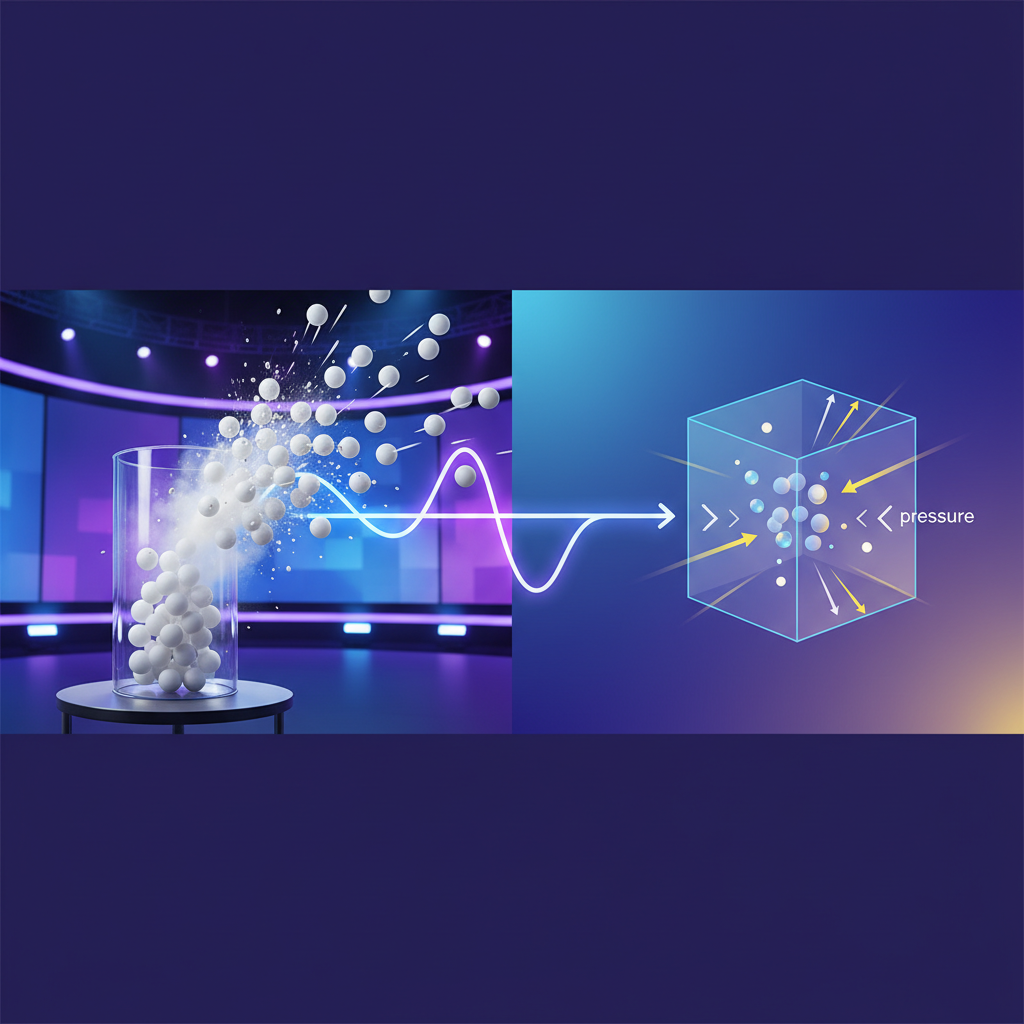
Mark Rober doesn't make science videos. He makes spectacle videos that happen to teach science. The difference is structural, not cosmetic. Where most educational content front-loads explanation and hopes viewers stick around, Rober inverts the formula: visceral hook first, teaching second, payoff third. In his April 2026 TED talk, he opened by detonating a barrel of liquid nitrogen and ping-pong balls on stage before explaining a single concept. The explosion came first. The physics lesson followed. That sequencing decision is the engine of his 60 million subscriber operation.
The Hook Comes Before the Setup
Rober's TED opener demonstrates the core principle: create a visceral response in the first five seconds. The video opens with animated TED branding, then cuts immediately to Rober on stage holding a smoking bottle, saying "I want to start off tonight with a two-step experiment." Within 15 seconds, the barrel explodes. White balls scatter across the stage. The audience gasps. Only after that does Rober explain gas molecules and pressure.
This is not accidental. Rober has stated explicitly: "All you have to do is create a visceral response in the viewer. They have to feel happy. They have to feel amazed. They have to feel shocked. Nobody shares a video they haven't finished watching. That's it. That's the trick." The hook is not a teaser. It is the payoff, delivered early, before the viewer has earned it. This creates debt: the viewer now wants to understand what just happened.
In the same TED video, the cut rhythm during the explosion sequence averages one to three seconds per shot. Fast cuts during action, slower cuts during explanation. The editing rhythm mirrors the narrative structure: high energy peaks bookend the teaching moments. The video uses jump cuts to compress his speech, removing pauses, maintaining momentum even during the educational segments.
Setup as Scaffolding, Not Lecture
After the hook, Rober builds context, but never in a linear lecture format. The TED video transitions from the explosion into a rapid-fire montage of his YouTube content, each clip illustrating the same pressure principle: cannons, Nerf blasters, T-shirt launchers, the elephant toothpaste volcano. The editing uses match cuts and split screens, showing Rober demonstrating a concept on the bottom half while animated representations play on the top half. This allows visual explanation without losing the speaker's presence.
The B-roll is not supplementary. It is the primary teaching tool. In the shorter TED clip, the video uses extensive B-roll to illustrate gas molecules and pressure, cutting between Rober's demonstrations and animated graphics. Motion graphics show the cannon and Nerf blaster firing mechanisms. The animations are clear, concise, and timed to his narration. The viewer learns by watching, not by listening to exposition.
Rober calls this "hiding the vegetables." The science is embedded in spectacle. The teaching happens while the viewer is entertained. The structure ensures that even if a viewer tunes out the explanation, they retain the visual memory of the demonstration. The payoff validates the setup, but the setup never feels like homework.
Payoff as Proof of Concept
The third act is where Rober connects the principle to a larger project. In the TED video, after explaining pressure through multiple examples, he pivots to his glitter bomb series. The screen splits into three panels showing different camera angles of the prank. This is the ultimate payoff: the same scientific principle applied to a real-world problem (package theft), resulting in a video that received 25 million views in one day.
The payoff is not just spectacle. It is proof that the principle scales. Rober's videos often end with a reveal: the experiment worked, the contraption succeeded, the hypothesis was validated. This is narrative closure. The viewer who stayed for the explosion and tolerated the explanation now gets rewarded with a satisfying conclusion. The structure trains the viewer to trust that Rober will deliver.
Sound design reinforces the payoff. In the TED video, the audio emphasizes the "bang" of the explosion and the "thwack" of the Nerf dart. Audience laughter and applause are integrated into the edit. The sound is not ambient. It is engineered to heighten the emotional response. Every sensory channel is optimized for impact.
The Business Model Behind the Structure
Rober's content structure supports a specific business model. He did not quit his NASA job until he had 10 million subscribers. He did not launch CrunchLabs until he could fund it himself. The content came first. The monetization followed. CrunchLabs, his monthly subscription box company, inspires kids to "think like an engineer" by building toys. The videos function as proof of concept for the product. If a viewer finishes a Rober video, they have already experienced the CrunchLabs value proposition: learning through making.
According to CrunchLabs head of media Luke Hale, "If you think about the amount of revenue that gets funneled off of CrunchLabs into this nonprofit, no corporation would make that decision. But it's not a corporation, it's Mark Rober's business." The structure of the content reflects the structure of the business: long-term, patient, optimized for total lifetime output rather than quarterly metrics.
Rober's videos are not frequent. He publishes roughly one video per month. Each video is a narrative event, not a content unit. The hook, setup, payoff structure ensures that each video can stand alone, drive completion, and generate shareability. His content goes viral on TikTok and Instagram, where clips are shared widely. The structure is platform-agnostic because the narrative beats are universal.
What EditorDuel Readers Can Take From This
Rober's formula is replicable outside science content. Any business selling a complex product or service can apply the same structure: show the result first, explain the process second, prove the concept third. If you are selling software, open with the outcome (the dashboard, the report, the solved problem) before explaining the features. If you are selling consulting, show the transformation before the methodology.
The editing rhythm matters. Fast cuts during high-energy moments, slower cuts during explanation. Use B-roll as the primary teaching tool, not as decoration. Match cuts and split screens allow you to explain without losing momentum. Sound design should heighten emotional peaks, not just fill silence.
Most importantly, optimize for completion. Rober's rule: "Nobody shares a video they haven't finished watching. That's it. That's the trick." If your video does not deliver a payoff, the viewer has no reason to share it. Structure is not cosmetic. It is the difference between content that educates and content that spreads.
Want to build content like this for your business? Post a competition on EditorDuel and get matched with editors who can deliver.