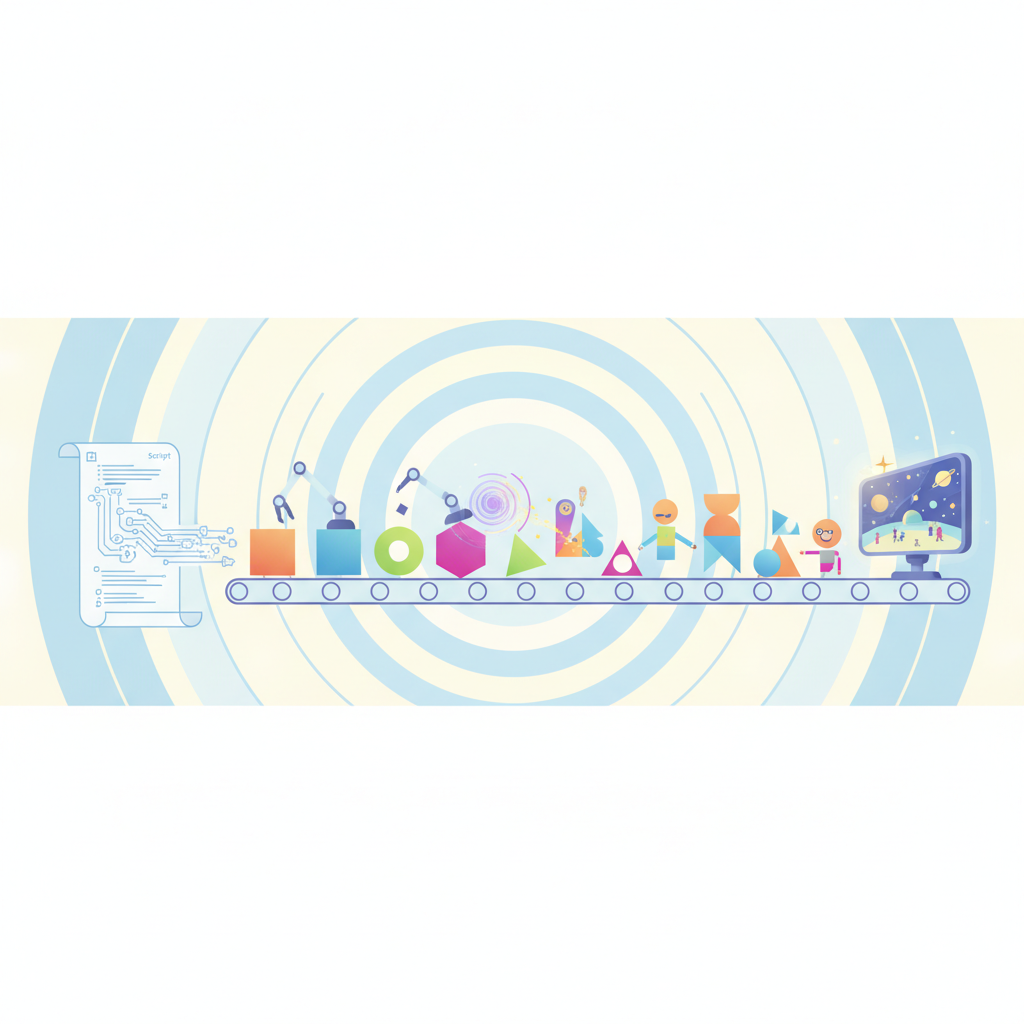
The Production Paradox
Kurzgesagt publishes a new animated explainer roughly every two weeks. Each video contains hundreds of custom illustrations, fluid motion graphics, synchronized sound design, and narration recorded in multiple languages. The production quality resembles Pixar shorts. The release tempo resembles a news desk.
This is not how animation typically works. Feature studios measure output in minutes per year. Kurzgesagt measures output in videos per month. The German team (around 25 people, according to their own disclosures) has built an assembly line that treats motion graphics like manufactured goods: standardized components, repeatable processes, script-driven timelines.
The result is a channel with 23 million subscribers, 75.5 million views in a single recent month, and a business model that flips the typical YouTube economics. Where most creators chase sponsorships to supplement ad revenue, Kurzgesagt does the opposite: 65% of revenue from 2020 to 2022 came from merchandise sales, with sponsorships and grants contributing just 24%.
Script as Blueprint
Kurzgesagt's assembly line starts with the script, not the visuals. The team writes a dozen drafts before recording, and the recorded narration "provides the timing for the animation team." This inverts the typical explainer workflow, where animators build scenes and editors cut to fit.
The script structure is formulaic in the best sense. In the cancer explainer, the opening five seconds establish character (Philipp), conflict (chemotherapy), and frame ("This is not a sad story"). The next 50 seconds deliver historical context (Cisplatin's accidental discovery in 1963). The middle section explains mechanism (DNA as zipper, Cisplatin as chewing gum). The final act reveals impact (90% survival rate for testicular cancer). Every section has a discrete function. Every transition is signposted.
The fridge explainer compresses the same structure into 72 seconds: hook ("Can YOU Cool Down Your Room with a Fridge?"), setup (initial coolness feeling), explanation (refrigerant cycle, second law of thermodynamics), consequence (room heats up), payoff (vent heat outside, invent air conditioning). The script moves in blocks. The animation team can parallelize work because each block is self-contained.
For one-minute explainers, the target word count is 140 to 160 words, matching a calm narrator's natural pace. This is not creative constraint. It is manufacturing tolerance. If every script hits 150 words, every animation block gets roughly the same production time.
Visual Vocabulary as Reusable Components
The Kurzgesagt style (flat vector art, vibrant palettes, anthropomorphized objects) is not just aesthetic. It is a component library. The penguin character in the fridge video reappears across dozens of uploads. The DNA-as-zipper metaphor in the cancer video recycles visual logic used in earlier biology explainers. The motion graphics are modular: arrows for heat flow, lightning bolts for energy, wavy lines for radiation.
In the cancer video, cuts occur every one to three seconds during explanations, slowing only for narrative beats. The rhythm is medium to fast throughout, but it never feels rushed because the visual metaphors do cognitive work. When Cisplatin "sticks to DNA like chewing gum," the viewer does not need a biology degree. The metaphor carries the concept.
Text overlays appear constantly: names (Philipp, Barnett Rosenberg), dates (2018, 1963), terms (Cisplatin, Testicular Cancer, DNA). This is not subtitling. It is redundancy by design. Viewers scrolling without sound still absorb the structure. Viewers with sound get reinforcement. The text is part of the component library, styled once and deployed everywhere.
Color grading follows strict conventions. Bright yellow signals hospital environments. Dark blue indicates internal body views. Muted brown marks historical footage. The fridge video uses red arrows and wavy lines for heat, blue for cold. These are not creative choices per video. They are system defaults.
Sound Design as Retention Scaffolding
Kurzgesagt's sound design operates on two layers: diegetic effects (hair falling, liquid dripping, compressor pumping) and non-diegetic score (upbeat background music that shifts tone with narrative beats). In the cancer video, the "disaster" moment (Cisplatin drop hitting the petri dish) gets a distinct sound effect. The discovery beat (bacteria dying in the Cisplatin zone) gets a musical swell. The final stat (90% survival rate) gets a triumphant chord.
This is retention scaffolding. Every five to ten seconds, a sound cue signals a micro-payoff. The viewer's brain registers progress. The medium cut rhythm (one to three seconds per shot) prevents dead air, but the sound design provides the emotional map.
The fridge explainer runs 72 seconds with continuous background music, sound effects for every animation (fridge door opening, heat escaping), and a voiceover that never pauses for more than half a second. The density is high, but the layering is clean. No two sounds compete for the same frequency range.
Monetization Through Merchandise Depth
Kurzgesagt's revenue model is unusual. AdSense and YouTube memberships contributed only a fraction of income, with 65% coming from merchandise sales between 2020 and 2022. The channel sells posters, notebooks, plushies, calendars, and a proprietary card game. Every product line extends the visual vocabulary. The DNA zipper becomes a poster. The penguin becomes a plushie.
This only works because the content is evergreen. Videos continue earning millions of views years after publication. A viewer discovering the channel in 2026 might binge a 2019 explainer on black holes, then buy the black hole poster. The merchandise is not tied to trending topics. It is tied to the archive.
Sponsorships and grants made up 24% of revenue, including funding from the Bill and Melinda Gates Foundation in 2015 and Open Philanthropy in 2022. These are not typical brand integrations. They are institutional partnerships funding specific content areas (global health, existential risk). The sponsorships do not interrupt the video. They fund the production.
What EditorDuel Readers Can Take From This
Kurzgesagt's system works because it treats creative work as manufacturing. Three lessons translate directly to business content operations:
First, script before visuals. Recording narration first and using it to time the edit eliminates revision loops. If your team animates first and scripts later, you are rebuilding the car after the test drive.
Second, build a component library. Kurzgesagt's visual metaphors, color conventions, and character designs are reusable assets. Every new video draws from the same pool. If your brand's explainer videos look different every time, you are paying for the same design work repeatedly.
Third, monetize depth, not breadth. Kurzgesagt publishes 24 videos per year, not 240. Each video is a long-term asset. The merchandise model only works because the content has a shelf life measured in years. If your content expires in weeks, you are locked into the ad revenue treadmill.
Want to build content like this for your business? Post a competition on EditorDuel and get matched with editors who can deliver.