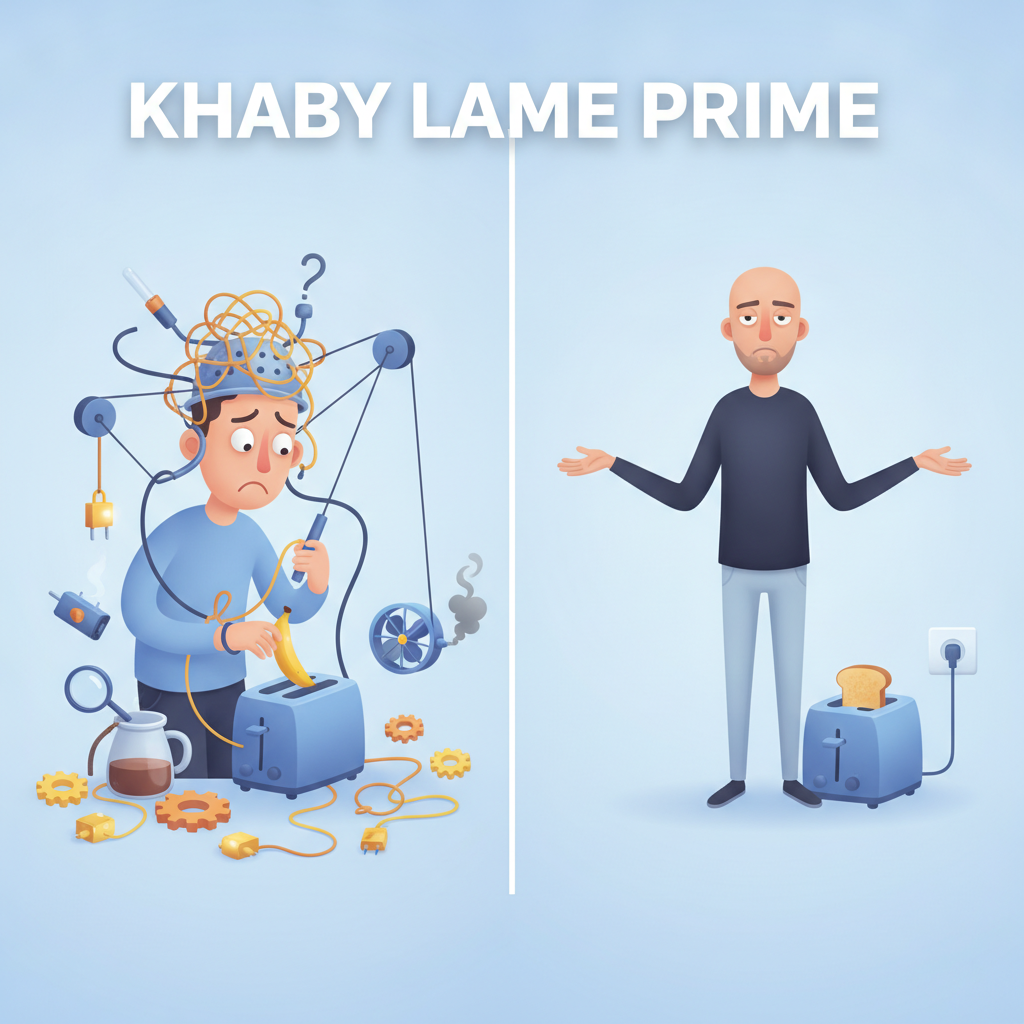
Khaby Lame became the most followed individual on TikTok without speaking a word. Over 161 million followers watch him react to overcomplicated life hacks with a signature deadpan stare and hand gesture. The format is deceptively simple, but the retention mechanics behind it represent one of the most efficient viral structures in short-form video. Top creators earn $17 million to $20 million annually, primarily through brand deals with Hugo Boss and Binance. TikTok itself reportedly paid Khaby Lame $20 million in 2024. For businesses trying to crack short-form retention, Khaby's structure offers a blueprint: predictable format, instant payoff, zero language barrier.
The Three Beat Structure That Drives Every Video
Every Khaby video follows an identical rhythm. In this recent upload, the pattern repeats across multiple mini-skits: someone performs a task in an absurdly complicated way (wiping a surface with paper towels, then trying to dry the towel with a hand dryer), cut to Khaby watching with confusion, cut to Khaby demonstrating the obvious solution (just use the hand dryer on your hands), followed by his signature shrug and a skull emoji overlay. The entire sequence runs 5 to 8 seconds per skit.
The structure works because it front-loads the payoff. Viewers know within one second what they're watching (the Khaby Lame format), and the punchline arrives before attention can drift. In another video, the cut rhythm accelerates during the setup (a man pressing a soap dispenser repeatedly, causing soap to spill everywhere) with shots changing under one second, then slows slightly when Khaby reacts, allowing his expression to land. The rhythm itself signals when to anticipate the joke.
This is not accidental pacing. The setup must be absurd enough to justify the reaction but short enough to prevent drop-off. The reaction must be long enough to register but tight enough to loop into the next skit. The format delivers consistent payoffs because each element is timed to maintain momentum.
Sound Design as Structural Scaffolding
Khaby's videos layer sound in a way that reinforces the three beat structure. Across multiple uploads, a rhythmic "Hey!" vocal sample punctuates every cut, training viewers to expect a new beat. The sound acts as an audio cue: setup ("Hey!"), reaction ("Hey!"), payoff (skull emoji sound effect). The background music is consistent, upbeat, and never competes with the visual joke.
Exaggerated sound effects amplify the absurdity of each setup. In the soap dispenser clip, rapid high-pitched squeaks accompany each pump, making the action feel more ridiculous. When Khaby delivers his solution, the sound drops to his signature "Pfft" exhale, a non-verbal dismissal that functions as the punchline. The skull emoji often arrives with a sharp sound effect, a final punctuation mark.
For content teams, this demonstrates the role of sound in pacing. The music maintains energy, the vocal samples create rhythm, and the sound effects exaggerate the setup. Each layer serves a function, and none of them require dialogue.
Text Overlays as Branding and Signposting
Khaby's videos use persistent text overlays to reinforce identity and guide viewer expectations. In this upload, "KHABY LAME PRIME" and "KHABY HOW" appear at the top and bottom of the frame throughout the video. The text does not explain the joke or add commentary. It brands the format and signals to scrolling viewers what they're about to watch.
In listicle-style compilations, numbered lists appear on screen ("5. Fool", "4. Fire pizza", "3. Speechless"), acting as chapter markers. Each number corresponds to a mini-skit, giving viewers a sense of progression and encouraging them to watch through to number one. The text overlays function as retention anchors, making it clear how much content remains.
Motion graphics are minimal but consistent. Question marks appear above Khaby's head during his confused reactions. The skull emoji is a recurring visual punchline. A small yellow star graphic appears during Khaby's segments in some videos. These elements are not decorative. They are part of the format's visual language, instantly recognizable to repeat viewers.
The Clipper Economy Khaby Doesn't Need
Unlike creators who rely on clipper teams to extract viral moments from long-form content, Khaby's format is natively short. Each video is already a clip. There is no source material to repurpose, no podcast to chop into TikToks. The content is born at the ideal length for platform algorithms.
This structural efficiency has business implications. Khaby does not need a team of editors scanning hours of footage for shareable moments. The production model is lean: shoot multiple setups in a single session, edit each into a standalone 10 to 15 second loop, publish at high frequency. The format has extended beyond TikTok to YouTube Shorts, where his videos use the same retention mechanics (fast pacing, curiosity hooks, instant payoff) that dominate the Shorts algorithm.
For businesses evaluating content velocity, this is the extreme end of the spectrum. Khaby's model sacrifices depth for volume, but the volume is what feeds the algorithm. The format is repeatable, the production is fast, and the retention is predictable.
Why Silent Content Scales Globally
Khaby's decision to avoid spoken dialogue is often framed as a creative choice, but it is also a distribution strategy. Silent content requires no translation, no subtitles, no localization. A viewer in Lagos and a viewer in Los Angeles see the same joke land the same way. His reach spans over 161 million followers, with no language barrier limiting distribution.
The visual clarity of each setup makes the format universally readable. A man trying to open a car door by breaking the window when the door is unlocked does not require cultural context. The absurdity is self-evident, and Khaby's reaction (opening the door normally, then shrugging at the camera) is a punchline that works in any market.
For brands operating in multiple regions, this is a template: design content that communicates through action, not narration. The tighter the visual storytelling, the wider the potential audience.
What EditorDuel Readers Can Take From This
Khaby Lame's format is not directly replicable for most businesses, but the retention principles are. First, establish a predictable structure. Viewers should know within one second what kind of content they are watching and when the payoff will arrive. Khaby's three beat rhythm (setup, reaction, solution) works because it is consistent across every video. Audiences learn the format and return for the structure.
Second, use sound design to reinforce structure. The "Hey!" vocal sample in Khaby's videos is not decoration. It is a rhythm track that trains viewers to anticipate cuts. For explainer videos, product demos, or case studies, consider how audio cues can guide attention and signal transitions.
Third, treat text overlays as functional elements, not afterthoughts. Khaby's persistent branding ("KHABY LAME PRIME") and numbered lists give viewers a sense of progression. For educational or listicle content, on-screen text can reduce drop-off by showing how much value remains.
Fourth, optimize for silence when possible. If your content can communicate without voiceover, it can travel further. Visual clarity scales across platforms and regions in ways that dialogue cannot.
Finally, recognize that high retention and high volume are not mutually exclusive. Khaby's format is designed for repetition. Each video is short enough to produce quickly and structured tightly enough to retain attention. For businesses publishing at scale, this balance is the operational challenge: how do you maintain quality while increasing frequency? Khaby's answer is to simplify the format until it becomes a system.
Want to build content like this for your business? Post a competition on EditorDuel and get matched with editors who can deliver.