Johnny Harris operates at the intersection of investigative journalism and YouTube retention mechanics. With 8 million subscribers and estimated monthly ad revenue between $6,432 and $23,565, he has built a documentary format optimized for algorithmic distribution. His company Newpress, co-founded with Iz Harris, recently closed a $12M funding round to expand the model across 16 channels. For businesses trying to produce educational content that holds attention, Harris offers a case study in structuring complex information for platform-native consumption.
The Hook-Driven Investigative Structure
Harris videos follow a predictable retention architecture. In this recent China infrastructure video, the opening five seconds pose a direct question about China's political system, immediately followed by a "Coming up..." text overlay. The structure builds curiosity by promising a surprising answer, then delays gratification through multiple escalating segments. The video uses "shocked tourist" montages as a setup, transitions into systemic explanations via interviews and data visualization, and resolves with a discussion of incentives and accountability. Energy peaks are timed to retention-critical moments: rapid-fire infrastructure montages and animated data visualizations arrive just as explanatory segments risk losing momentum.
This is not accidental pacing. The format treats the viewer's attention span as a resource to be managed across 10 to 20 minute runtimes. Every structural beat serves retention: the cold open question creates a knowledge gap, the montages provide visual dopamine hits, and the payoff arrives late enough to maximize watch time but early enough to prevent drop-off.
Visual Vocabulary: Maps, Markup, and Motion Graphics
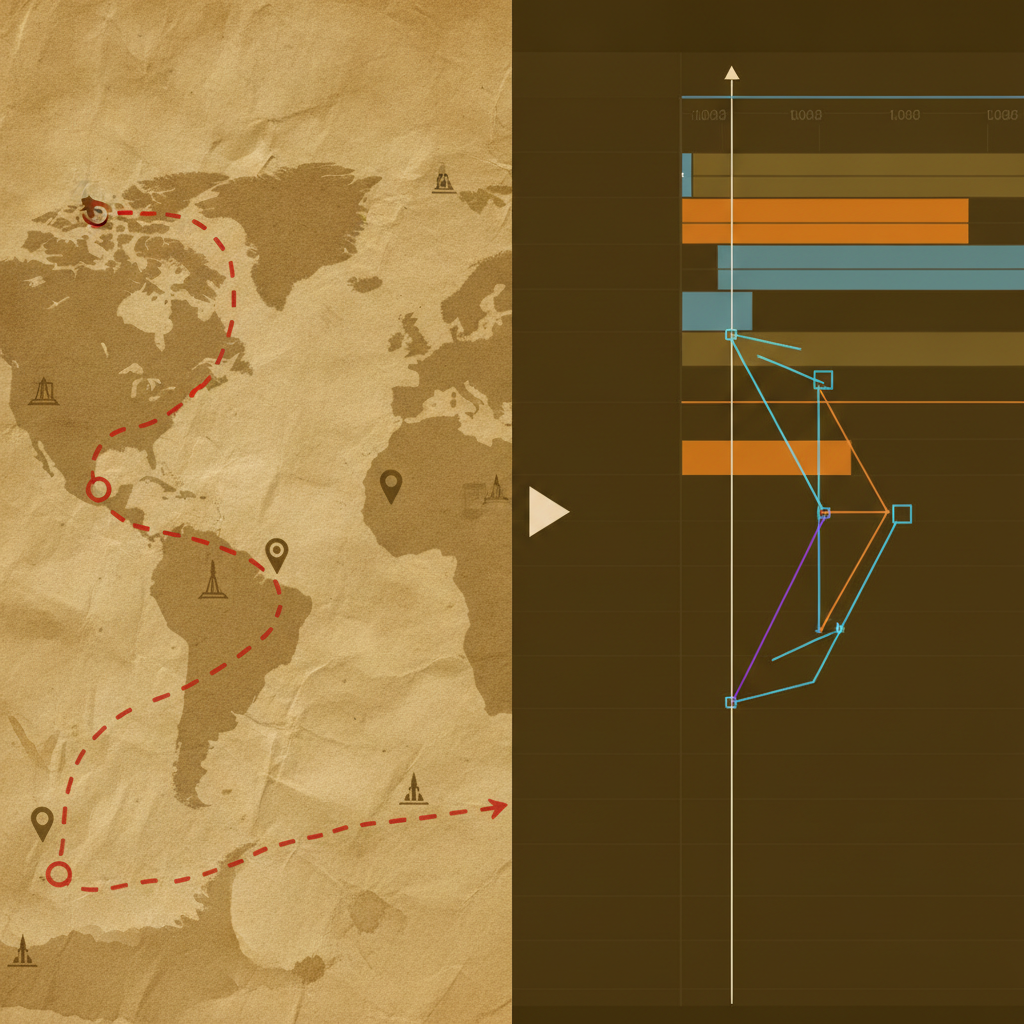
Harris has developed a signature visual language recognizable enough that AI tools now offer "Johnny Harris style" presets. The core elements: animated paper maps with hand-drawn red routes, marked-up archival footage with circled subjects and typewriter labels, slow push-ins on documents with pen underlining. A tutorial video demonstrating the style breaks down the mechanics: camera zooms on textured maps, red lines drawing themselves across geographies, handwritten annotations appearing in sync with narration.
These are not decorative choices. Map transitions break up talking-head segments and maintain visual variety, giving the eye something to track during dense information delivery. The markup style (circles, arrows, handwritten labels) mimics the visual language of investigation, signaling to the viewer that they are watching research unfold in real time. The warm, slightly desaturated color grade on direct-address segments contrasts with vibrant, futuristic B-roll, creating visual distinction between explanation and evidence.
The cut rhythm supports this. In the China video, cuts average one to three seconds during montages, slowing down during direct address. Jump cuts remove pauses in the speaker segments, maintaining forward momentum even during explanatory passages. Sound design layers upbeat music under montages, with sound effects punctuating text overlays and graphic animations. The result is a documentary that feels propulsive rather than contemplative.
The Newpress Operating Model
Harris runs this operation through Newpress, a production company structured to support creator-led journalism at scale. The business model is funded through video ads and sponsorships, with Newpress acting as the operational backbone. The $12M funding round signals an expansion strategy: replicate the Harris format across multiple subject-matter creators, each operating their own channel under the Newpress infrastructure.
This is a bet on format portability. If the retention mechanics (hook-driven structure, visual vocabulary, cut rhythm) can be systematized, the model scales beyond Harris himself. The company describes its vision as "a media institution" that supports creator-led journalism without relying on outrage or speed. In practice, this means applying documentary rigor to YouTube's retention requirements: research-heavy content delivered in algorithmically optimized packages.
The economics depend on volume and consistency. With 91% of views coming from long-form content, Harris optimizes for mid-roll ad placements and sponsor integrations rather than viral short-form clips. The $60 membership tier mentioned in funding coverage suggests an emerging direct-to-consumer revenue stream, layering subscription income on top of ad revenue.
What EditorDuel Readers Can Take From This
The Harris playbook offers three transferable lessons for businesses producing educational content:
First, structure every video as a question with a delayed answer. Do not lead with conclusions. The knowledge gap between the opening question and the payoff is what holds attention across long runtimes. For B2B content, this means framing case studies as mysteries, product explainers as investigations, and thought leadership as surprising revelations.
Second, develop a consistent visual vocabulary that signals your content type at a glance. Harris uses maps and markup; your brand might use data visualizations, process diagrams, or before-and-after comparisons. The goal is to create visual shortcuts that let viewers recognize your content in thumbnail form and understand what cognitive experience they are signing up for.
Third, treat cut rhythm as a retention tool, not just an aesthetic choice. Vary pacing to match information density: speed up during transitions and B-roll, slow down during key explanations, use jump cuts to remove dead air in direct address. The viewer should never have time to check their phone, but also never feel rushed past important details.
The Harris model proves that documentary-style content can compete on YouTube without sacrificing depth. The trick is not dumbing down the material, but re-architecting how it is delivered. Complex topics become digestible when broken into retention-optimized segments, supported by motion graphics that visualize abstract concepts, and paced to reward continued attention.
Want to build content like this for your business? Post a competition on EditorDuel and get matched with editors who can deliver.