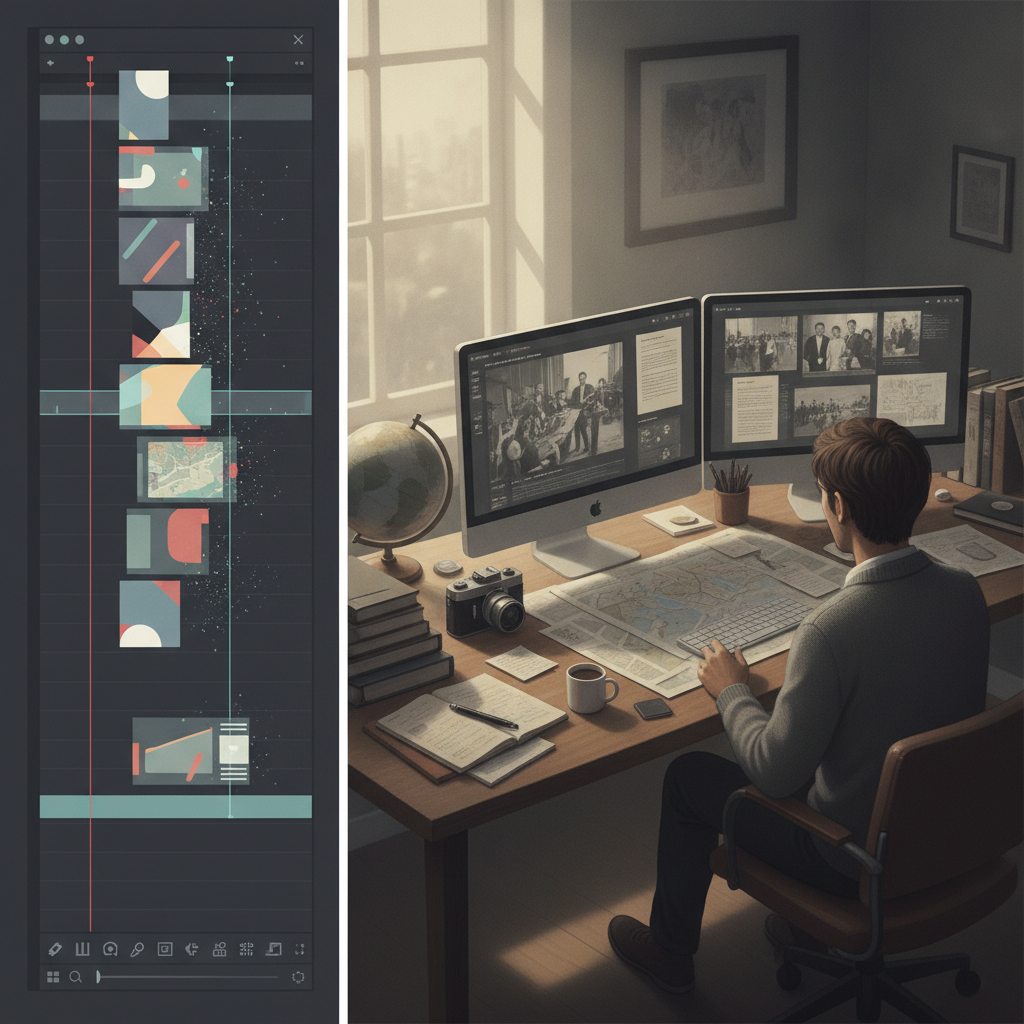
Johnny Harris uploads a new video. Within the first five seconds, viewers see a rapid montage of clips, each under one second, audio snippets firing in quick succession: "inflation explained," "civil liberties," "tax policy." The pace is relentless. The hook is immediate. By second six, the viewer is already committed to solving whatever puzzle Harris is about to lay out.
This is not accidental. Harris, who built his audience at Vox before launching independently), has engineered a documentary format that treats every topic like a detective story. The mechanics are visible, repeatable, and grounded in retention science. For businesses trying to hold attention in the YouTube economy, Harris's structure offers a blueprint worth dissecting.
The Opening Hook: Intrigue, Not Context
In a typical Harris video, the first five seconds function as a cold open. The montage technique establishes the subject (Harris himself, the diverse topics he covers) while withholding the actual thesis. The audio is fragmented, the visuals chaotic. This creates a fast-paced, intriguing hook that immediately establishes the subject and prevents a click-away.
Traditional documentary opens with context: who, what, where, when. Harris opens with a question or a provocation, then spends the next 60 seconds deepening the mystery before offering any explanation. The structure mirrors true crime podcasts and investigative journalism, where the audience is invited to solve the problem alongside the creator.
The cut rhythm in these openings averages well under one second per shot. The analysis of his work clocks the opening montage at "less than a second" per clip, with the pace only slightly relaxing to one to two seconds per shot once the narrative begins. This velocity is not stylistic flourish. It is a retention gate. Viewers who survive the first ten seconds are statistically more likely to watch to completion.
The Question to Report Cycle
Harris videos follow a formulaic structure that the analysis describes as "Question to Report." The video poses a question (often in bold text overlays: "Why is the news boring?"), then presents a "report" that answers it, but the report itself generates new questions. The cycle repeats.
This structure keeps the narrative in constant forward motion. Each answer is a cliffhanger. Each cliffhanger demands the next segment. The analysis identifies this as a circular diagram, with motion graphics illustrating the loop. The viewer is never allowed to settle into passive consumption. They are always one question away from the next payoff.
For content operations, this is the key lesson: retention is not about pacing alone. It is about structuring information so that each beat creates narrative debt. Harris does not explain a topic linearly. He withholds, teases, and resolves in controlled intervals. The viewer stays because they need closure on the question they were just asked.
Editing Techniques That Compress Time and Amplify Urgency
The technical craft behind Harris's videos is visible in the cut rhythm and motion design. The analysis catalogs the toolkit: jump cuts to remove dead air, match cuts to create continuity across locations, split screens to compare sources, speed ramps to condense time, and text overlays to emphasize key phrases.
B-roll is deployed not as filler but as narrative punctuation. When Harris discusses a geopolitical topic, the B-roll is archival footage, maps, or behind-the-scenes shots of Harris himself working. The color grading is consistently desaturated and cinematic, giving even mundane topics a sense of gravitas. Sound design layers upbeat music under voiceover, with sound effects (door creaks, paper rustling, typing) that reinforce the investigative tone.
The result is a video that feels faster than it is. A 15-minute Harris video contains more cuts than a 30-minute traditional documentary. The editing compresses information density, allowing him to cover complex topics without losing momentum. For businesses producing explainer content, this is the trade: speed and density over exhaustive detail.
The Newpress Model: Scaling the Format Beyond One Creator
Harris has not kept the formula to himself. Harris and his wife Iz publicly launched Newpress, a production company and platform for creator-journalists. Newpress handles hiring, sales, and sponsorship deals while creators retain editorial control. The platform features shows by former Vox colleagues): Sam Ellis on sports and geopolitics, Christophe Haubursin on niche internet topics, Max Fisher on technology and world news.
The business model is funded through video ads and sponsorships, with Newpress acting as the operational backbone. Harris has described the vision as "a media institution" that supports creator-led journalism without relying on "outrage, speed, and volume." The structure is notable: creators own their channels, but Newpress provides the infrastructure (editors, researchers, salespeople) that allows them to focus on storytelling.
For content operations leaders, this is a case study in vertical integration. Harris did not just build a personal brand. He built a system that can replicate his format across multiple creators, each with their own audience but sharing a common production standard.
What EditorDuel Readers Can Take From This
The Harris playbook is not about personality. It is about structure. The opening hook, the question to report cycle, the cut rhythm, the B-roll patterns, the sound design. These are all replicable mechanics.
First, audit your cold opens. If your videos start with context instead of intrigue, you are losing viewers in the first ten seconds. The hook must create a knowledge gap that only the rest of the video can close.
Second, structure your content as a series of questions and payoffs. Do not deliver information linearly. Withhold, tease, resolve. Each answer should generate a new question. This keeps the narrative in motion and prevents drop-off.
Third, invest in cut rhythm. Harris videos average one to two seconds per shot during explanatory segments, under one second during hooks. This is not hyperactive editing. It is intentional compression. Every frame that does not advance the narrative is removed.
Fourth, treat B-roll as narrative tool, not decoration. Harris uses archival footage, maps, and behind-the-scenes material to reinforce the investigative tone. Your B-roll should do storytelling work, not just fill space.
Finally, if you are scaling a content operation, consider the Newpress model: centralized production infrastructure, decentralized creative ownership. Harris built a system where editors, researchers, and salespeople support multiple creators, each maintaining their own channel and audience. This allows the format to scale without diluting quality.
Want to build content like this for your business? Post a competition on EditorDuel and get matched with editors who can deliver high-retention documentary work that holds attention from the first cut to the final frame.