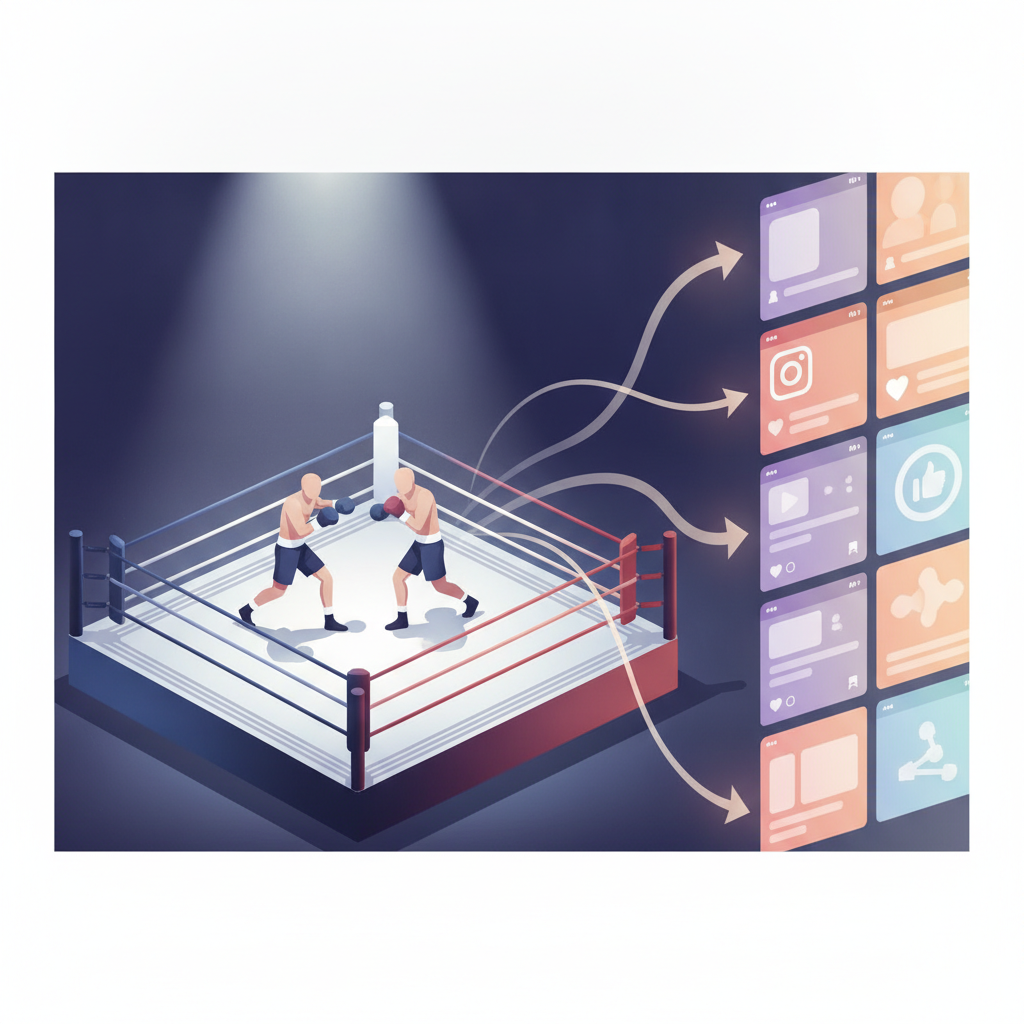
Jake Paul's operation is not a traditional boxing promotion or a conventional YouTube channel. It is a self-reinforcing content flywheel where combat sports events serve as raw material for social media distribution, which in turn builds audience demand for the next paid event. According to Yahoo Finance, Paul built his own marketing flywheel in boxing: promote a spectacle, convert attention into paid viewership, and turn every match into social media content that can build relevance for future fights. This model has allowed him to combine digital influence with high-value event economics at significant scale.
The Core Flywheel: Events as Content Factories
Most boxing promoters treat social media as an afterthought. Paul treats it as the product. Every fight produces dozens of reusable content units: press conference confrontations, training footage, weigh-in theatrics, fight highlights, post-fight interviews, and reaction clips. In this short, a single 15-second exchange at a table ("I'm going to do the right thing and f*** off") becomes a standalone piece of content with a text hook overlay and comedic payoff structure. The video uses a simple setup and payoff format: the text overlay promises a surprising interaction, the dialogue delivers the punchline, and Paul's genuine laughter reinforces authenticity. No complex editing, just a strong textual hook and comedic timing that makes the moment shareable.
The fight itself is just one node in a much larger content distribution system. This full fight highlight reel demonstrates the structural template: medium to fast cuts averaging 1 to 3 seconds during boxing sequences, frequent speed ramps to emphasize impactful punches, text overlays displaying round numbers and fighter stats, and split screens showing both fighters' reactions during the decision announcement. The video opens with immediate action (a close-quarters punch exchange), hooks viewers in the first 5 seconds, then maintains energy through strategic speed ramps and commentator dialogue. Every round becomes a self-contained story beat, and the entire fight becomes a library of clips that can be redistributed across TikTok, Instagram, YouTube Shorts, and Snapchat Spotlight.
Distribution Architecture: Clip Economies at Scale
Paul does not rely on a single platform. The Times of India reports that his model is increasingly event-driven, with each fight creating social clips, podcast discussion, YouTube content, and brand exposure. Snapchat Spotlight hosts millions of trending Jake Paul reaction videos. TikTok shows substantial engagement with posts tagged with his name, spanning training sessions, fashion clips, and fight predictions. This is not organic virality. It is a deliberate multi-platform distribution strategy where every piece of fight content is optimized for the format and audience of each platform.
The operational advantage is that Paul does not need to produce new content daily. One fight generates weeks of material. Press conferences become TikTok confrontations. Training sessions become motivational Reels. Walkout music choices become Snapchat fashion moments. Young Hollywood covered Paul teasing his fit and walkout music for an upcoming fight, turning pre-fight preparation into standalone content. Every asset is designed to be clipped, remixed, and redistributed by both Paul's team and third-party creators who amplify his reach without additional production cost.
Monetization Model: Attention Converts to Pay-Per-View
The flywheel's economic engine is simple: free social content drives paid event sales. Paul demonstrated early in his career that direct fan monetization could work at scale. That same principle applies to boxing: give away enough content to build demand, then convert attention into pay-per-view buys. The Times of India notes that Jake Paul has created a business model based on combat sports, promotion, and high-value event economics.
This is fundamentally different from traditional boxing economics, where promoters rely on cable deals and venue sales. Paul owns the audience relationship. He does not need a network to distribute his fights. He builds demand through social platforms, sells directly via streaming pay-per-view, and retains a larger share of revenue. The content flywheel ensures that every fight pre-sells the next one. As Rural Intelligence describes, Paul's journey from Vine to boxing represents one of the most remarkable case studies in modern creator-led disruption, transforming internet virality into sustainable sports-business equity.
Structural Formula: Spectacle Over Technique
Paul's fights are not designed for purists. They are designed for virality. In this fight highlight, the video opens with an aerial shot of the ring filled with people, immediately establishing the grand scale of the event. The cut rhythm is medium to fast (1 to 3 seconds per shot), with moments of faster cutting during intense exchanges. Slow-motion replays highlight significant punches, and the commentary builds excitement throughout. The structure follows a clear narrative: pre-fight instructions, round-by-round highlights, and the final decision with a split-screen showing both fighters' reactions. Energy peaks during punching sequences and the knockout, ensuring viewers stay engaged.
The formula is consistent: big names (even if not elite boxers), theatrical build-up, high production value, and moments designed to be clipped. Every fight includes at least one viral moment, whether it is a knockdown, a trash-talk exchange, or a controversial decision. These moments become the content seeds that propagate across social platforms, driving awareness for the next event.
What EditorDuel Readers Can Take From This
Paul's operation offers three actionable lessons for businesses building content systems. First, design content to be modular. One long-form asset (a fight, a keynote, a product launch) should yield dozens of short-form clips optimized for different platforms. Second, treat distribution as a deliberate system, not an afterthought. Identify which platforms your audience uses and format content specifically for each one. Third, use free content to pre-sell paid offerings. The flywheel only works if the free material builds enough demand to convert into revenue at the next stage.
The key insight is that Paul does not separate content creation from business model. The content is the business model. Every video, every clip, every reaction post exists to feed the flywheel that drives the next paid event. That principle applies whether you are selling boxing matches, software subscriptions, or consulting services.
Want to build content like this for your business? Post a competition on EditorDuel and get matched with editors who can deliver.