Cleo Abram's YouTube channel, launched after leaving Vox in January 2022, has become a case study in retention-focused science content. Her series "Huge if True" pulls 2.75 million subscribers by applying a consistent structural and editing formula that transforms dense scientific concepts into highly watchable short and long-form videos. For businesses trying to make educational or technical content stick, her approach offers concrete lessons in pacing, visual hierarchy, and narrative structure.
The Opening Hook: Immediate Visual + Relatable Question
Every Abram video analyzed opens with the same structure: a striking visual paired with a question the viewer has likely wondered about but never articulated. In her cloud video, the first five seconds show a plane window view of clouds while her voiceover asks, "Have you ever looked out a plane window and wondered, what if I could just land on a fluffy cloud?" Her sun video opens with close-up footage of the sun's surface and the question, "Have you seen these incredible new images of our sun?"
The pattern is deliberate: no preamble, no channel branding, no introduction. The hook is the content itself. The visual is already playing before the question finishes. This structure works because it assumes the viewer is scrolling and gives them a reason to stop within two seconds.
Cut Rhythm: 1 to 3 Second Intervals With Constant Visual Stimulation
Across all three analyzed videos, the cut rhythm averages 1 to 3 seconds per shot. The sun video uses "predominantly fast" cuts with "shots changing roughly every 1 to 2 seconds." The Saturn video maintains "medium to fast" pacing at "1 to 3 seconds" per cut.
This isn't arbitrary speed. The cuts are timed to the information density of the script. When Abram introduces a new concept (density, buoyancy, metallic hydrogen), the B-roll changes to illustrate it. When she moves to the next beat, the visual updates. The result is that every sentence gets its own visual support, preventing the viewer's attention from drifting.
The technique also relies on picture-in-picture framing. Abram's face stays visible in a small overlay while B-roll fills the main frame. This allows her to react to the visuals in real time, adding a conversational layer without interrupting the information flow.
Text Overlays as Information Architecture
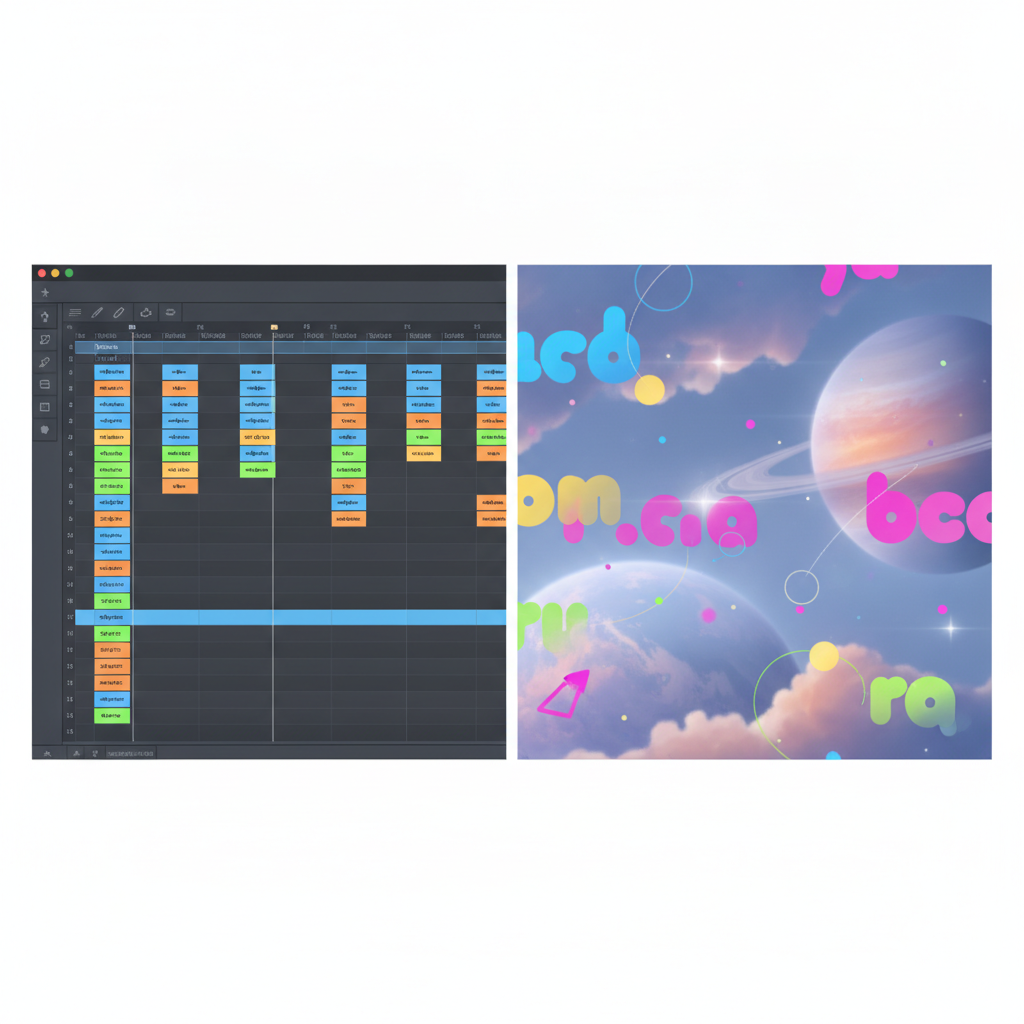
Abram uses large, colorful text overlays not as decoration but as a second information track. In the cloud video, key phrases like "DENSITY" and "METALLIC HYDROGEN" appear on screen as she says them. The sun video highlights "Truly Crazy is Their Scale" and "Our Sun" in bold, contrasting colors.
The overlays serve three functions. First, they reinforce audio for viewers watching without sound. Second, they create visual hierarchy, signaling which concepts are most important. Third, they break up the frame, giving the eye something to track even during longer explanatory passages.
Emojis appear strategically in the overlays (🤯, 🔥, ☀️, 💎) to add emotional texture without slowing the pace. The sun video uses checkmarks (✅) and fire icons (🔥) to punctuate claims. These aren't random. They appear at moments of emphasis, functioning like visual exclamation points that guide the viewer's emotional response.
Motion Graphics and Sound Design as Explanatory Tools
Abram's videos treat motion graphics as necessary infrastructure, not polish. The cloud video uses "animated elements to illustrate concepts, such as a person jumping onto a cloud, a weighing scale showing density, and a planet's atmosphere density slider." The sun video zooms into the sun to reveal Earth's scale at 0:09 to 0:16, then overlays a US map at 0:29 to 0:31 to show the size of surface convection cells.
These aren't expensive effects. They're simple animations that clarify relationships between ideas. When Abram explains that clouds are less dense than air, the animation shows a scale tipping. When she describes metallic hydrogen forming under pressure, the visual shows layers compressing.
Sound design follows the same logic. The sun video uses "whoosh for zooming, pop for text, ding for checkmarks, fire for heat, glass breaking for energy blasts." The Saturn video adds drilling, wind, and electricity sounds to match the B-roll. The sound effects aren't decorative. They mark transitions, signal new information, and maintain rhythmic momentum.
Narrative Structure: Problem, Escalation, Extreme Payoff
Abram's videos follow a consistent three-act structure. The cloud video opens with the hook (can you land on a cloud?), spends the middle explaining why you can't on Earth (density, buoyancy, ideal gas law), then delivers the payoff: on Jupiter, you could land on a cloud made of metallic hydrogen. The structure is hook, setup, payoff.
The Saturn video uses the same pattern: what if you drilled into Saturn? The middle section walks through each atmospheric layer, escalating the extreme conditions (no ground, powerful winds, crushing pressure). The payoff is the metallic hydrogen core. The progression always moves from relatable question to increasingly extreme scientific reality.
This structure works because it satisfies curiosity in stages. The hook promises an answer. The setup builds tension by explaining why the obvious answer doesn't work. The payoff delivers something more interesting than the original question. Energy peaks occur when new, counterintuitive facts emerge (Earth turning into Venus in the cloud video, solar flares impacting power grids in the sun video).
Sponsor Integration and Audience Positioning
Abram's sponsor mix includes Audible, Adidas, and fintech platform Mercury, which positions her audience as "educated, aspirational consumers" with "premium brand budgets." This sponsorship profile suggests her retention tactics work on viewers with disposable income and tolerance for technical content, a demographic many B2B and SaaS companies also target.
Her content also functions as "creator-led science journalism" that attracts "audiences that traditional media is losing." This framing matters for businesses: the same editing techniques that make plasma physics watchable can make product demos, case studies, or technical explainers more digestible.
What EditorDuel Readers Can Take From This
Abram's playbook is replicable for any business producing educational or technical content. First, open with a visual and a question, not a logo or introduction. The first two seconds determine whether the viewer stays. Second, match cut rhythm to information density. Every new concept should trigger a visual change. Third, use text overlays as a second information track, not decoration. Highlight key terms as they're spoken. Fourth, treat motion graphics and sound design as explanatory tools. Animate relationships between ideas. Fifth, structure content as problem, escalation, payoff. Satisfy curiosity in stages, not all at once.
The technical execution (1 to 3 second cuts, picture-in-picture framing, emoji punctuation, sound effect timing) can be replicated by mid-level editors. The strategic insight (retention-focused structure, visual hierarchy, escalating payoffs) requires editorial discipline but no special tools.
Hire Editors Who Understand Retention Mechanics
Want to build content like this for your business? Post a competition on EditorDuel and get matched with editors who can deliver. The platform connects you with video editors and podcast editors who understand pacing, structure, and retention tactics, not just software. You describe the project, editors submit sample work, and you hire based on demonstrated skill. If your content needs to hold attention and explain complex ideas, you need editors who've studied what works.