Valkyrae (Rachell Hofstetter) has been YouTube's most watched female streamer since 2020, co-owns 100 Thieves, and runs her own media company Hihi Studios. Her content operation pulled 1.7M views on a recent Just Chatting stream, but the engine behind those numbers is not gameplay skill or production budget. It is a highly refined reaction format that recycles viral moments from other creators into retention optimized clips.
Businesses trying to build audience through commentary, reaction, or aggregation content can learn from how Valkyrae structures these videos. The format is simple: watch something, react to it, let the audience watch you watch it. But the execution reveals specific editorial choices that keep viewers locked in.
The Split Screen as Primary Canvas
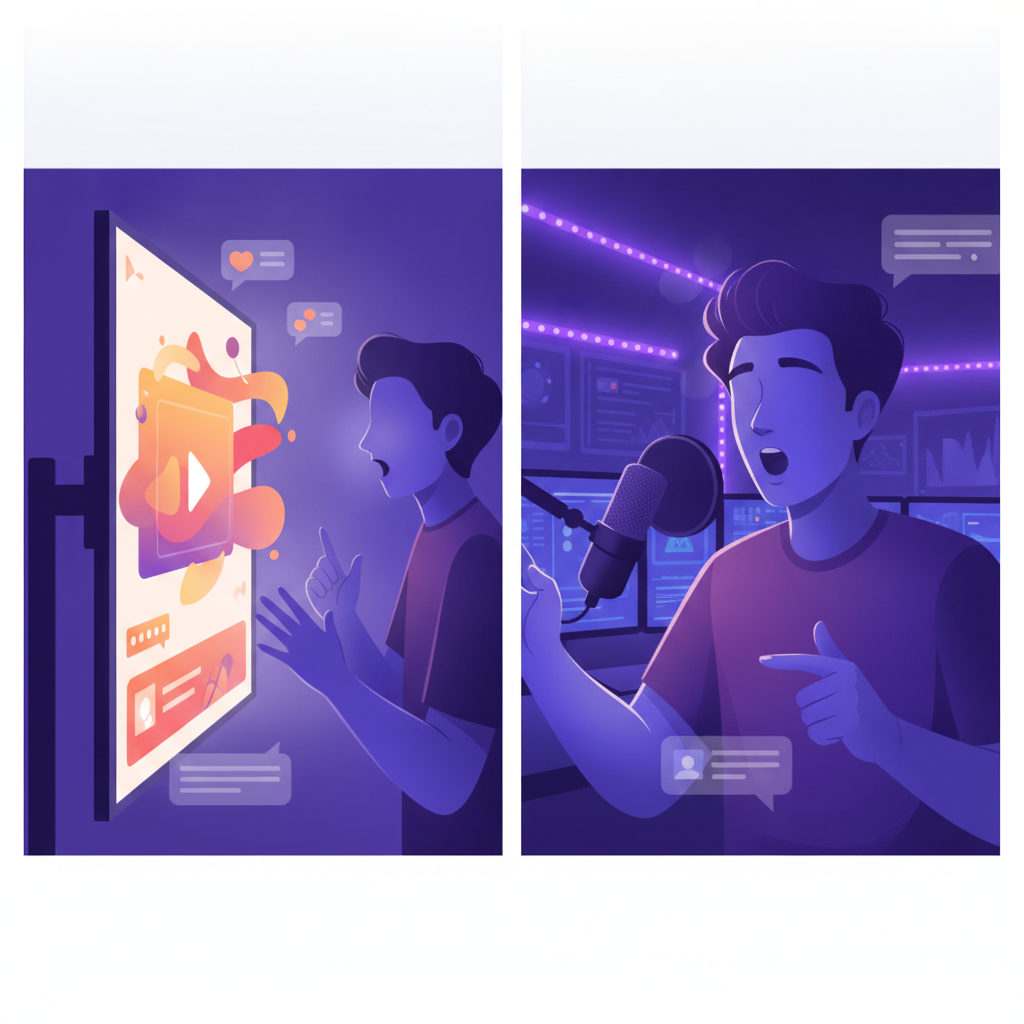
Valkyrae's reaction videos use a persistent split screen layout. In this clip reacting to Miyoung, the source material plays in a smaller picture in picture window on the left while Valkyrae occupies the main frame on the right. Chat messages from live viewers overlay the left side, creating a third information layer.
This is not accidental. The split screen allows the viewer to simultaneously consume the original content and Valkyrae's live, unedited response. The chat overlay adds a fourth wall breaking effect, viewers see other viewers reacting in real time, which creates a shared experience loop. The format borrows from sports commentary: you watch the play and the commentator at the same time.
The layout rarely changes. In the fanfan versus Burn voice clip, the split remains fixed for the entire 30 second short, with only occasional zoom ins on Valkyrae's face when her reaction intensifies. The consistency trains the viewer's eye: top half is source, bottom half is reaction, no need to reorient.
Cut Rhythm: Medium Pacing with Reaction Peaks
The cut rhythm in Valkyrae's reaction content typically holds shots for 3 to 5 seconds, which is slower than high velocity YouTube edits but faster than uncut live streams. In the Miyoung clip, the video holds on the split screen for extended beats, cutting only when Valkyrae switches from watching the clip to reacting directly to camera, or when the source clip itself has a hard cut.
The pacing accelerates during peak reactions. At the 0:58 mark in that same video, a hard cut jumps to a close up of Valkyrae laughing. The zoom in signals to the viewer: this is the payoff moment. The edit does not interrupt the reaction, it amplifies it.
In the Daigo parry clip, the rhythm speeds up during the most intense gameplay sequence, cutting more frequently between the game footage and the creators' faces. The faster cuts mirror the escalating tension in the source material, but the split screen never breaks. The viewer always knows where to look.
Replay Loops as Retention Anchors
One of the most effective retention mechanics in Valkyrae's format is the replay. In the Miyoung clip, a segment of the source video replays from 1:10 to 2:09, allowing Valkyrae to react to the same moment again. The first pass establishes the joke. The second pass lets her unpack it, laugh harder, and give the audience permission to laugh with her.
This is a borrowed technique from sports broadcasting and late night talk shows: show the clip, react, show it again, react more. The repetition does two things. First, it extends watch time without requiring new source material. Second, it gives viewers who missed the joke on the first pass a second chance to catch it, which reduces drop off.
The replay is not random. It targets the highest energy moment in the source clip, the beat that generated the strongest live reaction. Valkyrae's laughter from 0:58 to 1:09 in the Miyoung video is infectious, and the replay ensures no viewer misses her full emotional response.
Text Overlays and Sound Design
Text overlays serve two functions. First, they caption what the creators are saying, which makes the content accessible and platform agnostic (TikTok, Instagram, YouTube Shorts all favor captions). In the Daigo parry short, captions appear for both "Did he just parry everything there?" and key information in the gameplay like "1 HP."
Second, text highlights the hook. The question "Did he just parry everything there?" at 0:00 in that video immediately draws the viewer into the action. It sets up curiosity: what is about to happen? The text ensures the hook lands even if the viewer is scrolling with sound off.
Sound design is minimal but deliberate. The original audio from the source clip remains prominent. Valkyrae's live audio reaction layers over it, but the mix keeps both tracks audible. In the fanfan clip, the deep voice of the game character is the comedic centerpiece, and the streamers' laughter and exclamations are emphasized without drowning out the source.
There are no added sound effects, no background music, no transition whooshes. The purity of the reaction is the product.
Structure: Hook, Setup, Payoff
Valkyrae's reaction videos follow a three act structure compressed into 30 seconds to 3 minutes. The Daigo parry video demonstrates this clearly:
- Hook (0:00 to 0:02): Valkyrae asks, "Did he just parry everything there?" Immediate curiosity.
- Setup (0:03 to 0:08): The male co-host introduces the clip as "the most famous fighting game moment of all time," raising stakes.
- Payoff (0:09 to 0:21): The full gameplay clip plays with both creators reacting in real time, culminating in the KO and crowd reaction.
The structure works because it borrows narrative tension from the source material while adding a second layer of tension: will the reactor find this as amazing as the setup promised? The viewer stays to see both the clip and the reaction land.
Energy peaks are predictable: they occur when the source clip hits its climax and when Valkyrae's reaction hits maximum intensity. Editors can map these peaks in advance by watching the raw reaction footage, then tightening the cuts around those moments.
What EditorDuel Readers Can Take From This
Valkyrae's format is repeatable. Businesses building reaction content, commentary channels, or aggregation feeds can apply these mechanics:
- Lock the layout. Pick a split screen or picture in picture template and stick with it across episodes. Consistency trains your audience and reduces cognitive load.
- Replay the best 10 seconds. Identify the highest energy moment in your source material and show it twice. The first pass hooks, the second pass cements retention.
- Caption everything. Text overlays make your content platform agnostic and accessible. They also let you emphasize hooks and punchlines.
- Cut to reaction peaks, not to a metronome. Let shots breathe during setup, then accelerate cuts during payoff moments. The rhythm should mirror the emotional arc.
- Keep sound design minimal. If the reaction is genuine, you do not need music or effects. Let the source audio and the reactor's voice carry the content.
The format does not require expensive gear or a large team. It requires editorial discipline: knowing when to cut, when to hold, when to replay, and when to zoom in.
Valkyrae has been streaming since 2015 and signed an exclusive YouTube Gaming deal in 2022. She also maintains an active presence on Twitch for sponsored streams, using the reaction format across both platforms. The format scales because it is modular: one live stream generates dozens of clippable moments, each of which can be packaged as a standalone short or highlight.
Want to build content like this for your business? Post a competition on EditorDuel and get matched with editors who can deliver.