The Repeatable Hook as Content Infrastructure
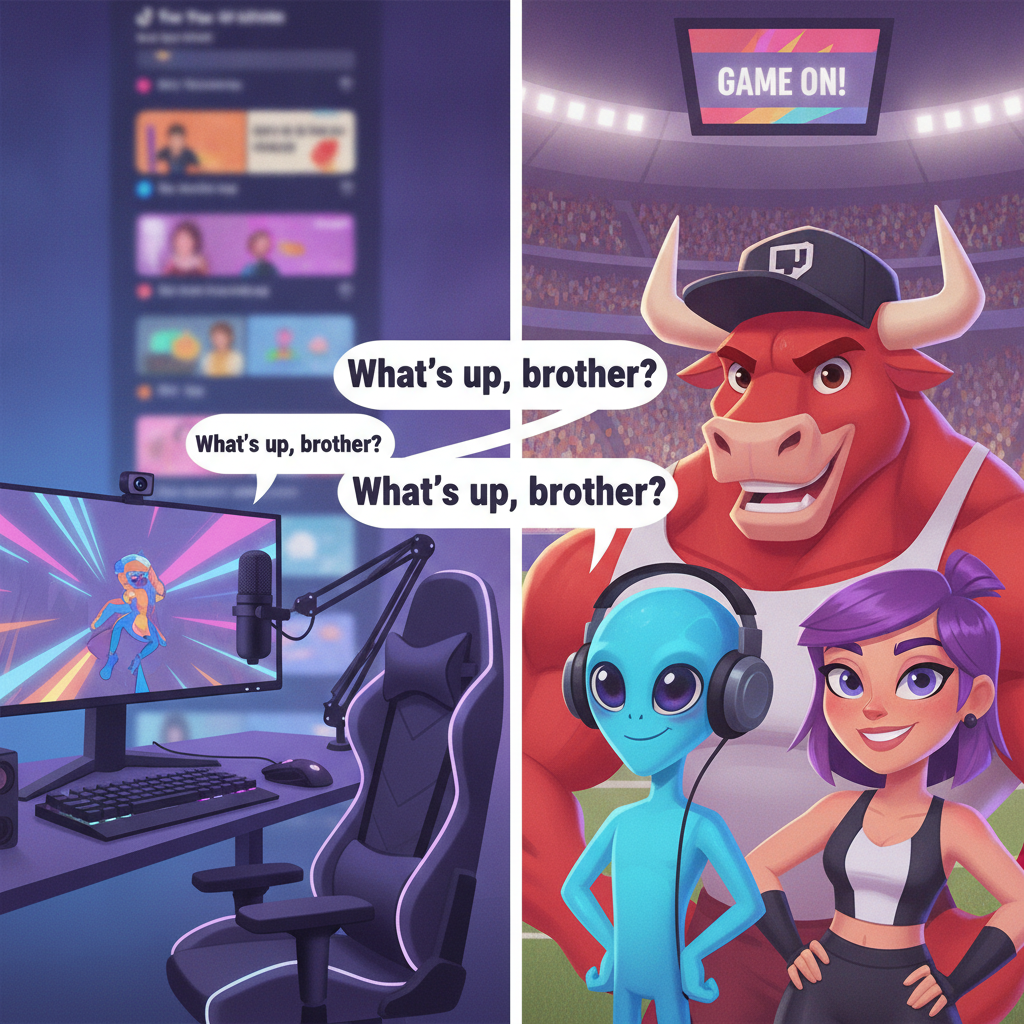
Kylie Cox, known online as Sketch or TheSketchReal), operates a content model that inverts conventional creator wisdom. Where most streamers chase production value or editing tricks, Sketch built a viral empire on a single repeatable element: the catchphrase "What's up, brother?" This phrase went viral and became a TikTok trend in 2024), crossing from Twitch streams into sports culture and short-form platforms without requiring complex post-production. The operational insight here is format compression. Sketch identified the smallest viable unit of shareable content (a greeting, a vocal inflection, a persona beat) and made it the load-bearing structure of every piece of output. Businesses chasing virality often over-engineer. Sketch's model suggests the opposite: find the one thing audiences will repeat, then build everything around its consistent delivery.
The Animated Character Layer: Lowering Production Friction
Sketch's content includes animated character work, as seen in this YouTube video featuring "Jo Dawg," a cartoon dog character discussing sketchbooks. The video opens with Jo Dawg presenting a new sketchbook, immediately establishing a friendly rivalry narrative. The cut rhythm is fast, with shots changing every 1 to 2 seconds during dialogue and compressing to 0.5 to 1 second during action montages. Text overlays label objects ("JO DAWG'S BK VOLUME 67"), and exaggerated sound effects accompany every action: sketchbook flips, pencil strokes, punches, explosions. The structure follows hook (new sketchbooks, friendly competition), setup (sketching hunt), rising action (comedic struggles with drawing subjects), climax (critique from a third character leading to a power-up moment), and resolution (renewed confidence). Energy peaks occur during rapid-fire arguments, chaotic sketching sequences with glowing character outlines, and the post-critique power-up.
The animated format solves a production problem: it decouples content velocity from live-action logistics. No location scouting, no lighting setups, no on-camera talent scheduling. Once character rigs and sound libraries are built, the marginal cost of each new video drops. For businesses evaluating content models, this is the build-once, deploy-repeatedly principle. Sketch's animated work functions as a content factory where the upfront investment in character design and sound assets pays dividends across dozens of uploads.
The Sketch Comedy Transplant: Traditional Format, Platform-Native Pacing
Sketch also produces traditional sketch comedy, as demonstrated in this YouTube short featuring two men in a shop. The video opens with a loud thud sound effect and a man in a black suit entering, immediately followed by a persistent text overlay: "EXCELLENT! NOT SEEN THIS ONE BEFORE..." The cut rhythm is slower, with shots lasting 2 to 5 seconds, allowing dialogue and reactions to land. Close-ups emphasize facial expressions during comedic exchanges. The structure is classic: hook (entry and bell ring with text overlay), setup (escalating verbal sparring and attempted extortion), payoff (visual gags involving broken glasses and an abrupt exit). Sound design carries the comedy: exaggerated item-drop sounds, bell rings, and the timing of dialogue pauses.
This format borrows from television sketch traditions (Key & Peele, Lonely Island are cited as viral sketch predecessors), but the execution adapts to platform constraints. The persistent text overlay functions as a shareability hook, giving viewers a reason to tag friends ("have you seen this one?"). The slower cut rhythm, counterintuitive for short-form platforms, works because the comedic beats are tightly scripted. Each shot earns its duration. For producers, the lesson is format transplantation: proven structures from one medium (TV sketch comedy) can succeed on new platforms if the pacing and shareability hooks are recalibrated.
The Cross-Platform Amplification Loop: Twitch to TikTok to Sports Culture
Sketch's catchphrase "What's up, brother?" became a trend on TikTok in 2024 and crossed into the sports world, demonstrating how a repeatable format can jump distribution channels without paid promotion. The phrase originated on Twitch streams, where live interaction and repetition created familiarity. TikTok users then remixed the audio, creating derivative content that amplified reach. Sports personalities adopted the phrase, bringing it into arenas and broadcasts. This is organic cross-platform syndication: the original content becomes raw material for remixes, and each remix drives traffic back to the source.
The operational advantage is distribution leverage. Sketch does not need to manually post on every platform or hire a multi-channel team. The format's repeatability makes it remix-friendly, and remixes function as unpaid marketing. Businesses can replicate this by designing content with extractable elements: a signature phrase, a visual motif, a sound bite that works in isolation. The goal is to make your content easy to steal, because theft becomes distribution.
The Faceless Content Parallel: Personality Without Presence
While Sketch is not fully faceless, the animated character work and catchphrase-driven model share DNA with faceless content operations. Faceless channels use voiceover, motion graphics, and stock footage to scale production. Sketch's animated videos function similarly: the personality is vocal and character-driven, not dependent on the creator's physical appearance. This allows for higher output velocity. A single voice actor can record dozens of scripts in a session, and animators can work in parallel on multiple episodes.
For businesses, this model reduces bottlenecks. Traditional video production stalls when talent is unavailable or locations are inaccessible. Sketch's approach treats the creator's voice and character IP as the core assets, with everything else as replaceable infrastructure. If you are building a content operation, ask: what is the irreplaceable element? For Sketch, it is the vocal delivery and character persona. Everything else (animation, sound design, editing) can be outsourced or systematized.
What EditorDuel Readers Can Take From This
First, format repeatability beats production complexity. Sketch's catchphrase and character-driven videos succeed because they are instantly recognizable and easy to remix. Businesses should identify their smallest viable content unit (a phrase, a visual style, a narrative beat) and make it the foundation of every upload. Second, animation and character work lower production friction. Once character rigs and sound libraries are built, content velocity increases without proportional cost increases. Third, cross-platform amplification is a design problem, not a distribution problem. Make your content easy to extract and remix, and audiences will distribute it for you. Fourth, slower cut rhythms can work if the underlying script is tight. Sketch's traditional sketch comedy videos use 2 to 5 second shots, but every shot earns its duration with strong dialogue or visual gags. Finally, vocal delivery and persona are the core IP. Everything else (editing, animation, platform strategy) is replaceable infrastructure.
Want to build content like this for your business? Post a competition on EditorDuel and get matched with editors who can deliver.