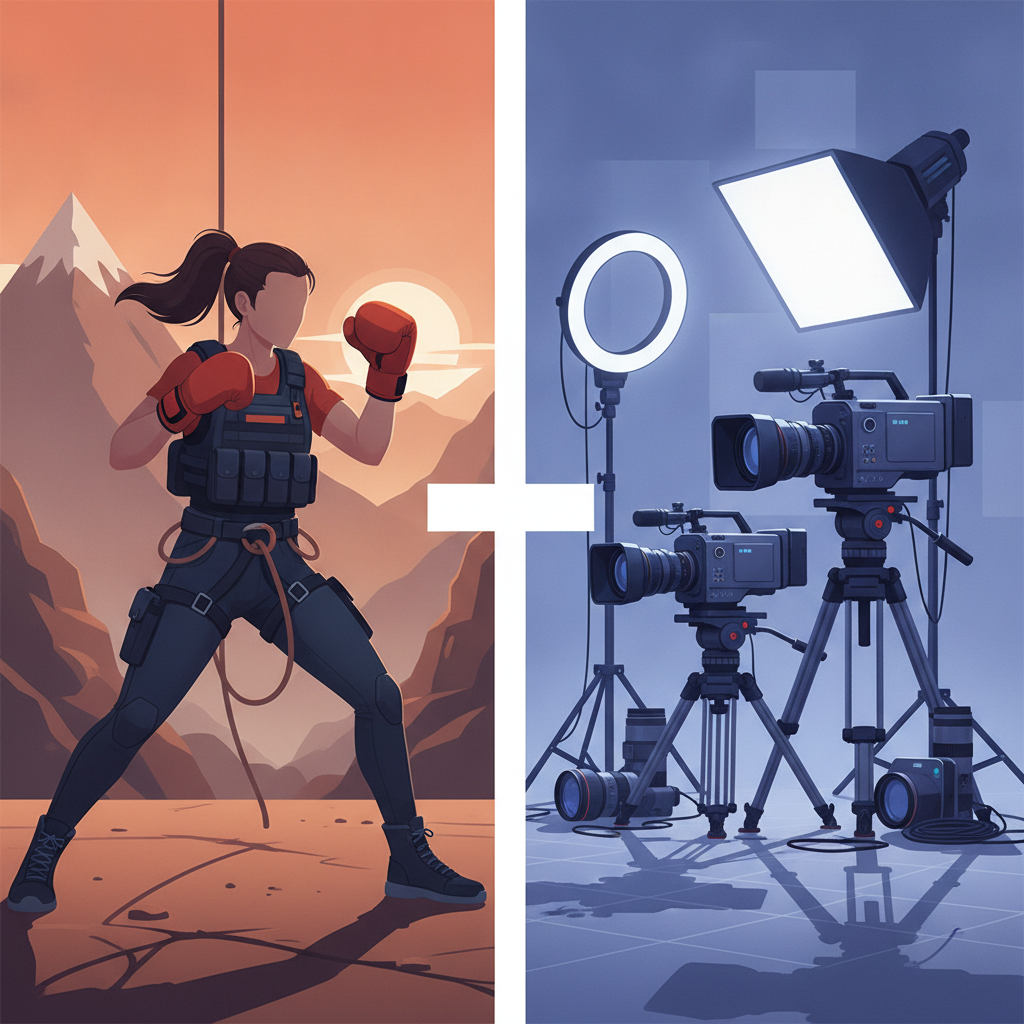
Michelle Khare runs one of YouTube's most distinctive content operations. Her series "Challenge Accepted" follows a simple premise: she embeds herself in extreme professional training programs (Secret Service motorcades, Navy SEAL exercises, professional boxing camps, stunt driving schools) and documents the experience. The format has generated an Emmy shortlist nomination and built a substantial subscriber base since she left BuzzFeed.
What makes the operation worth studying is not the stunts themselves but the structural discipline underneath. Khare has turned personal anxiety into a repeatable production system that delivers high retention episodes at a predictable cadence. For businesses trying to build educational or documentary content that holds attention, the mechanics are instructive.
The Embedded Training Format
The core format is consistent across episodes. Khare identifies a high skill profession or extreme training environment, gains access, undergoes the actual training regimen (often condensed from weeks into days), and documents both the physical challenge and the expertise of the trainers. Recent episodes have included rappelling 55 feet backwards, motorcade protection drills, and plane platform stunts.
The format works because it combines three retention drivers in one package. First, the training environments are visually dynamic (gyms, outdoor ranges, stunt rigs). Second, the learning curve is visible in real time as Khare progresses from novice to competent. Third, the trainers themselves (Secret Service veterans, professional stunt coordinators, Olympic athletes) provide authority and stakes.
This is not vlog footage. Each episode requires location scouting, expert coordination, liability clearance, and multi camera setups to capture both the action and Khare's real time reactions. The production standard is closer to documentary than influencer content.
Content Velocity and Team Structure
Khare's upload frequency sits at roughly monthly. That cadence reflects the lead time required for each episode. Securing access to elite training programs, coordinating schedules with professionals, and executing multi day shoots means each video represents weeks of pre production.
After graduating from Dartmouth in 2014, Khare joined BuzzFeed as a content producer, where she developed the initial version of the format. The BuzzFeed infrastructure (production teams, legal clearance, equipment access) allowed her to test the concept at scale. When she went independent, she had to rebuild that infrastructure as a small operation.
The team structure is lean but specialized. Khare handles on camera performance and much of the pre production coordination. A small crew manages cameras, sound, and post production. The format does not require a clipper economy or daily upload velocity. Instead, it optimizes for episode quality and access, trading frequency for production value.
Monetization and Expansion
The primary revenue model is YouTube AdSense, supplemented by brand integrations that align with the training theme (athletic wear, fitness products, adventure gear). The format's educational framing and family friendly tone make it advertiser safe, which matters for long form content monetization.
Khare has also expanded into adjacent formats. In 2020, she produced YouTube Rewind 2020: The Musical after YouTube discontinued its official Rewind series. The project demonstrated her ability to coordinate large creator collaborations and musical production, skills that extend beyond the Challenge Accepted format.
More recently, Khare has taken an advisory role at Bedford, a new school training the next generation of influencers. The move signals a shift from pure content creation into creator education and infrastructure. For a business, this is the logical next step: monetizing the operational knowledge accumulated over multiple years of production.
She is also developing Karma, a competition show for HBO Max. The show applies the Challenge Accepted format to a different demographic and a traditional media platform. It represents a test case for whether her format can scale beyond YouTube's algorithm and into linear distribution.
Retention Mechanics and Narrative Structure
The episodes follow a three act structure. Act one introduces the challenge and the trainers, establishing both the difficulty and the expertise required. Act two documents the training process, often showing Khare failing initial attempts before improving. Act three delivers the final test or demonstration, where she either succeeds or falls short (both outcomes appear in her catalog).
The narrative honesty is critical. Khare does not fake competence. When she struggles, the footage shows it. When trainers correct her form or push her harder, the camera captures the exchange. This transparency builds trust with the audience and differentiates the content from highlight reel influencer posts.
The pacing within episodes varies by challenge type. Physical challenges (boxing, rappelling, stunt work) cut faster during action sequences. Skill based challenges (motorcade tactics, precision driving) slow down to let experts explain technique. The editing adapts to the material rather than imposing a uniform rhythm.
What EditorDuel Readers Can Take From This
First, repeatable formats beat one off viral attempts. Khare's format is simple enough to execute consistently but flexible enough to apply across dozens of training environments. Businesses building educational or documentary content should identify a structural template that can scale across topics.
Second, access is a competitive advantage. Khare's ability to secure training time with elite professionals (Secret Service, Navy SEALs, professional athletes) creates content moats that competitors cannot easily replicate. For B2B content, this translates to expert interviews, facility tours, or behind the scenes access that audiences cannot get elsewhere.
Third, production value signals authority. The multi camera setups, location shoots, and post production polish in Challenge Accepted episodes communicate seriousness. Audiences assess content quality within the first ten seconds. If your subject matter is complex or high stakes, your production standard must match.
Fourth, honesty beats highlight reels. Showing failure, struggle, and incremental progress builds more audience trust than polished perfection. For businesses creating case studies, tutorials, or transformation content, documenting the messy middle matters more than the final result.
Fifth, lean teams can deliver high production value if they optimize for episode quality over upload frequency. Khare's roughly monthly cadence would fail in a daily vlog economy, but it works for long form documentary content where each episode stands alone. Match your velocity to your format, not to an arbitrary benchmark.
Want to build content like this for your business? Post a competition on EditorDuel and get matched with editors who can deliver.