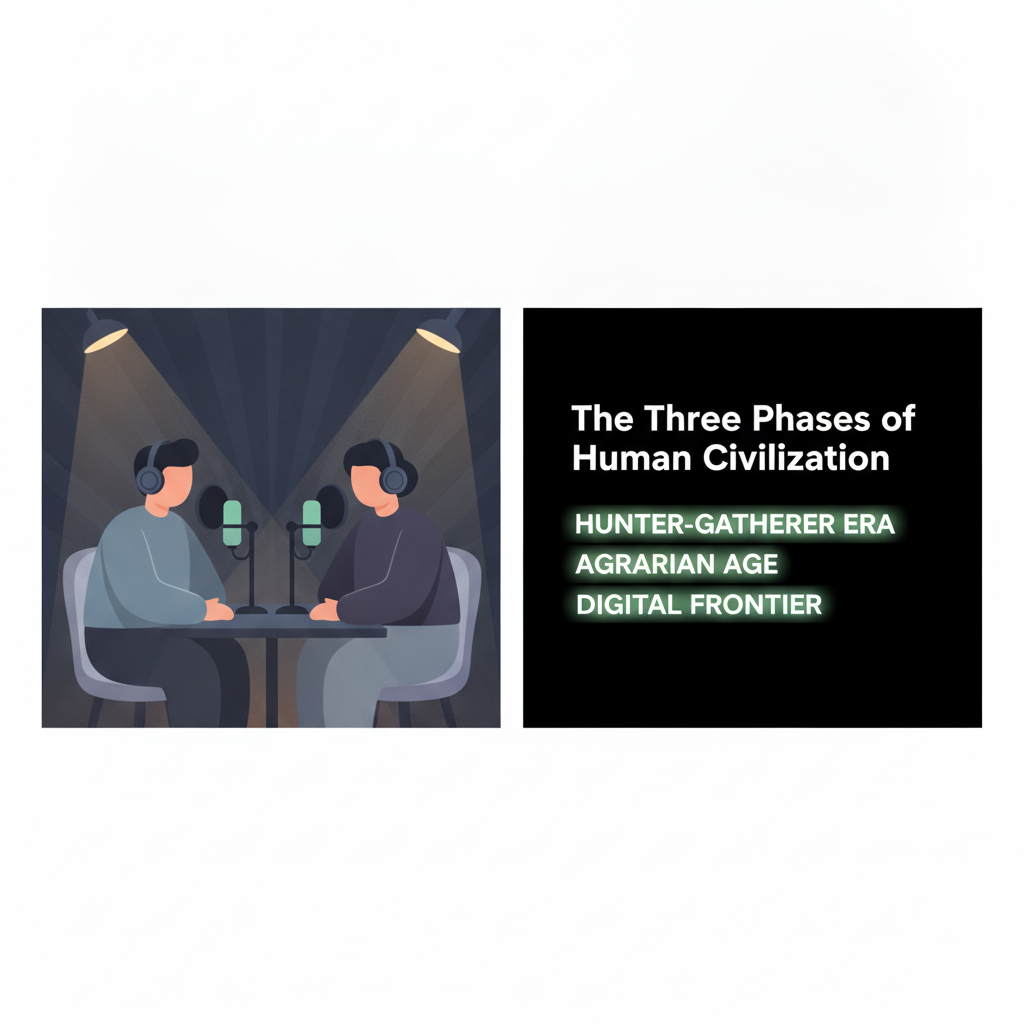
Lex Fridman runs one of the most successful long form podcasts on YouTube, attracting 3.6 million subscribers with episodes covering dense academic topics. His format defies conventional retention approaches: slow cuts, minimal B-roll, and talking heads discussing complex subjects. Yet the operation works. Understanding how requires looking past the surface simplicity to the structural mechanics.
The Counterintuitive Cut Rhythm
Most retention-focused creators chase fast cuts. Fridman does the opposite. In his recent episode with historian Anthony Kaldellis, the cut rhythm is predominantly slow, with shots often holding for several seconds. The pattern is deliberate: the camera switches only when the other person begins speaking, creating a conversational flow.
In another recent upload with Gary Gallagher on the Civil War, the same rhythm holds during conversation segments. Shots hold for several seconds during explanations. This slow baseline creates contrast for the moments when pacing accelerates, which happen strategically during visual aids.
The retention mechanic here is rhythm variation. Long holds establish a baseline, then bursts of faster cuts during maps or text overlays create energy shifts without breaking the conversational flow.
Text Overlays as Retention Anchors
Fridman's signature editing technique is the strategic deployment of text overlays on black backgrounds. In the Kaldellis episode, key phrases appear as full-screen text: "The Three Phases of Human Civilization" followed by detailed breakdowns with specific parts highlighted in green, such as "95% of that span" and "less than 0.1% of human history."
In the Gallagher episode, historical facts are presented as text overlays with highlighted words in yellow or green. Maps with colored regions illustrating Union and Confederate territories appear to complement geographical discussions.
These overlays serve multiple functions. They break up talking-head monotony without interrupting the intellectual flow. They reinforce the verbal content with visual presentation. They create natural chapter breaks within long episodes, structuring the content into distinct segments rather than an undifferentiated block.
The technique adds visual scaffolding to support the content's density.
The Opening Hook: Aspiration Over Urgency
Most viral content opens with immediate conflict or curiosity gaps. Fridman opens with a stunning visual of Earth from space with the sun rising over the horizon, followed by "Lex Fridman Podcast" text and animated "LIKED" and "SUBSCRIBED" button prompts. The Gallagher episode uses the same Earth visual with a gentle atmospheric hum and subtle click sound effects for the button presses.
This is not a retention hook in the traditional sense. It does not promise immediate payoff or tease a dramatic moment. Instead, it establishes tone: grand, philosophical, elevated. The space visual sets the stage for high-level conversation.
The first spoken words in the Kaldellis episode are "Just because you've seen this grand history," immediately positioning the viewer inside an ongoing intellectual exploration. There is no cold open teasing a controversial soundbite. The opening is aspirational rather than urgent.
Strategic B-roll and Sound Design
In the Civil War episode, historical paintings and images such as Fort Sumter under fire, Ulysses S. Grant, and William T. Sherman are used as B-roll to complement the discussion. The B-roll appears precisely when the conversation references those figures or events.
Sound design is minimal but purposeful. Subtle sound effects accompany text overlays and B-roll: a whoosh for text, a faint battle sound for the Fort Sumter image. These audio cues signal a shift in information type.
The editing avoids over-stimulation. There is no background music during conversations, no constant motion graphics, no rapid zooms or pans. The sensory approach is restrained, with visual and audio accents used sparingly.
The Structural Formula
Fridman's episodes follow a question and answer structure. The host poses a thought-provoking question, the guest responds with detailed explanations, and visual aids are inserted to illustrate specific points. In the Kaldellis episode, Lex asks about human history's trajectory, the guest outlines three phases of civilization, then Lex builds on this by suggesting a potential fourth phase involving technology and consciousness.
Energy peaks occur through the intellectual exchange itself. The format establishes expectations for depth and detailed exploration of complex topics.
What EditorDuel Readers Can Take From This
Fridman's approach offers three actionable lessons for businesses producing long form content. First, slow cuts are not inherently problematic when the content itself sustains interest. The pacing serves the material rather than compensating for it.
Second, text overlays and visual aids should reinforce comprehension. Use them to scaffold complex information. The overlays work in Fridman's format because they clarify the verbal content.
Third, aspiration can function as a retention strategy. The format signals depth and expertise from the opening, establishing expectations that align with the content delivery. The businesses that succeed with long form content are those that match format to substance and provide structural support for complex material.
Want to build content like this for your business? Post a competition on EditorDuel and get matched with editors who can deliver.