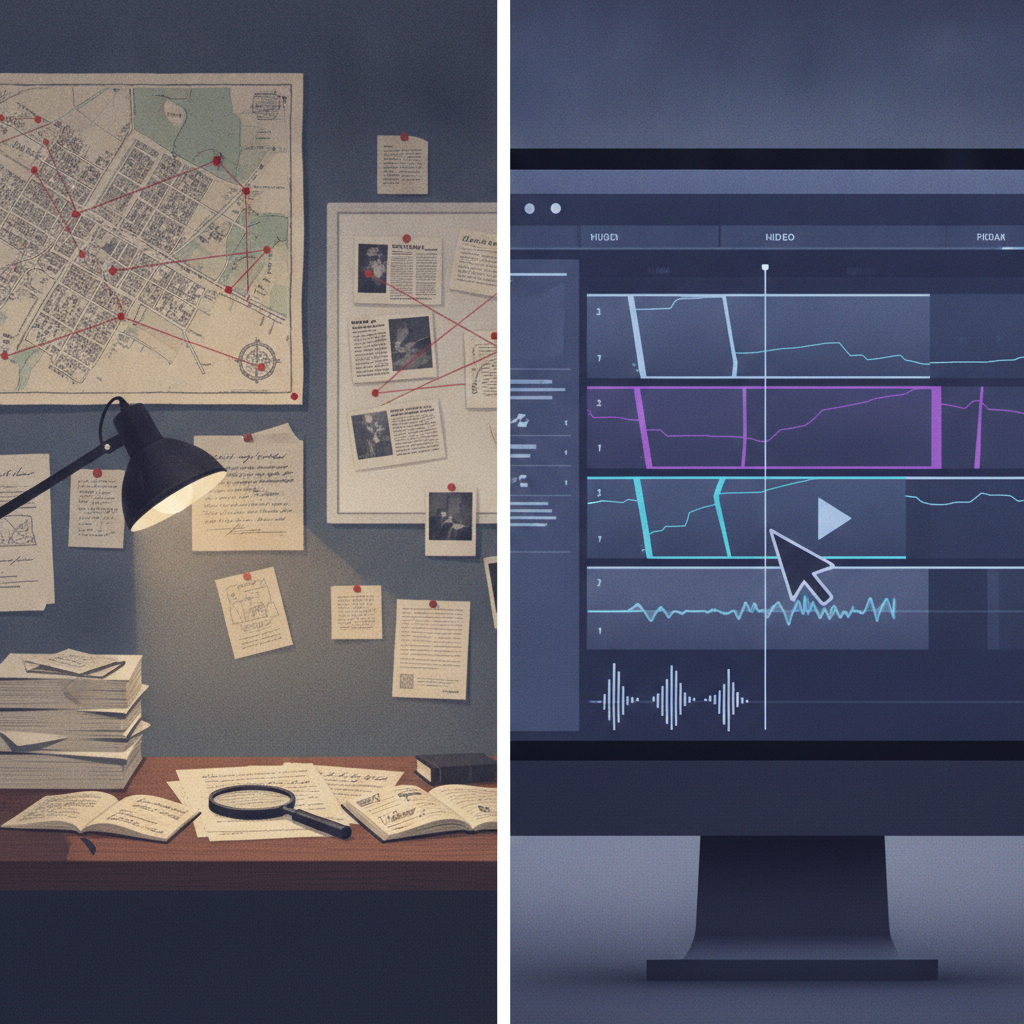
Johnny Harris has built a YouTube operation that routinely turns subjects like inflation, shell companies, and civil liberties into videos with tens of millions of views. The mechanics behind that success are not accidental. A recent video analysis of Harris's work reveals a consistent structural formula: every video is engineered as a detective story, with the viewer cast as investigator rather than passive audience.
This is not about personality or production budget. It is about a repeatable format that solves the core retention problem facing educational content: how do you make someone care about a topic they did not wake up wanting to learn about?
The Three Act Structure: Murder, Clues, Investigation
Harris's videos follow what the analysis calls a "murder mystery" structure. The opening seconds establish a hook (the "murder"), the body presents clues and suspects ("showing and asking"), and the resolution delivers the investigation's payoff. In the opening 5 seconds of a typical Harris video, viewers see a rapid montage: Harris in multiple locations, speaking phrases like "inflation explained," "civil liberties," "anonymous shell companies." Shots change well under 1 second each. This is not preamble. It is the promise of a mystery.
The structure works because it reframes educational content as a puzzle. Traditional explainer videos tell you what happened. Harris's format asks you to figure out what happened alongside him. The difference in retention is measurable. By presenting information as clues rather than conclusions, the format converts passive watching into active problem solving.
The "murder" is the hook: a provocative question or contradiction that does not resolve immediately. The "clues and suspects" phase involves showing footage, maps, documents, and asking questions aloud rather than narrating answers. The "investigation" phase takes the viewer through the research process, making them complicit in the conclusion.
Cut Rhythm and Visual Pacing: Sub-Second Shots as Standard
The video analysis documents cut rhythm as a core retention lever. Throughout Harris's videos, shots change well under 1 second on average, especially during montages or when illustrating a point with multiple examples. Jump cuts condense speech. Match cuts transition between similar actions across different locations. Text overlays highlight key phrases ("show don't tell," "showing and asking," "question," "report").
This is not hyperactive editing for its own sake. The pacing mirrors the cognitive load of the content. When Harris introduces a new concept, the cuts slow slightly. When he is building momentum toward a revelation, the cuts accelerate. The rhythm is calibrated to the narrative arc, not to a fixed tempo.
B-roll is deployed in quick succession: maps, landscapes, news clips, movie scenes. Motion graphics are simple but functional (formulas appearing on screen, circular flows from "Question" to "Report"). Sound design punctuates actions (doors closing, taps on rocks). Color grading is cinematic, slightly desaturated, contributing to a polished aesthetic that signals seriousness without feeling institutional.
Split screens compare and contrast ("boring" news anchors versus Harris's approach). The visual vocabulary is borrowed from documentary filmmaking, but the pacing is borrowed from social media. The result is content that feels substantive but moves like a feed scroll.
Showing and Asking vs. Telling: The Retention Wedge
The analysis identifies the core structural difference between Harris's format and traditional news reporting. News anchors tell you what happened. Harris shows you footage and asks questions. The shift from declarative to interrogative changes the viewer's relationship to the information.
When Harris presents a map, he does not narrate the geography. He points, asks "why here?", and lets the visual sit for a beat before answering. When he shows a document, he does not summarize it. He zooms in on a specific line and asks what it means. The viewer is forced to engage with the primary source before receiving interpretation.
This "showing and asking" pattern creates what the analysis calls a "detective story" dynamic. The viewer is not being lectured. They are being invited to solve a case. The information is the same, but the framing transforms retention. People stay to see if their hypothesis was correct. They stay because they have invested cognitive effort in forming a hypothesis.
The format also allows Harris to present complex or controversial information without triggering defensive reactions. When you ask a question and show evidence, the viewer arrives at the conclusion themselves. When you state a conclusion, the viewer evaluates whether to accept or reject it. The former feels like discovery. The latter feels like persuasion.
The Newpress Model: Scaling the Formula Beyond One Creator
Harris has operationalized this format into a media company. According to Wikipedia), Newpress features multiple channels: Search/Party by Sam Ellis (sports and geopolitics), Tunnel Vision by Christophe Haubursin (niche internet topics), and The Bigger Picture by Max Fisher (technology and world news). All four creators previously worked at Vox. Newpress is funded through video ads and sponsorships.
In a recent TikTok, Harris described the model as "a place where creators can build their channel, but they are buffered and supported by a media institution." The goal is creator-led journalism that is not driven by "outrage, speed, and volume." The detective story formula is the structural answer to that goal. It allows educational content to compete for attention without relying on controversy or clickbait.
The Newpress model suggests Harris views the format as exportable. The structure (hook, clues, investigation) and pacing (sub-second cuts, showing and asking) can be taught and replicated. The format is not dependent on Harris's on-camera presence. It is a set of editorial choices that any team can execute.
What EditorDuel Readers Can Take From This
The Harris formula is directly applicable to business content. If you are producing educational videos, product explainers, or thought leadership, the detective story structure solves the same retention problem Harris faces: how do you make someone care about information they did not seek out?
First, reframe your content as a mystery. Do not open with your conclusion. Open with a contradiction, a surprising statistic, or a question your audience has not thought to ask. The hook is not "here is what we do." The hook is "here is something that does not make sense."
Second, show primary sources and ask questions before providing answers. If you are explaining a product feature, show the interface and ask "what is this solving?" before narrating the solution. If you are presenting data, show the chart and ask "what is the outlier?" before interpreting it. The viewer should feel like they are solving the problem with you, not being told the answer.
Third, calibrate your cut rhythm to your narrative arc. Accelerate cuts during build-up, slow them during payoff. Use B-roll in quick succession to illustrate concepts, not to fill time. Text overlays should highlight key phrases, not summarize paragraphs. Sound design should punctuate moments, not provide constant background noise.
Fourth, invest in the opening 5 seconds. Harris's montages change shots well under 1 second each, establishing energy and scope before a single sentence is complete. Your opening should signal the scale and pace of what follows. If your first 5 seconds are a slow fade-in to a talking head, you have already lost the retention battle.
The Harris formula is not a personality play. It is a structural playbook. Any team with competent editors and a commitment to showing rather than telling can execute it.
Want to build content like this for your business? Post a competition on EditorDuel and get matched with editors who can deliver retention-focused video content using proven structural techniques.