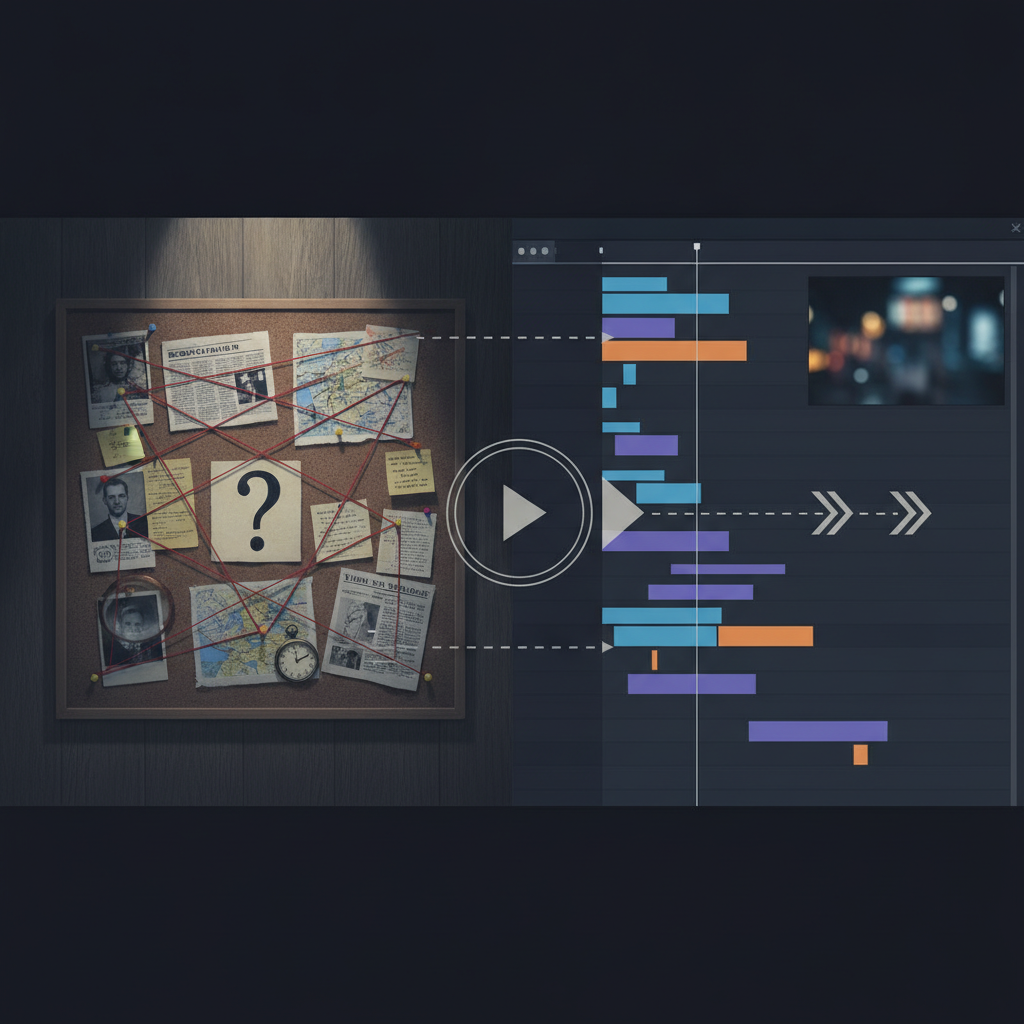
Johnny Harris makes videos about tax policy, inflation, and anonymous shell companies. These are topics that traditionally send viewers fleeing to more entertaining corners of the internet. Yet his channel commands a substantial subscriber base and significant viewership. The mechanics behind this success are not mysterious. They are replicable, deliberate, and built on a structural formula Harris himself has articulated: turn every explainer into a detective story.
The Murder Mystery Structure
Harris frames his approach with a simple equation visible in this video analysis: J = [M + (C × S)] × I → A. Translated: Journalism equals Murder plus Clues and Suspects, multiplied by Investigation, leading to Answer. This is not metaphor. It is operational doctrine.
Every Harris video opens with a "murder" (the hook question that creates immediate tension). In the analyzed video, the first 5 seconds deliver rapid fire phrases like "inflation explained," "civil liberties," "anonymous shell companies," before a voiceover asks: "How does Johnny Harris make videos about some of the most boring topics on Earth and get tens of millions of people to watch?" That question is the murder. The viewer now has a mystery to solve.
The body of the video introduces clues and suspects (the elements that might explain the phenomenon), then takes the viewer on an investigation (examining each element in turn), building toward the answer. This structure mirrors detective procedurals, which is intentional. The video explicitly contrasts this approach with traditional news, which "tells" rather than "shows and asks." Harris positions the viewer as co-investigator, not passive recipient.
Cut Rhythm and Retention Engineering
The editing mechanics support the structural formula. The opening montage features cuts under 1 second for the first 5 seconds, establishing immediate velocity. Throughout the video, the cut rhythm remains medium to fast, typically 1 to 3 seconds per shot. Jump cuts eliminate dead air during direct address. Match cuts create visual continuity across location changes (Harris in different settings but similar poses). Speed ramps condense time or add dramatic punctuation.
Text overlays appear constantly, highlighting key phrases ("boring," "chaos," "murder," "retention") and formulas. Motion graphics illustrate concepts as they are spoken. Split screens compare approaches ("showing" versus "telling," "boring" news versus "chaos" news). The B-roll is relentless. Harris is shown in various locations, interacting with objects, gesturing, moving. The camera rarely stays static.
This is not stylistic flourish. It is retention architecture. The fast cut rhythm prevents the viewer from disengaging. The text overlays ensure comprehension even with sound off (critical for social platform discovery). The constant visual variety (location changes, B-roll inserts, motion graphics) creates the sensation of forward momentum even when explaining static concepts like tax structures.
The Newpress Model and Creator Journalism Infrastructure
Harris operates through Newpress, a production company he and his wife Iz launched publicly in 2026. According to CreatorDB, Newpress helps creator journalists launch, expand, and monetize their own shows, handling hiring, sales, and sponsorship deals while creators retain editorial control. The company features shows by former Vox colleagues: Search/Party by Sam Ellis (sports and geopolitics), Tunnel Vision by Christophe Haubursin (niche internet topics), and The Bigger Picture by Max Fisher (technology and world news).
Wikipedia notes) that Newpress is primarily funded through video ads and sponsorships. This model represents a middle path between independent creator chaos and traditional media bureaucracy. Harris has described it as "the place where creators can build their channel, but they are buffered and supported by a media institution" focused on substance rather than "outrage, speed, and volume."
The infrastructure matters for content velocity. Harris maintains a consistent upload schedule across a main channel and Newpress properties. The production support (hiring, sales, sponsorship management) allows the creator journalists to focus on research and storytelling rather than operational logistics. This is the opposite of the solo creator grind. It is industrialized creator journalism.
The Vox Visual Vocabulary
Harris developed his visual style during his tenure at Vox, where he became a breakout star. A Final Cut Pro tutorial site describes the aesthetic: archive photos that judder, cut out figures with white stroke, everything one notch removed from smooth. The look is deliberately slightly rough, slightly urgent. It signals "reporting in progress" rather than "polished broadcast."
Color grading is consistent, often slightly desaturated or cinematic. Sound design pairs upbeat, driving music with clear voiceovers and sound effects that emphasize actions or transitions. The overall effect is high energy documentary, not lecture. The viewer feels like they are following Harris into the field, not sitting in a classroom.
What EditorDuel Readers Can Take From This
The Harris model offers three concrete lessons for businesses producing educational or explainer content:
First, structure determines retention more than topic. Boring subjects become engaging when framed as mysteries to solve. Every video needs a "murder" (the hook question), "clues and suspects" (the elements to investigate), and an "investigation" (the journey to the answer). This is not limited to journalism. Product explainers, case studies, and training content can all adopt detective story structure.
Second, cut rhythm and visual variety are not optional. If your explainer videos feature static talking heads with cuts every 10 to 15 seconds, you are losing viewers in the first 30 seconds. Harris demonstrates that 1 to 3 second shot durations, constant B-roll, text overlays, and motion graphics are baseline requirements for retention on modern platforms. This requires more editorial labor and more footage, but the retention data justifies the investment.
Third, infrastructure enables velocity. Harris did not scale by working harder as a solo creator. He built Newpress to handle hiring, sales, and sponsorships so creators could focus on storytelling. Businesses trying to build content operations need similar infrastructure (project managers, sponsorship coordinators, editing pools) or they will bottleneck at the creator's personal capacity.
Want to build content like this for your business? Post a competition on EditorDuel and get matched with editors who can deliver the cut rhythm, motion graphics, and retention engineering that make explainer content work in 2025.