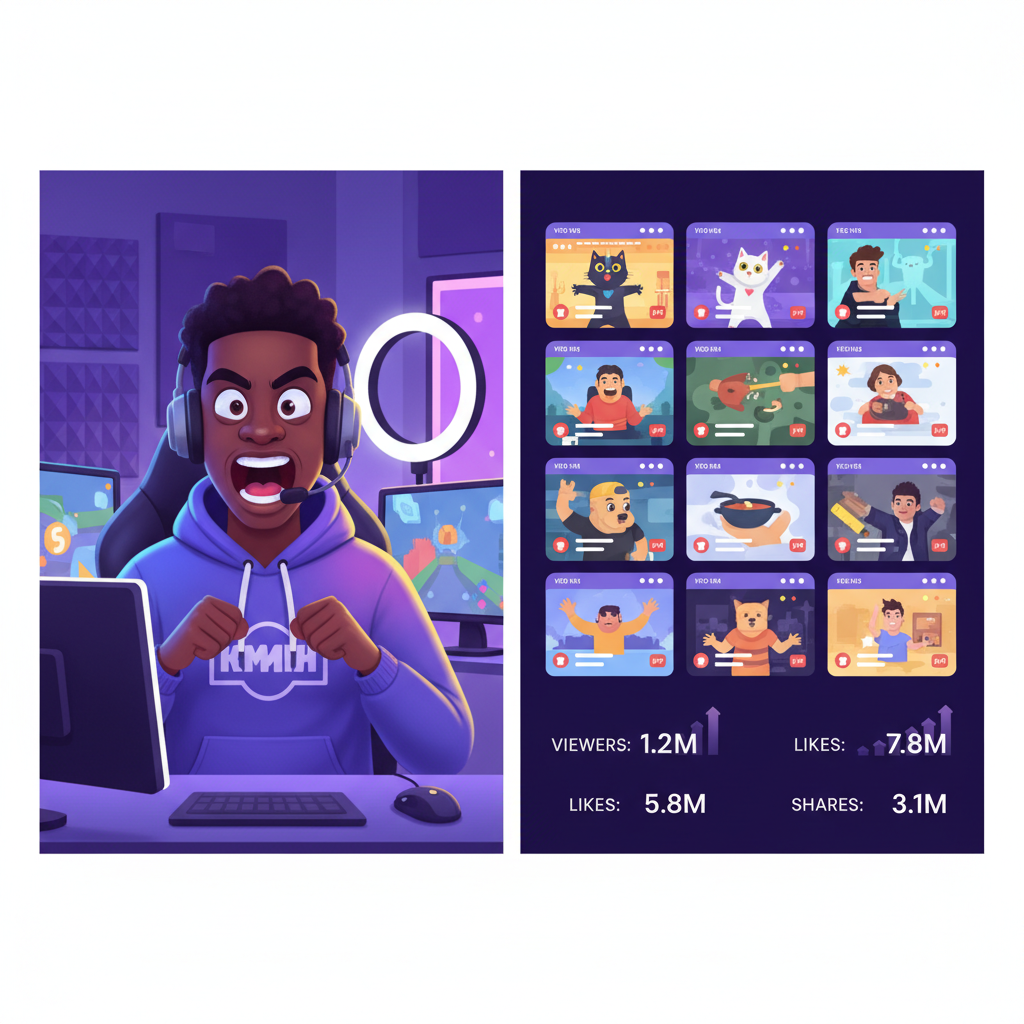
IShowSpeed (Darren Watkins Jr.) runs one of the most efficient content operations on YouTube: 33 million subscribers built on streams that rarely run long but generate millions of views as replays. Where most streamers chase watch hours, Speed optimizes for concurrent viewership and post-stream replay value. The result is a format that behaves like live television, a viral clip factory that turns every broadcast into standalone moments.
Brief Broadcasts: Concurrent Over Cumulative
Modern streaming analytics reveal that Speed's brief broadcasts consistently outperform marathon sessions in total reach. His strategy maximizes concurrent viewers rather than cumulative watch time. When a stream ends, the recording instantly becomes VOD, functioning like a television rerun. Fans who missed the live event watch later, driving views long after the broadcast concludes. His recent Caribbean tour streams each crossed 3 million views, with the replay value often exceeding live attendance.
The format works because Speed compresses energy into a narrow time window. Sustained intensity generates more clipable moments per minute than diluted marathon sessions. Editors and fan accounts can extract multiple standalone clips from a single broadcast, each functioning as its own distribution unit across TikTok, Twitter, and YouTube Shorts.
Structural Chaos: Unscripted Hooks Throughout
Speed's videos operate on perpetual surprise. In this Virgin Islands broadcast, the opening establishes location and energy level, then the format becomes a sequence of unpredictable reactions. Segments shift rapidly in tone, whether that's a sudden sprint, an encounter with fans, or an impulsive decision to change locations.
The LA Knight WWE crossover stream demonstrates the format's adaptability: it opens from black at 0:00, cutting to a wide shot that immediately establishes the collision of two audiences (gaming and wrestling). The video sustains attention through constant escalation, each beat raising stakes or introducing a new variable. There's no traditional three act structure. Instead, the format is modular: frequent beats deliver potential hooks that could standalone as clips.
This structure is why Speed's content thrives in the clip economy. A single jail-themed marathon stream with Kai Cenat generated a 50.4M view clip from one scene. The parent stream was several hours long, but the format's density meant editors could extract high retention moments. Each clip functions as an ad for the full VOD, driving viewers back to the source.
Expressive Reaction Economy: The Face as Retention Hook
Speed's facial expressions and vocal reactions have become standalone content formats. A 2021 Fortnite stream where a young player pleaded with him went massively viral across TikTok and YouTube, not because of gameplay but because of Speed's emotional response. The moment was unintentionally funny, combining genuine emotion with exaggerated delivery.
His shocked reaction template is now a green screen asset used by thousands of creators. The clip is described as high tension, perfect for jump scares or revealing shocking news, and is specifically designed to drive high retention. This is the creator economy's ultimate efficiency: one moment from one stream becomes infrastructure for thousands of derivative videos, each citing Speed and driving traffic back to his channel.
The expressive vocabulary is consistent across videos. In this car reveal short, the hook combines a statement with a visual reveal. The format is under 60 seconds, but the reaction density is identical to his long form work: rapid cuts, escalating energy, no dead air. Speed has essentially productized his own face and voice as retention devices that work at any length.
The Clip-to-Sponsorship Pipeline
Speed's viral moments convert directly into brand deals structured around his format. Expedia partnered with him to reimagine Gen Z travel, leveraging his international tour content. Dick's Sporting Goods sponsored a show tracking him training with professional athletes like Tom Brady and Kevin Durant. These aren't traditional sponsorships where a creator reads a script. They're content formats built around Speed's existing structure: short, high energy, unpredictable.
He reportedly earns significant revenue per sponsored post, but the larger income comes from integrations that don't disrupt the format. His Ronaldo-focused content pulled higher engagement and stronger global viewership, opening doors to international tours and live appearances that now comprise a significant income stream. The content itself is the product: brands pay to associate with the format's energy and reach, not to interrupt it.
What EditorDuel Readers Can Take From This
Speed's operation demonstrates three principles businesses can apply:
Optimize for replay value, not just live metrics. If your content dies when the live event ends, you're leaving distribution on the table. Structure broadcasts so they work as standalone VOD. That means clear in-points, high density pacing, and moments that function out of context.
Build for the clip economy from the start. Frequent hooks throughout your content allow editors to extract multiple clips from a single piece of long form work. Each clip is a distribution node that drives traffic back to the source.
Expressive consistency is a retention asset. Speed's face and voice are recognizable in a brief clip. That's not accident, it's format discipline. If your on-camera talent or brand voice is inconsistent, clips won't compound. Develop a vocabulary (visual, tonal, structural) that works at any length.
Want to build content like this for your business? Post a competition on EditorDuel and get matched with editors who can deliver high retention cuts, extract viral clips from long form, and structure content for replay value.