Derek Muller's Veritasium has accumulated 4.67 billion views across 541 videos and sits at 21.3 million subscribers. The channel monetizes through a mix of AdSense, estimated sponsorships ranging from $21,300 to $63,900 per integration, and product lines like the Snatoms magnetic molecule kit, which became one of Kickstarter's most-funded science education products in late 2023. But the real engine behind those numbers is a video structure optimized for retention at every layer, from the opening seconds to the final payoff.
Veritasium doesn't rely on personality or production spectacle alone. Every video is architected around a question the viewer wants answered, then withholds that answer through a sequence of escalating challenges. The format works because it turns passive learning into active problem solving. Businesses trying to hold attention in educational or B2B content can reverse engineer the same mechanics.
The Frame-Zero Hook: Physical Demo Over Talking Head
In the video announcing the new channel InGenius, the opening five seconds show host Latif Nasser outdoors, mouth open mid-sentence, announcing "We are launching a whole new channel." The cut rhythm in those opening seconds is fast, under one second per shot, immediately transitioning to a split screen with another person. That velocity creates urgency before the viewer has time to scroll.
The pattern holds across the catalog. In the atomic clock video, the hook is a wide shot of an observatory on a mountain with dramatic sky, paired with the claim: "This might be the most ambitious long-shot precision experiment that I've ever seen." The next three cuts show a bustling lab, intricate machinery, and a scientist in safety glasses. No exposition, no channel intro, just immediate evidence that something ambitious is happening.
The data backs this up. An analysis of 158 Veritasium shorts found that shorts opening on a physical demo or action in frame zero got 25,800 to 200,000 views, while talking-head or archive openings got 3,300 to 6,300 views. The lesson: show the payoff object or the experimental setup before you explain why it matters.
Chapter Structure: Breaking Complexity Into Discrete Challenges
Veritasium videos are long, often 10 to 20 minutes, but they never feel like lectures because they're segmented into chapters with distinct narrative beats. The atomic clock video is organized into three chapters: "The Clock," "The Climb," "The Count." Each chapter introduces a specific challenge (building an accurate clock, transporting it, measuring its output), then resolves it before moving to the next.
This structure creates multiple energy peaks instead of one long plateau. The viewer gets a dopamine hit every three to five minutes when a sub-problem is solved, which resets their attention span. The format also makes it easy to scrub through the video or return later, because each chapter has a clear entry and exit point.
For businesses producing training content, product explainers, or case study videos, the takeaway is to break the narrative into discrete problems and solutions rather than a single linear argument. Each chapter should answer one question the viewer came with, then tee up the next question.
Motion Graphics as Cognitive Scaffolding
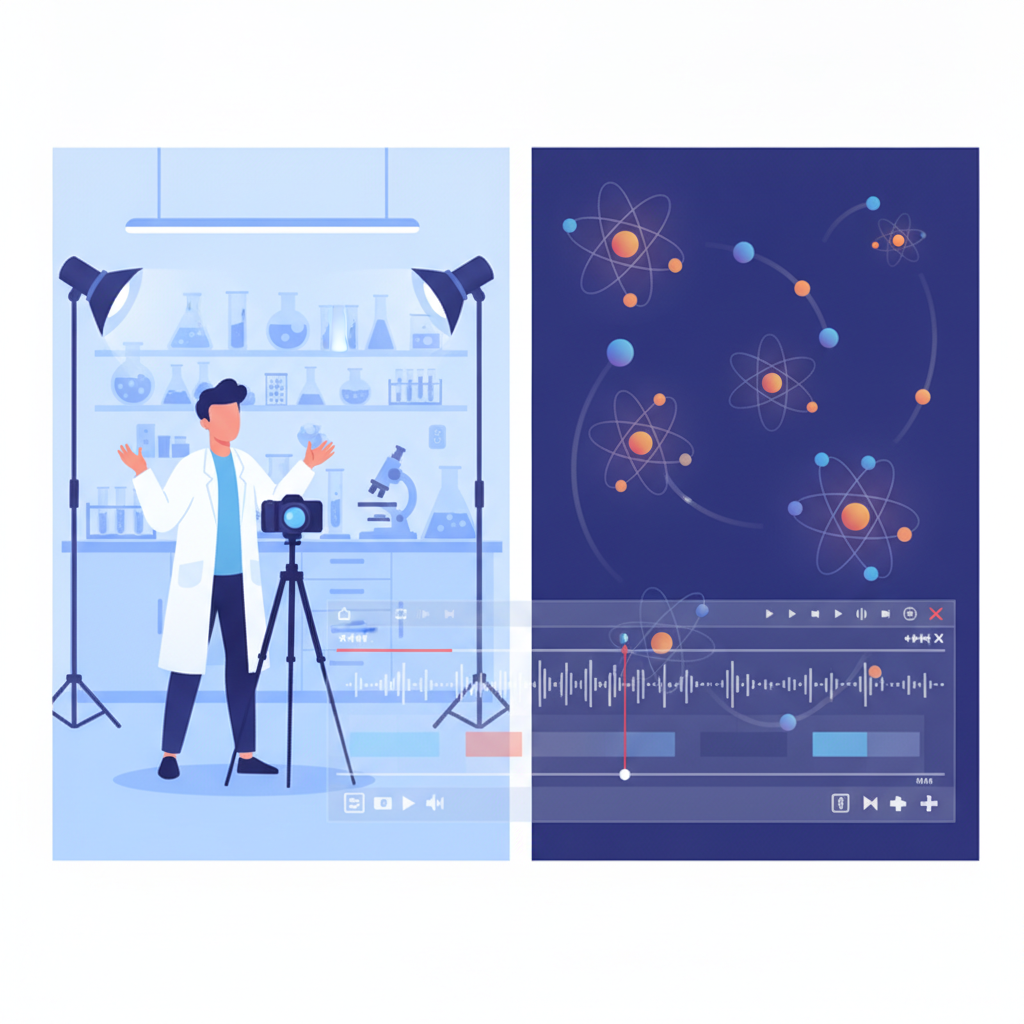
The atomic clock video uses motion graphics extensively to visualize abstract concepts like spacetime bending, atomic clock mechanisms, and laser cooling. Text overlays reinforce key terms and data points. The color grading shifts from natural outdoor tones to cooler lab environments to stylized animations, giving each segment a distinct visual identity.
This is not decoration. The graphics are doing the work of translation, converting concepts that would require a PhD to parse in text into visual metaphors that a general audience can follow. The InGenius launch video uses animated sequences to show the historical impact of the shipping container, alternating between live-action footage and motion graphics to keep the visual experience fresh.
The editing rhythm adapts to the information density. Fast cuts (under one second) during high-information segments keep the pace urgent. Medium cuts (one to three seconds) during narration give the viewer time to process. Slower cuts (three seconds plus) for establishing shots or when a speaker is on screen provide breathing room. The atomic clock video accelerates during explanations and slows during results, creating a rhythm that mirrors the viewer's cognitive load.
The Payoff: Answering the Question You Opened With
The InGenius video follows a hook, setup, narrative, payoff structure. The hook (0 to 6 seconds) announces the new channel. The setup (6 to 33 seconds) explains why a new channel is needed. The narrative (33 seconds to 4 minutes 54 seconds) delivers the first story about the shipping container, starting with a specific object and expanding to its global impact. The payoff (4 minutes 54 seconds to 5 minutes 8 seconds) reveals the channel name and directs viewers to watch the full video there.
This structure works because it delivers on the promise made in the opening seconds. The viewer clicked because they wanted to know what the new channel was about. The video withholds the channel name until the end, but gives them a complete story in the meantime, so they feel rewarded even if they don't click through.
The atomic clock video uses the same pattern. The hook promises "the most ambitious long-shot precision experiment." The setup introduces the challenge of measuring time dilation. The narrative walks through the three chapters of building, transporting, and measuring. The payoff reveals the experiment's findings and their implications for physics. The viewer who came for "ambitious experiment" leaves understanding why atomic clocks on mountains matter.
What EditorDuel Readers Can Take From This
Veritasium's retention mechanics are transferable to any content vertical where you need to hold attention through complexity. Start with a physical object, demo, or claim in the first five seconds. Structure the video as a sequence of discrete challenges, each with its own mini-resolution. Use motion graphics not as decoration but as cognitive scaffolding to translate abstract ideas into visual metaphors. Vary your cut rhythm to match information density, fast during explanations and slower during payoffs. Always answer the question you opened with, even if you withhold part of the answer to drive a click.
The format works because it respects the viewer's time. Every chapter earns the next chapter. Every graphic clarifies rather than distracts. Every cut serves retention. Veritasium's 4.67 billion views are the result of a system that treats viewer attention as the primary constraint and engineers every frame to hold it.
Want to build content like this for your business? Post a competition on EditorDuel and get matched with editors who can deliver.