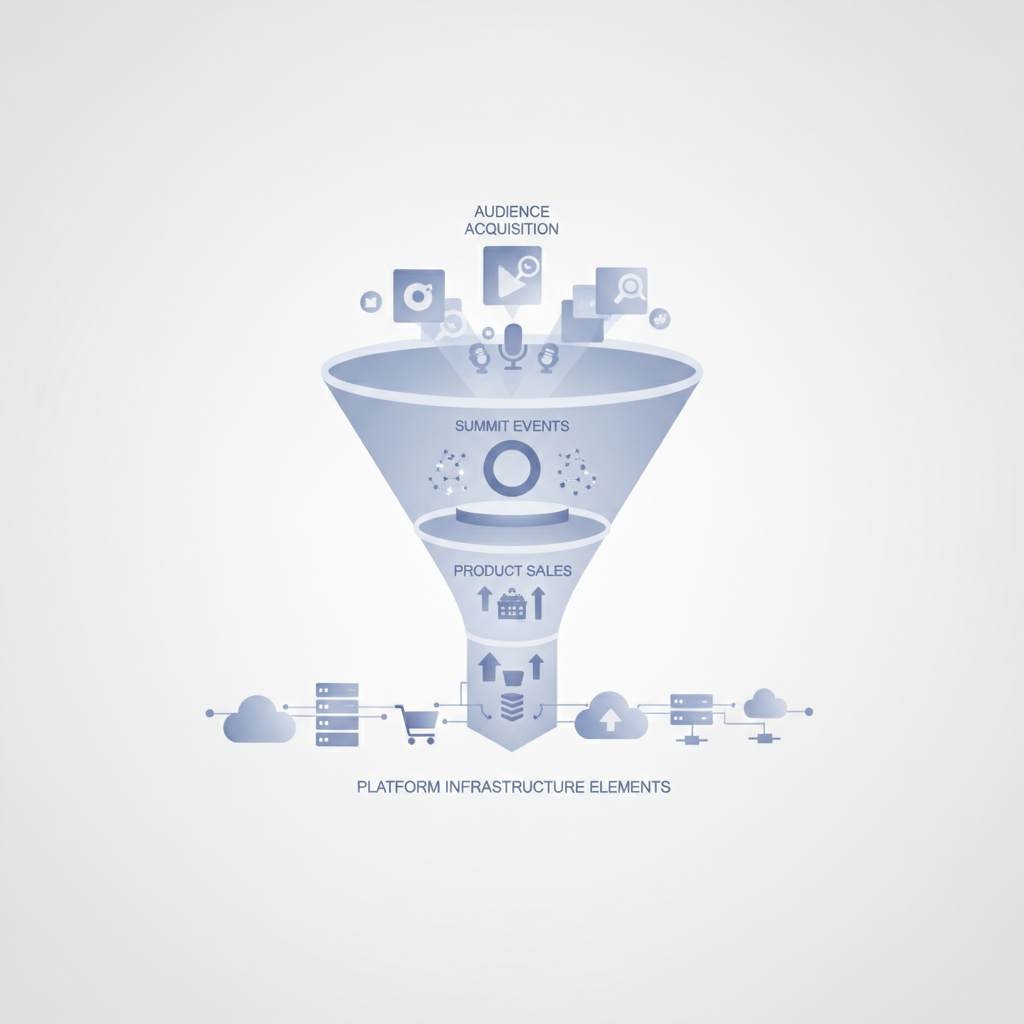
Iman Gadzhi's 2026 business model is not primarily about creating content. It is about creating a launch machine. Where most creators monetize through ads or sponsorships, Gadzhi co-owns Whop, the platform his program Monetise runs on, and uses live summit events to drive product sales at scale. Analysis of his recent launch funnel shows a sophisticated architecture designed for repeatable conversions. The operation is worth studying not because of lifestyle content, but because it demonstrates how a creator can build infrastructure around education products, control distribution, and generate predictable revenue without relying on ad CPMs or brand deals.
The Funnel Architecture: Summits as Conversion Events
Gadzhi's primary customer acquisition vehicle is the multi-day live summit. His Side Hustle Summit with Russell Brunson ran with replays set to be deleted within 24 hours of the final session. This creates urgency. The summit format allows him to deliver free value upfront, build trust, and then pitch a paid program at the end. In the final session, he positions AI Digital Products as the solution to problems he spent the previous days outlining. The pitch includes testimonials, specific income claims, and a money-back guarantee. The entire funnel is designed to move viewers from curiosity to purchase within a compressed timeframe.
The summit is not a one-time event. It is a repeatable format. Gadzhi has run variations of this model multiple times, adjusting the product offering and the pitch based on what is currently positioned as the opportunity. Earlier versions of Monetise focused on Shadow Operating and helping creators monetize existing audiences. The 2026 version broadened to AI-powered digital product creation for people without audiences, without paid ads, and without technical skills. The shift reflects market feedback and the ability to pivot messaging while keeping the underlying funnel structure intact.
Platform Ownership and Vertical Integration
The most significant operational move Gadzhi made was becoming a co-owner and strategic partner of Whop in April 2025. Whop is the platform where Monetise lives. Course content, community, live calls, and software all exist in one workspace. This is vertical integration. By owning a stake in the platform, Gadzhi controls the customer experience, the data, and the economics. He does not pay platform fees to a third party. He does not risk being deplatformed. He can test new features, adjust pricing models, and optimize conversion flows without external approval.
This also creates a compounding advantage. Every student who joins Monetise becomes a Whop user. As Whop grows, so does the infrastructure supporting his products. Gadzhi also acquired a competitor's flagship course, consolidating market share in the agency education space before pivoting to digital products. The pattern is clear: build audience, acquire or partner on distribution, control the platform, and scale.
Content as Marketing, Not Revenue
Gadzhi's YouTube content is not monetized primarily through AdSense. It is a lead generation engine. One reviewer noted that Gadzhi's YouTube strategy is very effective marketing, delivering value to build trust, which in turn drives sales. The videos are not designed to go viral in the traditional sense. They are designed to educate a specific audience on a problem, then position his paid solution as the answer.
In this breakdown video, the opening hook is direct: "I watched the long video so you don't have to. Iman Gadzhi's side hustle summit." The structure is straightforward. Hook, setup, demonstration, conclusion. Text overlays reinforce key points. Screen recordings show the process. The editing is clean, with jump cuts every one to three seconds to maintain pace. The goal is not entertainment. The goal is clarity and credibility. The viewer leaves understanding the system, which makes them more likely to trust the paid version.
Another video analyzing Gadzhi's final summit session uses medium to fast cuts, text overlays for key phrases and numbers, and B-roll to illustrate concepts. The structure follows a clear hook, setup, argument, counter-argument, and pitch. Energy peaks occur during the revelation of success stories and the final call to action. The editing supports the sales narrative. Every cut, every overlay, every testimonial is in service of moving the viewer closer to a purchase decision.
The AI Digital Products Positioning
The current iteration of Monetise centers on AI digital products. The strategy involves partnering with micro-creators who have engaged audiences but lack monetization strategies. The pitch is that you can use AI to build, launch, and manage digital products for these creators without needing technical skills, a personal brand, or paid advertising. Gadzhi's approach emphasizes low upfront capital, high scalability, and easy fulfillment.
This positioning is intentional. It lowers the barrier to entry, which expands the addressable market. It also aligns with current interest in AI tools, making the offer feel timely. The product itself is a system: training, templates, software access, and community support. The value proposition is not just information. It is a repeatable process that students can follow to generate income. Whether that process delivers on the promise is a separate question, but the positioning is designed to maximize conversions by addressing common objections upfront.
What EditorDuel Readers Can Take From This
Gadzhi's operation demonstrates three principles businesses can apply. First, own your distribution. Whether that means a stake in a platform, an email list, or a proprietary community, controlling where your audience lives reduces risk and increases leverage. Second, build repeatable systems. The summit format, the funnel structure, the product positioning can all be templatized and rerun. This allows you to scale without reinventing the wheel every launch. Third, use content as a trust-building mechanism, not a revenue stream. If your primary monetization comes from products or services, your content should be designed to educate and convert, not to maximize watch time or ad impressions.
For teams building video content, the lesson is clarity over flash. Gadzhi's videos are not cinematic. They are functional. Text overlays, screen recordings, and tight pacing make complex information digestible. The editing supports the message. If your goal is to drive action, your content should be structured around that outcome, not around virality or engagement metrics that do not correlate with revenue.
Want to build content like this for your business? Post a competition on EditorDuel and get matched with editors who can deliver.