Airrack (Eric Decker) has built a channel of over 10 million subscribers by producing high-stakes challenge and prank videos that follow a consistent structural formula. What separates his operation from lower-tier challenge creators is the speed at which concepts move from ideation to execution, and increasingly, the role of AI-assisted pre-production in that velocity.
In a recent Adobe Firefly collaboration, the entire creative arc is visible: the video opens with the question "What are we going to do for the next video?" followed immediately by "It has to be something big. I want to disappear." Within 90 seconds, the team has moved from blank slate to a concrete concept (hiding among hundreds of AI-generated doors), and within the video's runtime, they've executed it. This is not accidental. It's the result of a repeatable structure that prioritizes rapid iteration and clear narrative beats.
The Hook-Setup-Payoff Formula
Every Airrack challenge video follows the same three-act structure. The hook is always a problem or constraint stated in the first 10 seconds. In the Adobe video, it's "what's the next video idea?" In other uploads, it might be "I'm going to hunt down 100 iPhone thieves" or "I'm hiding in a famous livestream." The question is direct, relatable to other creators, and sets up an obvious tension.
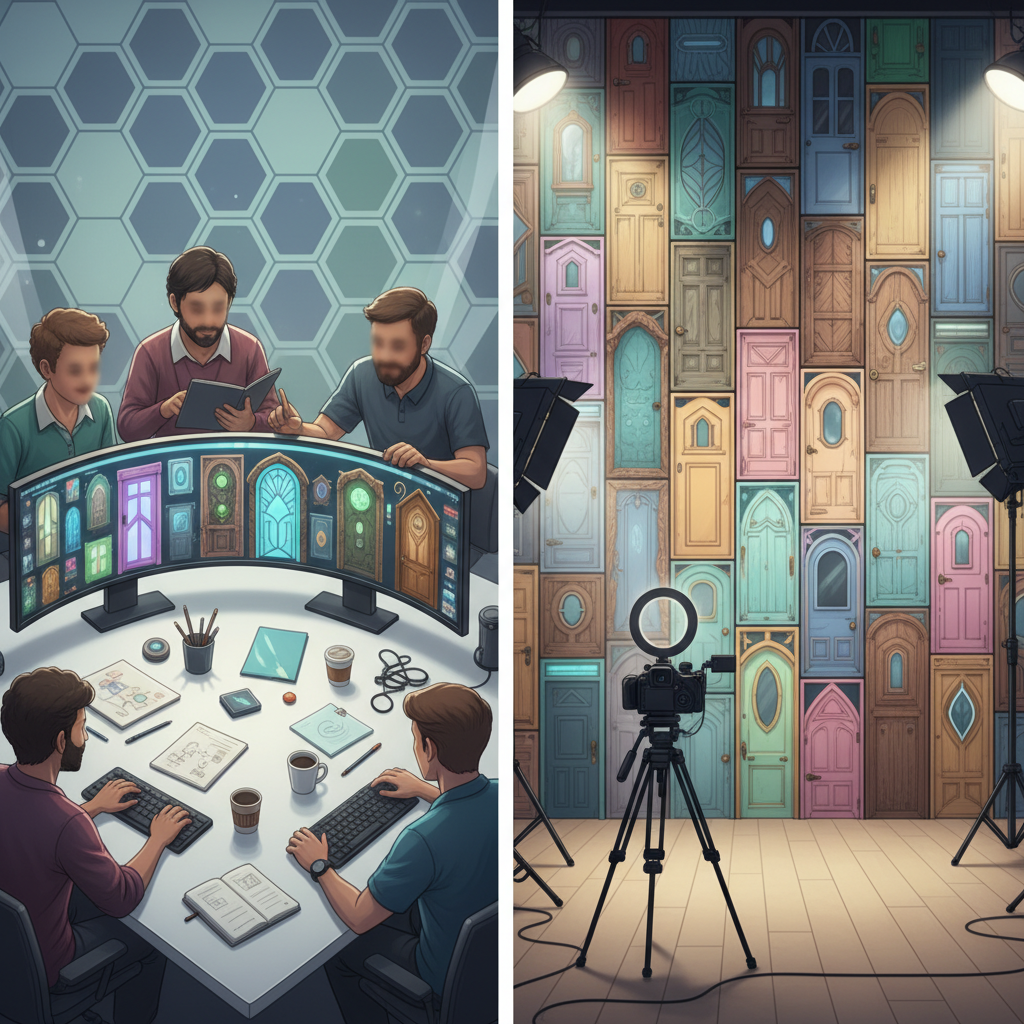
The setup is the brainstorming and preparation phase. This is where Airrack's videos differ from pure reaction or vlog content. The setup shows the work: the team throwing out ideas, testing concepts, encountering obstacles. In the door video, the setup is the Adobe Firefly session where text prompts like "wall of door" and "tile them all together" generate hundreds of door images in real time. The energy escalates as ideas flow faster than they can be spoken.
The payoff is the execution and reveal. The creator attempts the challenge, the result is shown, and the video ends with a meta moment (often Airrack watching his own completed video or reacting to the outcome). The door video ends with Airrack successfully hidden among the generated doors, then cuts to him watching the full upload on YouTube, closing the loop.
This structure works because it mirrors the viewer's own creative process. The hook poses a problem the viewer can relate to. The setup shows the messy, energetic work of solving it. The payoff delivers satisfaction and a sense of completion. Each act has a clear function, and none overstays its welcome.
AI as a Pre-Production Accelerant
The Adobe Firefly integration is not a one-off sponsorship stunt. It's a window into how Airrack's team uses generative tools to collapse the time between concept and shoot. In the video, the team generates hundreds of door images in minutes using text prompts. The AI output is then tiled into a physical set backdrop, allowing them to shoot the "hiding among doors" concept the same day.
Traditionally, a concept like this would require sourcing hundreds of door photos, hiring a designer to composite them, printing large-scale backdrops, and coordinating logistics over days or weeks. By using AI generation, the team compresses that timeline to hours. The creative bottleneck shifts from asset production to concept selection.
This is not about replacing human creativity. It's about removing friction from the ideation-to-execution pipeline. The team still has to come up with the concept ("hundreds of doors"), refine the prompt ("tile them all together"), and execute the shoot. But the AI handles the tedious middle step, the part that traditionally kills momentum.
For businesses watching this, the lesson is not "use Adobe Firefly." The lesson is: identify the slowest step in your content pipeline and ask whether a tool (AI or otherwise) can collapse that step. If your bottleneck is scripting, test AI drafts. If it's B-roll sourcing, use stock libraries or generation tools. If it's editing turnaround, hire more editors or use assembly tools. Airrack's operation is fast because every friction point has been examined and optimized.
Cut Rhythm and Energy Management
The door video demonstrates Airrack's signature cut rhythm: medium pacing (1 to 3 seconds per shot) during the hook and setup, accelerating to sub-1-second cuts during the AI generation sequence, then slowing slightly for the payoff. This rhythm matches the emotional arc of the story. The opening is conversational, so cuts are slower. The brainstorming is chaotic, so cuts speed up. The reveal is satisfying, so cuts slow down to let the moment land.
Jump cuts are used heavily to remove dead air and maintain energy, especially during the brainstorming. Text overlays display AI prompts as they're typed, making the process transparent. Motion graphics (animated brains running around doors, doors rotating and changing) visualize the creative process. Screen recordings of the Firefly interface are integrated directly, showing the AI in action. Sound design includes upbeat background music, keyboard typing sounds, door creaks, and whooshes that accompany visual changes.
The result is a video that feels fast without feeling frantic. The viewer is always oriented (they know what act they're in), but they're never bored. This is the editing craft that separates high-retention challenge content from low-retention challenge content. Both might have the same concept, but only one knows how to pace it.
The Clipper Economy and Distribution
Airrack's content is designed for clip extraction. Each challenge video contains multiple self-contained moments (the initial hook, the brainstorming peak, the final reveal) that can be isolated and posted to TikTok, Instagram Reels, or YouTube Shorts. Search results show active clip farming on TikTok, with users extracting carnival games, money transformations, and unexpected moments from full uploads.
This is not parasitic. It's symbiotic. The clips drive awareness and funnel viewers to the long-form uploads. Airrack's team likely has a dedicated clipper (or multiple clippers) extracting and posting these moments shortly after the main upload goes live. The structure of the videos (clear beats, self-contained moments, high-energy peaks) makes this extraction trivial.
For businesses, this means: design your long-form content with clip extraction in mind. Every long-form video should contain multiple moments that work as standalone short-form clips. If your content doesn't have those moments, you're leaving distribution on the table.
What EditorDuel Readers Can Take from This
Airrack's operation offers three concrete lessons for businesses building challenge or educational content:
- Structure beats spontaneity. The hook-setup-payoff formula is repeatable because it mirrors how humans process stories. Apply it to product demos, case studies, or educational content. State the problem (hook), show the work (setup), deliver the result (payoff).
- Identify and eliminate pipeline bottlenecks. Airrack uses AI to collapse asset production time. You might use templates, stock libraries, or assembly editors. The tool matters less than the diagnosis: what step is slowing you down?
- Design for clip extraction. Every long-form video should contain multiple self-contained moments that work as standalone clips. If you're not extracting and distributing those clips, you're underutilizing your content.
Airrack's channel is not built on luck or personality alone. It's built on a repeatable structure, optimized pacing, and a production pipeline that removes friction at every step. These are systems any business can study and adapt.
Want to build content like this for your business? Post a competition on EditorDuel and get matched with editors who can deliver.