Druski's Coulda Been Records audition sketches generate millions of views using a format so consistent it functions like a retention machine. One recent sketch hit 20 million views in 24 hours, demonstrating the format's viral potential. The structure is simple: contestant walks in, judge (Druski) rejects them within seconds, security removes them, next contestant. The loop repeats. What looks like throwaway comedy is actually a tightly engineered video format optimized for watch time and shareability.
The Opening Hook: Immediate Absurdity
In this typical sketch, the first contestant walks onto a red carpet and immediately says, "Hey! How you doing? I just got fired today, so please give me a chance!" The hook lands in under 2 seconds. No setup, no context, just immediate absurdity. The viewer knows instantly what kind of sketch this is: audition parody, blunt rejections, rapid fire.
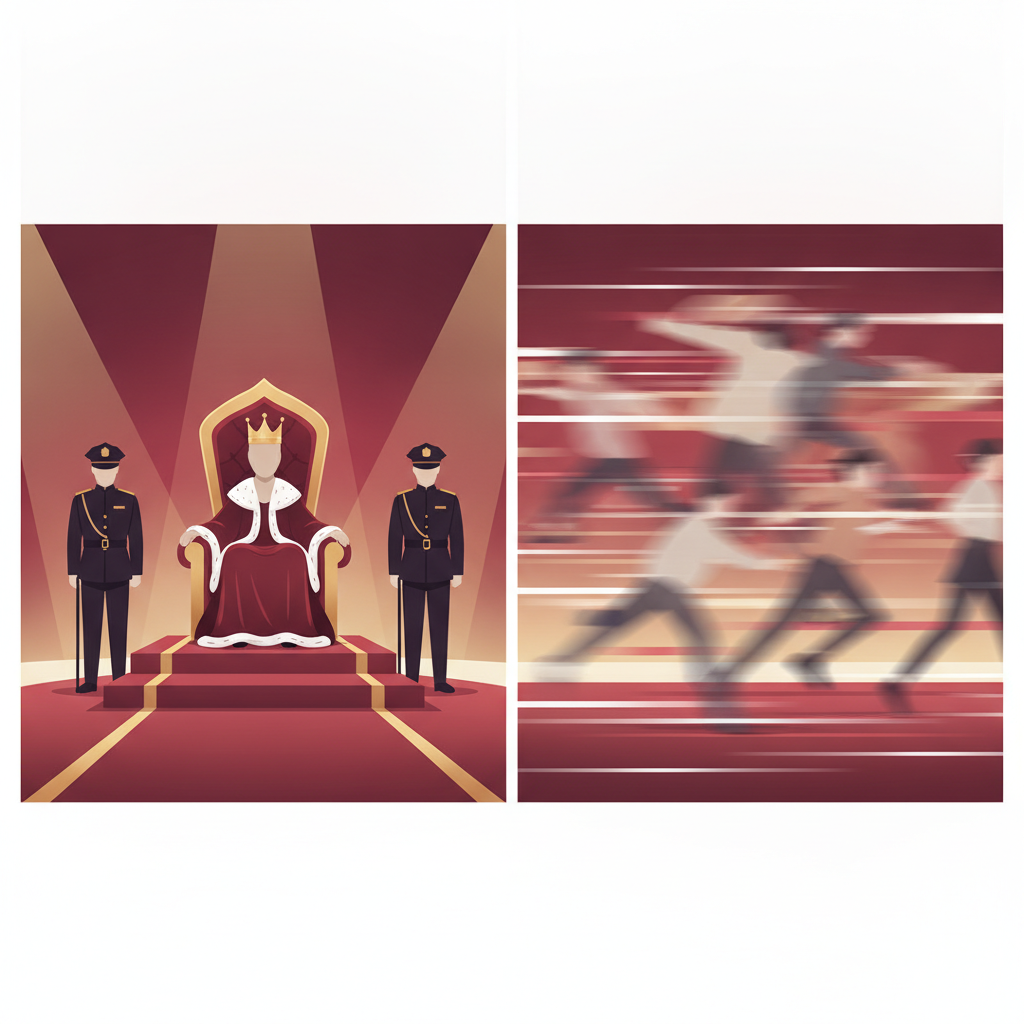
The visual grammar is consistent across every Coulda Been Records video: red carpet background, judge on a throne, security guards standing by. The predictability is the point. Viewers who have seen one sketch know exactly what to expect, which lowers the friction to clicking the next one. The format is a promise: you will see rejections, they will be fast, they will be funny.
Cut Rhythm: 1 to 3 Seconds Per Shot
The editing rhythm averages 1 to 3 seconds per shot. In this sketch, the pattern is: contestant sings, cut to judge reaction, cut back to contestant, cut to security grabbing them. The back and forth creates a conversational pace even when no one is speaking. Jump cuts remove dead air. The judge's dismissals are often one sentence, sometimes one word. "Fun size, get him out of here." Cut. Next contestant.
The rhythm speeds up during the removal sequences. A contestant is singing, the judge interrupts, security moves in, a sound effect punctuates the grab (a distinct "thump" in this video), and the contestant is gone. The entire sequence takes 5 to 8 seconds. Then the next contestant enters and the loop resets.
The Rejection Formula: Blunt, Specific, Absurd
The rejections follow a pattern: the judge identifies a trivial or absurd reason to disqualify the contestant, states it bluntly, and signals security. In one sketch, a contestant is removed for "nut retention." Another is dismissed as "fun size" because of his height. In another, the judge immediately comments, "I can tell by your sideburns you from Baltimore," before rejecting him.
The specificity makes the joke. The rejections are not generic insults. They are hyper-specific observations that feel improvised but land as punchlines. The judge's delivery is deadpan. There is no buildup, no hesitation. The decision is instant. The contestant is gone before they can respond. The format denies the contestant agency, which is part of the comedy. They walk in with hope, they are dismissed in seconds, they are physically removed. The loop is merciless.
Sound Design and Energy Peaks
Sound effects punctuate the key moments. In this sketch, there is a "thump" when security grabs a contestant. In another, a bell "ding," a "ba-ba-ba" sound, and a "damn" exclamation mark the rejections. The music cuts abruptly when a contestant is removed. The silence after the cut emphasizes the finality of the dismissal.
Energy peaks occur during the judge's dismissals and the physical removal. The sketches are structured as a series of micro-peaks, each lasting 5 to 10 seconds. The viewer gets a dopamine hit every time a contestant is rejected, then the next contestant enters and the cycle begins again. The format is designed to deliver frequent, predictable payoffs.
Why the Format Works for Retention
The Coulda Been Records format works because it exploits two retention principles: pattern recognition and rapid payoff. Viewers learn the pattern in the first 10 seconds. Once they understand the loop, they stay to see the variations. Each rejection is a micro-story with a beginning (contestant enters), middle (judge observes), and end (rejection and removal). The entire arc completes in under 10 seconds, which means the viewer gets multiple story arcs in a single 60 to 90 second video.
The format is also infinitely repeatable. Druski can produce these sketches at volume because the structure is fixed. The only variable is the specific rejection. He has built a multi-faceted brand that extends beyond social media, but the Coulda Been Records sketches remain the core content engine. The format is simple enough to produce quickly, distinctive enough to be instantly recognizable, and structured to maximize watch time on short-form platforms.
The Business Model: Free Content, Corporate Sponsorships, Live Touring
Druski uploads these sketches for free, but the volume and virality have translated into corporate sponsorship deals. According to GQ, fans questioned for years how he was making money off these skits he was always uploading for free. The answer: he drove volume until brands paid attention. He now has deals with T-Mobile and Dunkin', and he hosted the BET Awards in 2026. He launched 4Lifers entertainment company in 2023, which handles live touring, TV, film, web productions, merchandise, and Coulda Been Records.
The free sketches are the top of the funnel. They generate awareness, build audience, and create a library of clips that circulate on TikTok, Instagram, and YouTube Shorts. The monetization happens downstream: brand deals, live shows, merchandise. GQ reports that Druski has reinvested most of the money into production rather than personal spending. The operation is designed for scale.
What EditorDuel Readers Can Take from This
The Coulda Been Records format offers three lessons for businesses building short-form content:
- Lock in a repeatable structure. Druski's format is the same every time: red carpet, throne, rejection, removal. The predictability is an asset, not a limitation. Viewers know what they are getting, which lowers the barrier to watching the next video. If you are producing volume, a fixed structure lets you focus creative energy on the variables (the specific jokes, the guest talent) rather than reinventing the format every time.
- Optimize for micro-payoffs. Each rejection is a complete story arc in 5 to 10 seconds. The viewer gets multiple payoffs in a single 90-second video. This structure is ideal for retention on platforms that reward watch time. If your content can deliver frequent, predictable dopamine hits, viewers will stay longer and platforms will promote it more aggressively.
- Use free content to build a monetizable audience. Druski uploaded sketches for free until the audience was large enough to attract corporate sponsors. The sketches are the lead generation tool. The revenue comes from brand deals, live events, and downstream products. If you are building a content operation, the short-form content does not need to monetize directly. It needs to generate attention that you can convert elsewhere.
Want to build content like this for your business? Post a competition on EditorDuel and get matched with editors who can deliver.