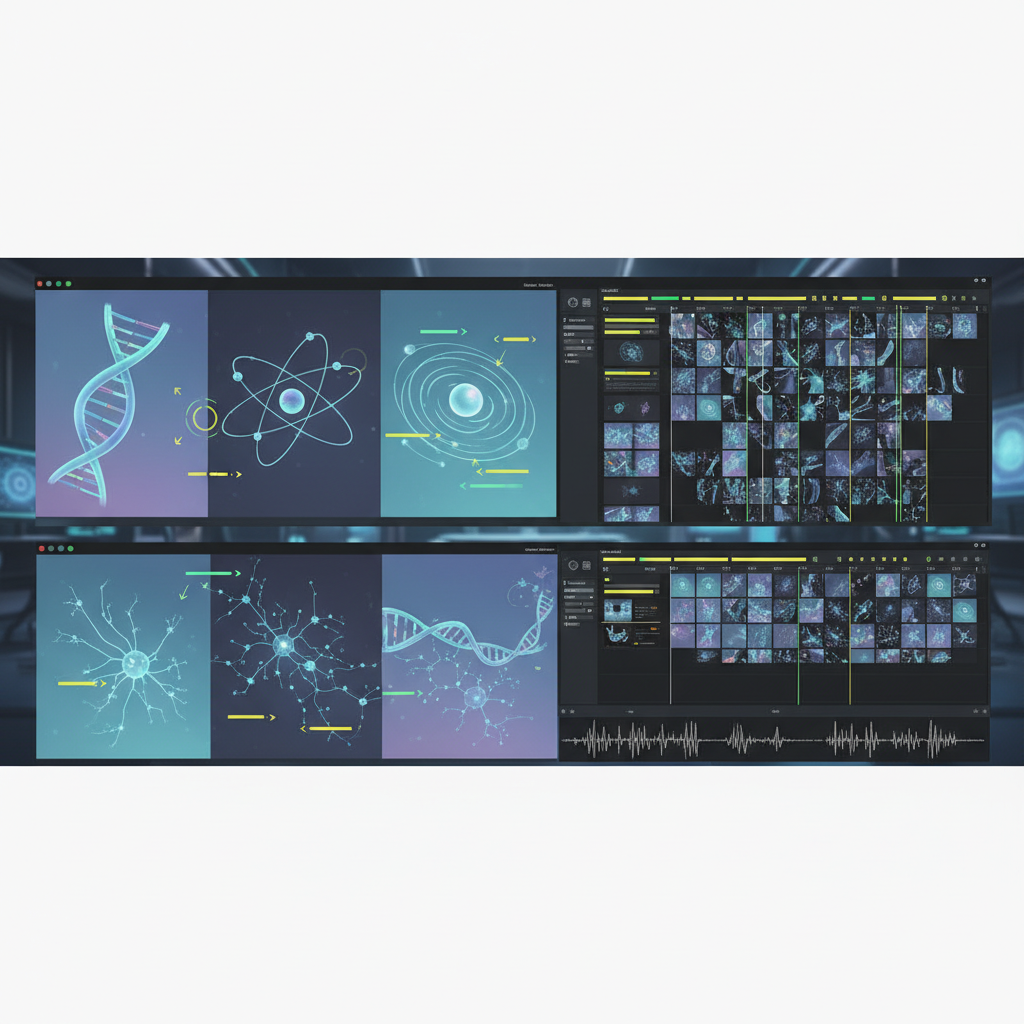
Cleo Abram left Vox in January 2022 to launch her own YouTube channel, "Huge if True," focused on emerging technologies. Within three years, she built a multi-million subscriber base and became one of YouTube's most coveted creators, invited to exclusive YouTube executive events alongside Trevor Noah and Johnny Harris. Her videos routinely attract millions of views. What makes her content work is not just optimistic tech storytelling but a specific editing formula that other creators now study and replicate.
The mechanics are visible in every upload: rapid cut rhythm in the opening, layered text overlays that highlight key phrases, and B-roll that functions as visual metaphor rather than decoration. One analysis of her editing style breaks down three core components: pacing control, retention baits, and emotional triggers. These are not abstract concepts. They are executed at the frame level, and they are why her videos feel addictive even when explaining complex science.
Opening Hook Structure
Abram's videos open with extreme information density. In a video about lab-grown diamonds, the first 5 seconds contain a split screen showing Abram gesturing, a close-up of a complex machine, an animated cross-section of Earth's core, and the text overlay "THIS CRAZY MACHINE MIMICS THE INSIDE OF THE EARTH TO GROW DIAMONDS." The cut rhythm in these openings features shots changing well under 1 second each. In another video about dark energy, the opening line is "This new image seems to show that dark energy is getting weaker," delivered over a split screen with a reactor and animated cosmic visuals. The hook is not a question or a tease. It is a claim, visually supported, delivered at speed.
This structure works because it front-loads the payoff. The viewer knows immediately what the video is about and sees visual proof that the claim is worth exploring. There is no slow build. The energy peak happens in the first 3 seconds, then sustains through rapid cuts and layered information.
Text Overlay as Retention Scaffold
Abram uses text overlays not as captions but as a second information layer. In the dark energy video, key phrases appear in yellow, green, and blue, often with emojis: up arrows, skulls, thinking faces, flexing arms, checkmarks, crosses, charts. The text animates in sync with the voiceover, reinforcing the spoken word while adding visual emphasis. This is not accessibility captioning. It is a retention device. The viewer's eye tracks both the visual B-roll and the text, creating a dual engagement path.
The analysis of her formula highlights this as "pacing control." The text overlays allow Abram to maintain a fast verbal pace without losing clarity. If a viewer misses a spoken phrase, the text catches them. If they zone out on the visuals, the text pulls them back. The technique is now widely copied, but Abram's execution is tighter. The text does not clutter. It appears, emphasizes, and disappears within 1 to 2 seconds, keeping the frame clean while delivering information at high density.
Visual Metaphor Over Generic B-Roll
Abram's B-roll is not stock footage. In the diamond-growing video, she uses an animated visual of balancing an airplane on a fingertip to represent the pressure required to form diamonds. In the dark energy video, animated cosmic images and galaxies illustrate abstract concepts like the expansion of the universe. The B-roll is motion graphics heavy, with close-ups and dynamic camera movements that match the pacing of the voiceover.
This is a deliberate choice. Abram has stated her strategy is reaching most people at the highest information density, which is video. Generic B-roll (lab coats, test tubes, generic space footage) does not carry information. Visual metaphors do. The airplane-on-fingertip image conveys pressure in a way that a verbal explanation alone cannot. The animated Earth core cross-section shows the process of diamond formation in real time. The viewer is not just hearing an explanation. They are watching the concept unfold.
Pacing Shifts to Sustain Attention
The opening cut rhythm is extreme, but Abram does not maintain that pace for the entire video. The analysis of her formula notes that after the fast-cut intro, the rhythm slows significantly when discussing specific techniques or showing examples. This allows for comprehension without losing momentum. The viewer gets the dopamine hit of the rapid opening, then settles into a slightly slower, more detailed explanation.
This pacing shift is critical. If the entire video maintained the opening rhythm, it would exhaust the viewer. If it never hit that rhythm, it would fail to hook. Abram's videos oscillate between these two speeds, creating energy peaks at strategic moments. In the diamond video, the energy peaks occur during rapid visual changes and emphatic reactions from the split-screen reactor. The structure is hook, setup, process explanation with pacing shifts, and payoff.
Split Screen Reaction Format
Many of Abram's videos are now analyzed by other creators in a split-screen reaction format. In one example, a nuclear engineer reacts to Abram's dark energy explainer, providing additional context and analogies. In another, the same format is used for the diamond-growing video. The split screen keeps Abram's original content on the bottom while layering expert commentary on top.
This format works because it adds a second voice without interrupting the original flow. The reactor's commentary is delivered through jump cuts, removing pauses and keeping the pace tight. The bottom screen continues to show Abram's animated B-roll and text overlays, so the viewer is never watching a static talking head. The format has become popular enough that other creators now study and replicate it, treating Abram's style as a case study in retention engineering.
What EditorDuel Readers Can Take From This
Abram's formula is replicable at the operational level. The opening hook structure (claim plus visual proof in under 5 seconds) can be applied to product demos, case studies, or explainer content. The text overlay technique requires minimal tooling (any NLE supports animated text) but demands tight scripting. Every phrase that appears on screen must justify its presence. If it does not reinforce the voiceover or add new information, cut it.
The visual metaphor approach requires more planning. Generic B-roll is cheap and fast, but it does not carry information. Commissioning motion graphics or sourcing specific metaphorical footage (the airplane on the fingertip, the animated Earth core) takes time, but it is the difference between a video that informs and a video that retains. For businesses producing educational or explainer content, this is the lever. The audience will tolerate a slower pace if the visuals are doing work.
The pacing shift principle applies to any long-form content. Open fast, settle into explanation, spike energy at key moments, close with payoff. This is not a YouTube-specific trick. It is narrative structure applied at the cut level. Editors who understand this can apply it to client work, internal training videos, or product launches.
Abram's success is not about personality or niche. It is about engineering retention through editing choices that other creators can study, dissect, and apply. The formula is visible in every upload. The question for businesses is whether they are willing to invest the production time to execute it.
Want to build content like this for your business? Post a competition on EditorDuel and get matched with editors who can deliver.