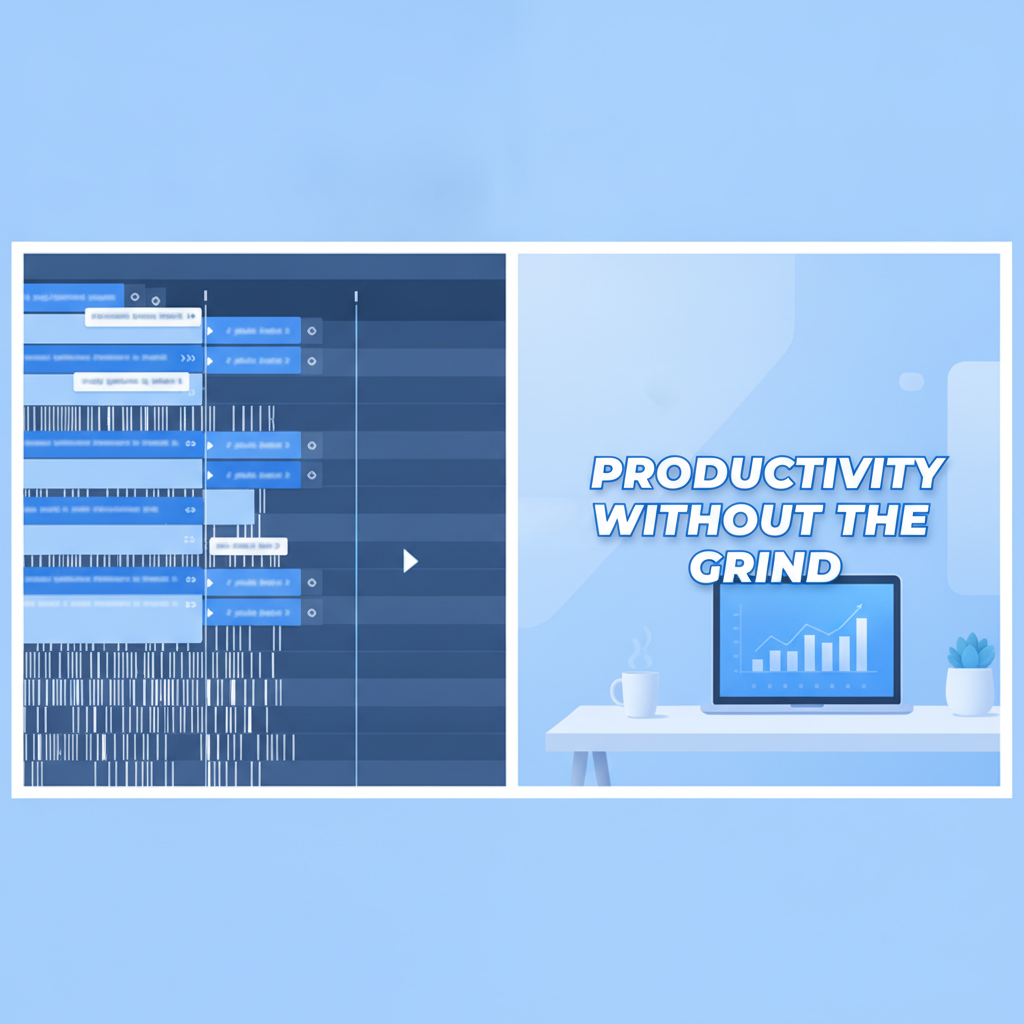
Ali Abdaal operates one of YouTube's most studied educational channels, with over 6 million subscribers watching videos that routinely exceed 10 minutes without losing viewer attention. The format looks simple: a talking-head productivity lesson broken into numbered segments. The execution is anything but. His videos deploy a specific structural playbook and editing vocabulary that transforms dense self-help content into high-retention viewing.
The Segment-Based Listicle Structure
Abdaal's format follows what industry educators now call the "listicle framework", a segmented narrative architecture designed for educational long-form. In this recent upload, the structure is visible within the first 30 seconds: a rapid-fire montage of motivational quotes (Steve Jobs, other public figures) with text overlays like "I LOVE MY JOB" flashing on screen, followed by a clear problem statement backed by data (Gen Z burnout statistics), then four distinct titled segments exploring a book's core ideas.
Each segment gets a title card. Each segment delivers one takeaway. The viewer knows at every moment where they are in the journey. This segmentation serves two retention functions: it creates natural chapter breaks that prevent mid-roll fatigue, and it allows viewers to skip ahead without losing the thread. The format assumes partial attention and designs for it.
The segments themselves follow a micro-structure: introduce the concept with text, illustrate with B-roll or stock footage, reinforce with voiceover, close with a summary overlay. The repetition builds pattern recognition. By the third segment, the viewer's brain anticipates the rhythm, which paradoxically makes longer videos feel shorter.
Text Overlays as Cognitive Anchors
Abdaal's editing signature is the aggressive use of animated text overlays. Research on educational YouTube confirms that creators like Abdaal "use text overlays to reinforce key points," a technique that serves dual duty: it accommodates viewers watching without sound (mobile, public transit), and it creates visual emphasis that mimics the highlighting a student would do in a textbook.
In the analyzed video, text overlays appear every few seconds, often with bold, animated typography that expands or slides into frame. The words on screen are not transcriptions of the voiceover, they are distillations. If Abdaal says "The book argues that productivity doesn't have to feel like a grind," the text reads "PRODUCTIVITY WITHOUT THE GRIND." The overlay compresses the idea into a tweet-length phrase, making it instantly scannable.
This is not accidental. The text functions as a second narrative layer, a visual summary track running parallel to the audio. Viewers who lose focus on the voiceover can catch up by reading the screen. The technique also creates natural pause points: the eye stops to read, the brain processes, then the video moves forward. The result is a self-pacing mechanism built into the edit.
Cut Rhythm and Visual Velocity
The cut rhythm is relentless. The video analysis notes that "the cut rhythm is very fast, with shots changing frequently, often under 1 second." This is not MrBeast-style chaos, it is controlled velocity. The cuts serve specific functions: they eliminate dead air, they swap between camera angles to simulate conversation, they introduce B-roll that visualizes abstract concepts.
The B-roll itself is eclectic: stock footage, movie clips, creator-generated content, often arranged in collages or split screens. The analysis describes "a mix of stock footage, movie clips, and creator-generated content as B-roll, often arranged in collages or split screens." The variety prevents visual monotony. A viewer watching a 12-minute video never sees the same shot type for more than a few seconds.
Sound design reinforces the pace. The video uses "a consistent, upbeat background music track, punctuated by sound effects that emphasize text and transitions." The sound effects are not decorative, they are punctuation. A whoosh accompanies a text slide. A subtle click marks a transition. The audio cues train the viewer to expect change, which keeps attention active rather than passive.
The Hook Formula: Data Plus Montage
Abdaal's openings follow a two-part formula visible in the analyzed video: a rapid montage (often of famous figures or cultural references) followed by a data-backed problem statement. The montage grabs pattern-recognition attention (the brain recognizes Steve Jobs, processes the familiar motivational language), then the data grounds the video in credibility ("Gen Z reports higher stress despite more tools").
This structure works because it satisfies two viewer types simultaneously: the scroll-stopping emotional hook for casual browsers, and the evidence-based framing for viewers who stay for substance. The first five seconds are designed for the algorithm's retention measurement, the next 20 seconds are designed to convert the curious into committed viewers.
The YouTube-to-Course Funnel
Abdaal's content velocity and production quality make sense when viewed as part of a larger business model. He views his YouTube channel as a marketing tool that drives traffic to his courses and other offerings. His education business has generated multi-million dollar annual revenue across courses, a book, sponsorships, and digital products. Estimated YouTube revenue is $8K to $43K per month, a fraction of total income.
The videos themselves are structured as course previews. Each segment could be expanded into a paid module. The listicle format is modular by design: a viewer who wants depth on segment three can find the corresponding course. The free content establishes authority and teaching style, the paid content delivers implementation.
His team runs three editors plus a videographer, with public job listings for London-based editors at £30,000 to £40,000 per year. This is not a one-person operation, it is a content studio optimized for educational long-form at scale.
What EditorDuel Readers Can Take From This
Abdaal's playbook is directly applicable to B2B educational content, SaaS explainer series, or any business trying to turn expertise into watchable video:
Segment your content into titled chapters. If your video covers multiple points, give each one a visual chapter marker. Viewers will stay longer if they know the structure.
Use text overlays as a second script. Do not transcribe, distill. The text should be the version a viewer would tweet, not the version they would read in a whitepaper.
Cut faster than feels natural. Educational content benefits from pace. A cut every two to three seconds is not too fast if each cut has purpose (new angle, new B-roll, new text).
Open with pattern recognition, then pivot to data. A montage of familiar references (customer logos, industry headlines, recognizable problems) grabs attention. A statistic or concrete problem statement converts that attention into commitment.
Design for partial attention. Assume viewers are watching on mute, skipping around, or doing something else. Text overlays, clear segments, and visual variety accommodate distracted viewing without punishing it.
Want to build content like this for your business? Post a competition on EditorDuel and get matched with editors who can deliver.