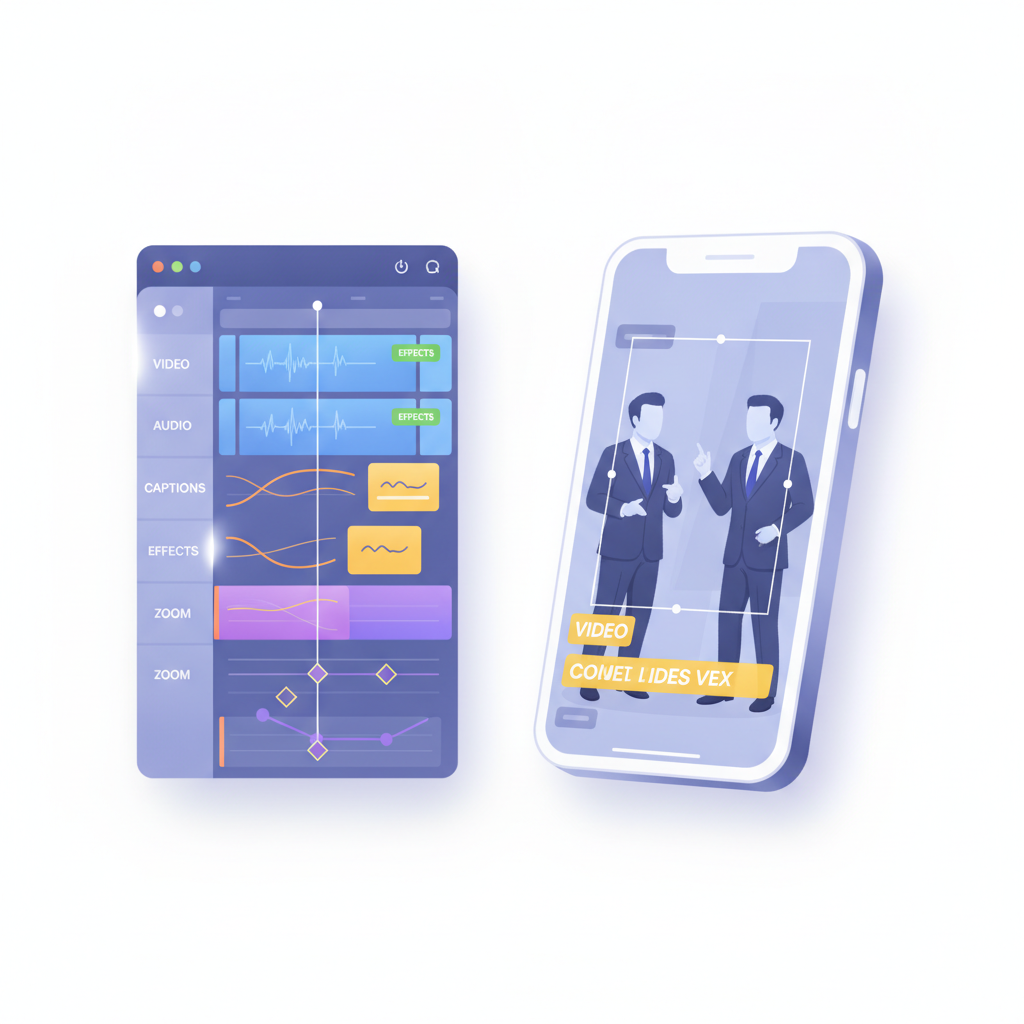
Alex Hormozi has built a reputation for delivering business advice in short-form videos. His content is frequently cited as the benchmark for what video editing tools now call "Hormozi-style edits", a format that layers pattern interrupts, animated captions, and dynamic scaling to keep viewers engaged through 60 to 90 seconds of information. For businesses trying to turn expertise into viral content, understanding the mechanical choices behind this format reveals how editing craft can transform a talking head into a retention-focused piece.
The Core Mechanic: Constant Visual Change
The foundation of Hormozi's editing approach is visual variation. Tools that replicate his style emphasize "pattern interrupts, zoom-ins, sound effects, dynamic captions, relevant B-roll, and constant visual changes" as the minimum feature set. The format assumes the viewer may swipe at any moment, so every element exists to reset attention before it drifts.
The most visible signature is what editors call "punch zooms", where key moments scale from 100% to 115% at important transitions to mimic dynamic camera movement. These micro-zooms create the sensation of forward motion even when the speaker is stationary. Combined with cuts timed to speech cadence and emphatic gestures, the result is a video that maintains momentum despite being shot in a single static frame.
Kinetic Captions as a Retention Layer
Hormozi's videos are equally recognizable for their animated subtitle treatment. Multiple video editing platforms now advertise "Alex Hormozi bounce style" captions as a preset, referring to the word-by-word highlighting that bounces or scales in sync with speech. The captions are not passive accessibility features. They function as a second visual rhythm track, giving the eye a target to follow even if the speaker's face or background remains static.
The technical execution matters. Subtitle accuracy above 97% is necessary because mistimed words break the rhythm. The captions typically use high-contrast colors (white or yellow on dark backgrounds) and bold sans-serif fonts to remain legible on mobile screens. The animation itself is minimal, a slight scale or position shift per word, but the cumulative effect over 60 seconds is a continuous visual pulse that maintains viewer focus.
The 60-Second Masterclass Format
Hormozi's content is frequently described as "60 second masterclasses", a format that compresses a single business concept into a sub-90-second monologue. The structure is consistent: open with a provocative statement or question, deliver three to five supporting points in rapid succession, close with a one-sentence reframe or call to action. The pacing is conversational but compressed, with filler words and pauses removed in post.
This format places significant demands on editing. A "Hormozi-style edit requires significantly more work" than a simple talking-head cut because every second must justify its presence. Editors trim breaths, tighten pauses between sentences, and layer B-roll or on-screen text to reinforce key terms. The goal is not cinematic beauty but informational density. The viewer should feel they learned something concrete in under 90 seconds.
Sound Design and Audio Pacing
While less visible than the visual edits, the audio layer in Hormozi-style videos is also engineered. Background music is typically minimal or absent, avoiding competition with the voice track. When present, it sits well below dialogue and uses neutral, non-distracting instrumentation. Sound effects (whooshes, pops, subtle risers) are used sparingly to punctuate transitions or emphasize on-screen text.
The voice itself is processed to sit forward in the mix, ensuring clarity on phone speakers. Breaths and mouth sounds are removed or reduced. The result is a clean vocal that remains intelligible even in noisy environments. This audio clarity is important for retention because viewers who cannot immediately parse the words will swipe rather than rewind.
Replicability and the Clipper Economy
The Hormozi editing style has become so codified that it now powers a range of tools and templates. AI subtitle generators advertise "Hormozi bounce style" as a one-click preset. Video editing platforms promise to "customize animations to mimic the style of top creators like Alex Hormozi." This availability is both a testament to the format's effectiveness and a challenge for differentiation. When every business advice creator uses the same punch zooms and kinetic captions, the format itself becomes table stakes rather than a competitive advantage.
For businesses, this means the editing style is accessible but insufficient. The underlying content must still deliver novel insight, clear structure, and authentic delivery. The editing amplifies good material but cannot rescue weak scripts or unconvincing speakers.
What EditorDuel Readers Can Take From This
Hormozi's editing playbook offers three concrete lessons for businesses producing short-form content:
First, treat every second as valuable. If a frame or phrase does not advance comprehension or reset attention, cut it. Retention is not about holding interest for the full duration but about never giving the viewer a reason to leave.
Second, layer multiple retention mechanisms. Punch zooms alone will not save a static video. Kinetic captions alone will not compensate for slow pacing. The format works because it stacks visual, auditory, and informational changes in rapid succession, creating a compound effect that maintains momentum.
Third, optimize for mobile and sound-off viewing. The majority of short-form consumption happens on phones in distracting environments. High-contrast captions, forward audio, and clear framing ensure the content works even when conditions are suboptimal.
The Hormozi style is not the only way to make short-form content work, but it is a proven template for turning expertise into digestible, shareable clips. Businesses that master the mechanics can apply the same principles to product demos, client testimonials, or founder storytelling.
Want to build content like this for your business? Post a competition on EditorDuel and get matched with editors who can deliver retention-optimized short-form videos that hold attention and drive action.