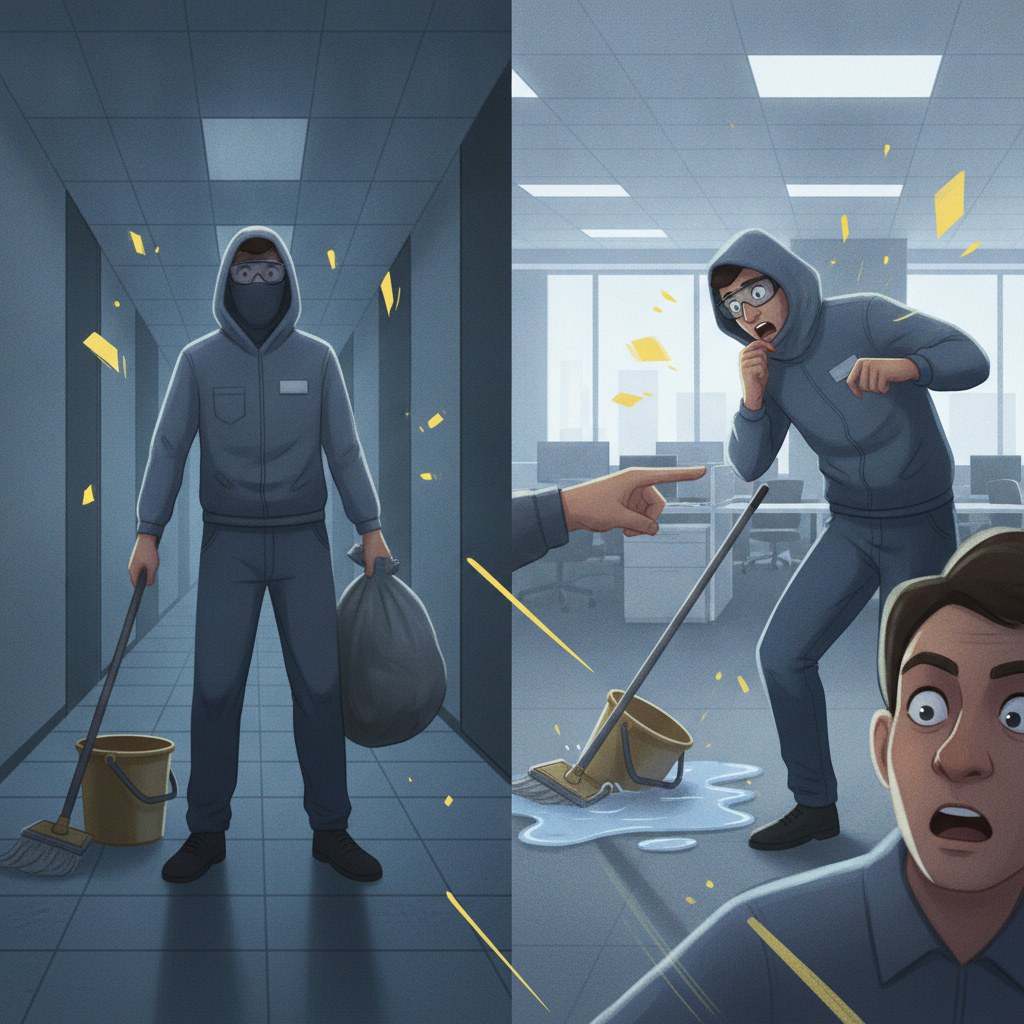
Eric Decker, known as Airrack, has built a channel around a specific retention mechanic: the undercover reveal. In this recent upload, he disguises himself as a janitor at what appears to be a creator event, pushing a cleaning cart until another creator confronts him with "What's up, Airrack?" at the four second mark. In another video, the same format plays out with an "old man" disguise, where the protagonist insists the elderly figure is actually Airrack, building tension until the handshake confirmation at 1:10. The format is simple, repeatable, and optimized for the exact moment viewers decide whether to keep watching.
The Cold Open: First Person Movement
The longer form video opens with a seven second first person shot, handheld or action cam, following someone jogging toward a lit building at dusk. Text overlays appear immediately: "7:15 Evening Wednesday" in the top left, "16671/17000 Basketball at 9PM CST!" in the top right. No music, just footsteps and ambient sound. The hook is pure momentum and context. The viewer has no idea who they are following or why, but the movement creates urgency and the overlays suggest a live event with stakes. This is the opposite of a talking head intro. The video earns attention by withholding information while showing action.
The short form version skips the run up and opens mid encounter: a bearded man in a grey uniform pushing a cart, looking up as someone says "What's going on, man?" at 0:02. By 0:04, the camera pans to reveal the confronter, who immediately says "What's up, Airrack?" The entire setup takes four seconds. The format adapts to platform: long form uses the approach to build mystery, short form cuts straight to the accusation.
The Recognition Beat: Viewer Omniscience
The core retention mechanism is asymmetric information. The viewer knows (or suspects) the disguised person is Airrack. The other person in the frame either does not know or is pretending not to know. In the janitor short, yellow text overlays emphasize the confronter's lines: "WHAT'S UP AIRRACK," "CAN'T FOOL ME," "YOU JUST LEFT." The disguised figure tries to deflect. The viewer stays because they want to see the moment the disguise breaks.
In the old man disguise video, the energy peaks twice: first during the direct confrontation at 0:12 to 0:30, when the protagonist excitedly identifies the old man, and again at 1:10 when they shake hands, confirming the reveal. The handshake is the payoff. The video structure is: movement (hook), encounter (setup), accusation (tension), confirmation (release). Each beat serves retention. If the viewer leaves before the handshake, they miss the resolution.
The visible live chat comments in the long form video add a second layer. Real time reactions from other viewers appear on screen, showing speculation and excitement. This turns a one on one interaction into a communal guessing game. The viewer is not just watching Airrack, they are watching an audience react to Airrack, which increases perceived stakes.
Cut Rhythm: Medium Pace with Text Anchors
The short form video cuts every one to two seconds, maintaining a dynamic feel without becoming chaotic. The camera is handheld, panning between the two speakers. The long form video uses a slower rhythm during the initial run (seven second opening shot), then shifts to one to three second cuts once the conversation starts. The editing does not rely on rapid fire jump cuts. Instead, it uses medium pacing with strategic text overlays to hold attention.
Text overlays in both videos highlight key spoken phrases. This is not subtitling for accessibility. The text appears selectively, emphasizing the words that drive the narrative: the accusation, the denial, the confirmation. The viewer's eye is directed to the exact moment the story turns. This technique compensates for the lack of music or heavy sound design. The videos use ambient sound (footsteps, background chatter, game sounds) and clear dialogue, with minimal effects. The retention comes from structure, not production density.
Format Portability: Disguise as Repeatable System
The disguise format appears across multiple contexts. Airrack has used it at creator events, during IShowSpeed's stream, and in arcade challenges. The setup changes, but the structure stays the same: go undercover, interact with someone who might recognize you, capture the reveal. The format works because it does not depend on expensive sets, complex scripts, or celebrity cameos. It depends on the creator's recognizability and the willingness to commit to the bit.
This is a format that scales. A team can shoot multiple disguise videos in a single day by changing locations and costumes. The editing is straightforward: handheld footage, medium cuts, text overlays, minimal color grading. One video analysis describes Airrack's use of desaturated color grading in certain segments to create visual contrast, but the disguise videos maintain a natural, slightly cool look consistent with real world lighting. The production approach is raw, which supports the unscripted feel.
What EditorDuel Readers Can Take From This
First, undercover formats create built in retention because they promise a specific payoff: the reveal. If your content can be structured around a clear before and after moment (the disguise vs. the unmasking, the hidden identity vs. the recognition), viewers will stay to see the transition. This works for product demos (before and after), client transformations (initial state vs. final result), or process videos (raw material vs. finished output).
Second, first person movement in the opening seconds creates urgency without requiring dialogue. The seven second run up in Airrack's video establishes momentum and context through action and text overlays alone. If your content starts with a static shot of someone talking, consider opening with motion: a walk through a space, a product being unboxed, a tool being picked up. Movement signals that something is about to happen.
Third, text overlays can replace expensive motion graphics. Airrack's videos use simple yellow text to emphasize key lines. This is faster to produce than animated lower thirds and often more effective because it feels less formal. If you are cutting interview footage or testimonials, try overlaying the most important phrases as text instead of relying on the viewer to catch every word in the audio mix.
Fourth, medium cut pacing (one to three seconds per shot) with strategic emphasis beats is more sustainable than hyper fast cutting. Airrack's videos do not rely on sub second cuts to hold attention. They use medium rhythm with clear narrative beats. This is easier on editors and less fatiguing for viewers. If your content feels exhausting to watch, the issue may not be that it is too slow, but that it lacks clear story beats.
Fifth, repeatable formats allow you to produce at volume. Airrack's disguise structure can be deployed in any public setting with minimal crew. If you can identify a format that works once (a specific interview style, a recurring challenge, a signature opening), you can produce multiples without reinventing the wheel each time. The format becomes the system.
Want to build content like this for your business? Post a competition on EditorDuel and get matched with editors who can deliver.