Adin Ross launched Brand Risk Promotions in 2024, creating an influencer boxing circuit that converts his streaming audience into pay-per-view viewers. The operation follows a clear pattern: book mismatched celebrity fights, broadcast them live with multi-angle commentary, and clip the outcomes for viral distribution. Recent cards featured Kimbo Slice's son, Anderson Silva's son, Johnny Manziel, Lance Stephenson, and Michael Beasley. The model is worth studying because it shows how a content creator can verticalize into live event production without traditional sports infrastructure.
The Mismatch Formula
Brand Risk Promotions events rely on visual novelty over competitive balance. In this Island Boy versus Jeremy Smith bout, the opening wide shot immediately establishes the height differential between fighters. The announcer's dramatic delivery of "Jeremy Smith" cuts to a close-up of the shorter boxer entering the arena. The mismatch is the hook. The video analysis notes that cut rhythm during the actual fight accelerates to under 1 second per shot, tracking punches and knockdowns in real time. Multiple replays with speed ramps ensure no viewer misses the technical knockout. The structure is hook (unusual matchup) to setup (fighter entrances) to payoff (rapid knockdowns and stoppage).
This approach inverts traditional combat sports logic. Competitive balance matters less than immediate visual interest. The audience tunes in for the spectacle, not the sport. The Yera versus Tessa fight uses the same template: commentators laughing over each other in split screen, upbeat hip-hop during entrances, exaggerated punch sounds during exchanges. The video opens with five commentators talking simultaneously, establishing the event as entertainment rather than athletic competition. Cut rhythm during the three rounds stays medium to slow between action (1 to 3 seconds), then speeds up during exchanges (under 1 second). Text overlays identify fighters and rounds. Slow motion replays emphasize key punches. The post-fight interviews provide closure.
Multi-Layer Commentary as Retention Mechanism
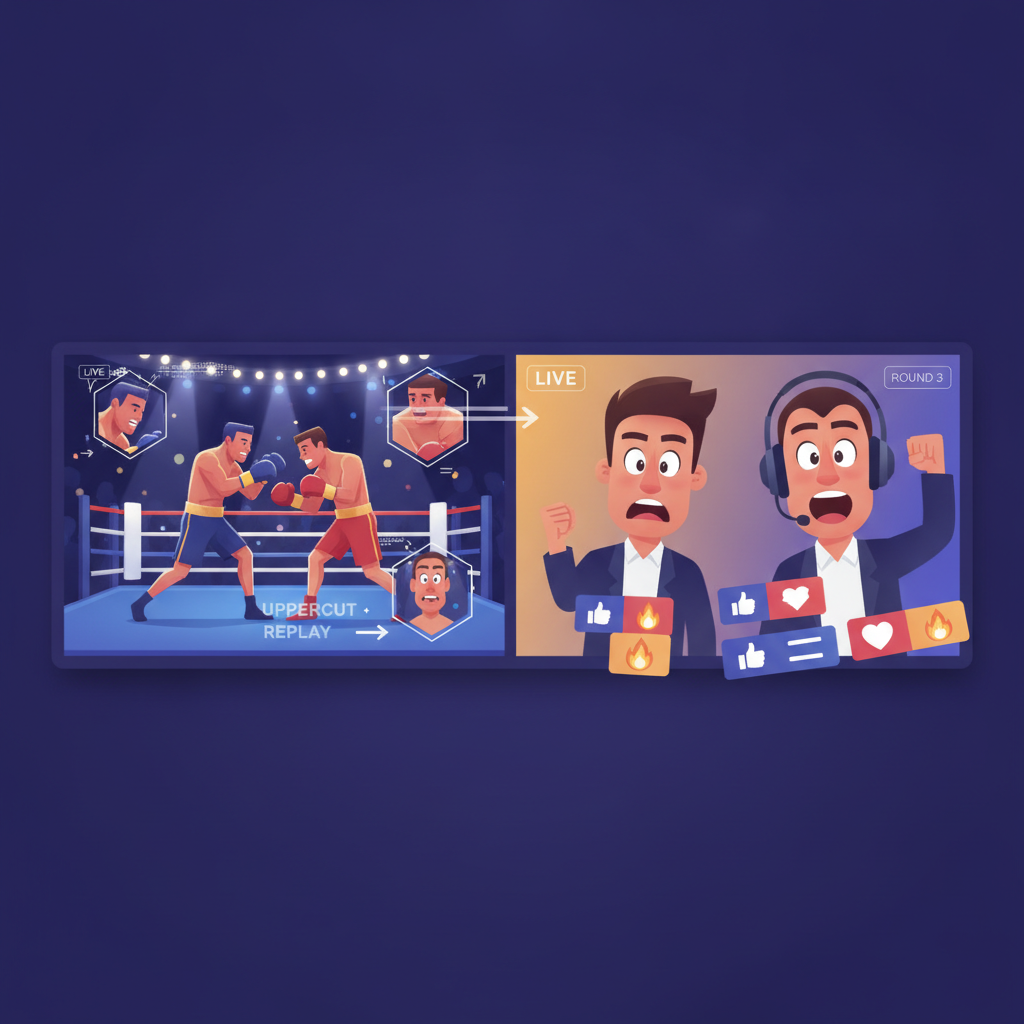
Both analyzed fights use picture-in-picture windows showing commentators reacting in real time. This is not decorative. The commentator layer serves as a continuous retention hook. When the action slows, the viewer's attention shifts to the commentary track. When the action peaks, the commentators amplify the energy. The video analysis of the Island Boy fight notes that "the commentators' reactions in the PiP window amplify the excitement and humor." In the Yera versus Tessa bout, the split screen runs throughout, allowing viewers to "simultaneously gauge the commentators' reactions, adding another layer of engagement."
This technique borrows from reaction video formats but applies it to live sports. The commentary is not post-production voiceover. It is synchronized, unscripted response. Ross himself often appears in the commentator box, which ties his personal brand to the event. The format creates two parallel narratives: the fight itself and the real-time social experience of watching it. For a streaming audience accustomed to live chat and emote spam, the commentator track replicates that participatory feeling within the video frame.
Celebrity Arbitrage and Name Recognition
Ross's events consistently feature names like Johnny Manziel, Lance Stephenson, Michael Beasley, Larry Wheels, and legacy fighters' children. These are not active professional boxers. They are recognizable figures with existing fanbases. The strategy is celebrity arbitrage: acquire name recognition at a discount (these figures are not commanding top-tier appearance fees), then monetize that recognition through streaming and pay-per-view. The Saturday card that featured Kimbo Slice's son versus Anderson Silva's son is a clear example. Both names carry inherited brand equity. The actual athletic outcome is secondary to the matchup's promotional value.
This mirrors influencer boxing broadly (KSI, Logan Paul, Jake Paul), but Ross verticalized it by owning the promotion rather than just participating. His public business ventures center on Brand Risk Promotions, which positions him as the platform rather than the talent. He books the fights, controls the broadcast, and owns the content rights. His exclusive deal with Kick, reportedly in the high eight figures, gives him distribution leverage and revenue share on streaming. The events themselves become content assets that drive viewership on Kick, YouTube, and social clips.
Clip Economy and Viral Distribution
The editing structure in both analyzed fights is optimized for clip extraction. Each knockdown is replayed multiple times from different angles. The video analysis of the Island Boy fight notes that "crucial moments, especially the knockdowns, are replayed multiple times from different angles, often with speed ramps." These replays are not just for live viewers. They are pre-packaged clips ready for TikTok, Instagram Reels, and YouTube Shorts. The post-fight interviews are jump-cut to condense dialogue and maintain pacing, making them easy to excerpt.
This is the content flywheel: the live event generates clips, the clips drive social media reach, the reach builds anticipation for the next event. Ross's streams frequently generate viral moments, and Brand Risk Promotions applies the same logic to boxing. The events are designed to produce shareable outcomes. Mismatched fighters increase the likelihood of decisive, visually dramatic finishes. Those finishes become the promotional material for future cards.
What EditorDuel Readers Can Take From This
First, multi-layer commentary increases retention when the primary content has natural lulls. If your video format includes waiting, setup, or slower segments, consider adding a synchronized reaction or analysis track. This works for product demos, event coverage, or tutorial content where the main action is intermittent.
Second, optimize for clip extraction during production, not post-production. Ross's events replay key moments multiple times from multiple angles during the live broadcast. This means the clip library is built in real time. For business content, identify the three to five moments in each video that are most likely to be shared, then structure the edit to isolate and emphasize those moments with clear in-and-out points.
Third, celebrity arbitrage applies beyond boxing. If your industry has recognizable figures whose commercial value has declined but whose name recognition remains high, those figures can be booked for content at below-peak rates while still delivering audience pull. This works for interviews, panels, collaborations, or endorsements.
Fourth, owning the platform (the promotion, the event series, the content rights) is more defensible than being the talent. Ross could stop appearing on camera tomorrow and Brand Risk Promotions would continue. The business model does not depend on his personal participation in every fight. For agencies and production companies, this means building repeatable formats and owning the IP, not just executing one-off projects for clients.
Want to build content like this for your business? Post a competition on EditorDuel and get matched with editors who can deliver.